

This is a brief overview—if you’re ready to dive deeper, check out my In Depth Guide to Harnessing Chi in Your Guitar Playing for an in-depth exploration.
Have you ever felt truly connected to your guitar, as if every note you play flows effortlessly from somewhere beyond yourself? That might just be the magic of chi—the universal energy that can transform your practice, performance, and creativity. Let me take you on a journey to explore how this ancient concept can enrich your guitar playing and help you discover new depths of expression.
What is Chi, and Why Does It Matter for Guitarists?
Chi, or “qi,” is the life energy that flows through everything in the universe. Rooted in Chinese philosophy, medicine, and spirituality, chi is all about balance—yin and yang, movement and stillness, sound and silence. When harnessed, this energy can bring clarity, focus, and even emotional depth to your playing.
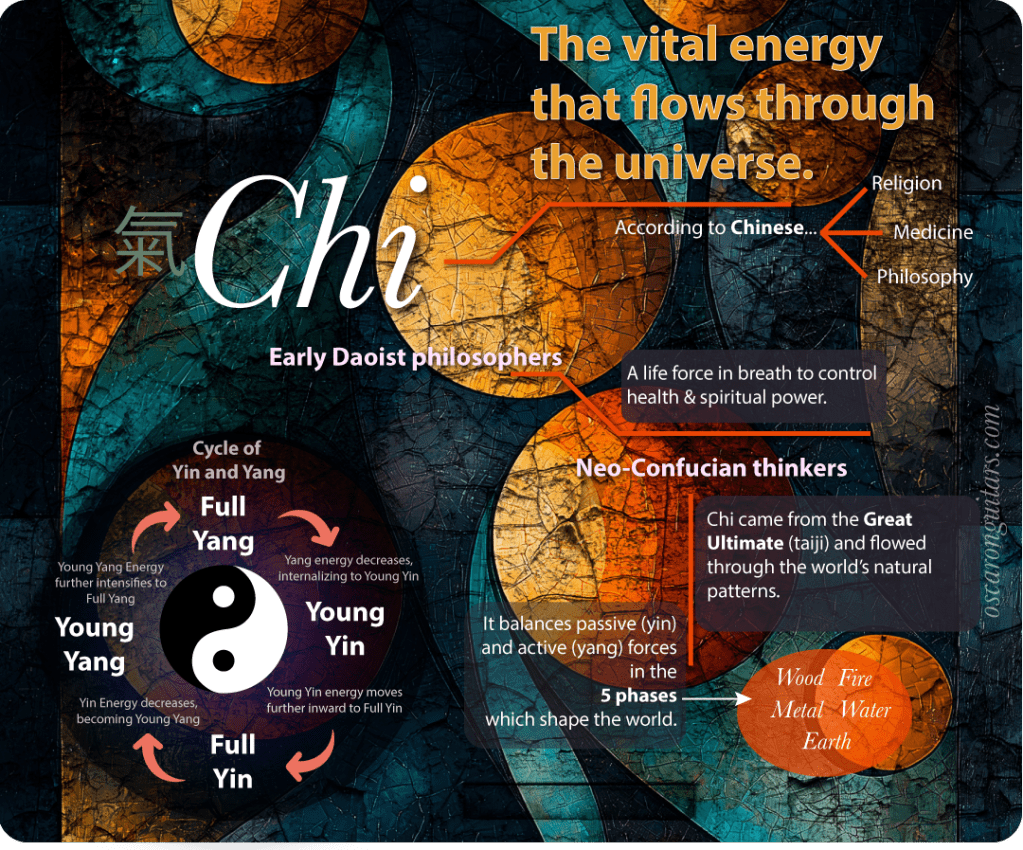
Mindfulness, which taps into chi, has been shown to reduce stress, improve focus, and refine fine motor skills—all essential for musicians. In fact, research shows that techniques like meditation can unlock subtle mental states that allow for more intentional and emotional performances.
Preparing Your Chi for Guitar Practice
Before you even pick up your guitar, take a moment to ground yourself. Here’s a simple two-minute exercise:
- Sit comfortably, close your eyes, and take deep breaths.
- Visualize your music flowing from your heart to your fingertips.
- Focus on your breath—inhale deeply and exhale slowly, feeling yourself rooted in the present.
This practice isn’t just about calming your nerves; it’s about creating a clear channel for the energy that will flow through your music.

Relaxation: The Key to Speed and Precision
Staying relaxed while playing is critical, especially when tackling intricate scales or fast riffs. Tension blocks your chi, limiting both speed and dexterity. Instead, focus on staying loose—think of your hands and fingers as light and nimble, letting the energy guide your movements.
Visualization: A Mental Rehearsal for Mastery
Did you know that visualization can sharpen your skills even when you’re not playing? Imagine yourself nailing a solo, every note crisp and intentional. Visualization creates neural pathways in your brain that prepare your body for action, boosting both precision and confidence.
From Inspiration to Intention
Step 1: Inspiration
Improvisation isn’t just about playing notes; it’s about channeling emotion. It all starts with inspiration and motivation, and a perfect example of this is Steve Morse’s rendition of “Cause We’ve Ended As Lovers.” Every note feels so deeply connected, and it’s a testament to how focusing on intention—rather than speed or flash, though there’s some of it too!—can create music that truly resonates on an emotional level. Let Steve Morse’s performance inspire you to infuse your playing with that same depth and feeling.
Step 2: Improvise with Intention
Now that you’re inspired, it’s your turn: With the backing track in C minor of “Cause We’ve Ended As Lovers,” let the music guide you. Start with a simple phrase and build on it, trusting your instincts. Silence is just as important as sound—it adds space for tension and release, giving your improvisation emotional depth. Instead of scales or geometric patterns, focus on the right notes you hear and feel. Leave space; silence is as important as sound in your improvisation. Make every note count; nothing mechanical or empty. Begin at a slow pace, as if you’re whispering the notes, and adjust the volume, speed, or energy as necessary. Be one with the music.
Chi in Action: Learning from Guitar Legends
Some of the greatest guitarists, like Steve Vai, Carlos Santana, and John McLaughlin, have embraced chi in their playing:
- Steve Vai channels his inner energy through meditation and mindfulness, creating transcendental works like “For the Love of God.”
- Carlos Santana views his music as a spiritual journey, playing directly from the heart to connect with listeners on a universal level.
- John McLaughlin uses his guitar as a mirror of truth, aligning his performances with the rhythms of the universe.
These masters show us that playing guitar isn’t just technical—it’s deeply spiritual.
Practical Exercises to Harness Chi
If you’re ready to bring chi into your guitar playing, here are some exercises to try:
- Grounding: Visualize energy flowing from the earth into your body. This will align your physical and mental state for focused playing.
- Mindful Breathing: Take slow, deliberate breaths before practice to calm your mind and sharpen your focus.
- Chi Movement: Feel the energy flowing from your fingertips into the strings, creating a seamless connection between you and your guitar.
- Visualization: Mentally rehearse solos or difficult passages, imagining every detail with clarity.
- Improvisation with Intention: Play with intent and let your feelings guide the music.
- Embrace Silence: Use pauses to create tension and add emotional weight to your playing.
Conclusion
Incorporating chi into your guitar practice isn’t just about technique—it’s about connecting with your instrument on a deeper level. By grounding yourself, practicing mindfulness, and channeling your emotions, you’ll find a new sense of creativity, focus, and authenticity in your music.
Give these techniques a try and see how they transform your playing. And remember—your guitar journey is just as much about personal growth as it is about music.
Let me know how it goes! If you want more info, tips and the science behind Chi check out my In-Depth Guide to Harnessing Chi in Your Guitar Playing.
 oscaronguitars.com
Leave a comment