
Are you tired of the same old formula on electric guitars? Do you want to delve into something truly interesting and unique? Then, this article is for you.
Exploring something different always sparks excitement, and this guitar is no exception. The Ibanez QX54QM challenges you to step out of your comfort zone, delivering a quirky, sometimes frustrating, yet endlessly fascinating experience. If you’re looking for a truly unique instrument, this could be the one. You might hate it—or it might become the guitar of your dreams. Who knows? It could even ignite a lifelong passion for headless guitars. Let’s dive into this adventure and see where it leads! So, buckle up because this is going to be a long ride!
A Fresh Perspective on Headless Innovation
The Ibanez QX54QM is a headless guitar that is way more than just a ‘Strandberg alternative.’ This guitar features unique pickups with 9 different tones available (and all of them are actually usable!). You’ll find an intriguing 8º angled fret in a unique multiscale fretboard. The luscious stainless frets are on a guitar that is truly different and that deserves a closer look.
Although headless guitars are far from a new concept, they’ve always intrigued me. And the Ibanez QX54QM is a very interesting proposition if you want to venture into this world. In my case it was a great solution since Strandberg guitars are incredible and ignited a true rennaissance. The problem? They are not cheap. And in Mexico, my country, getting your hands on a Strandberg is no easy feat. Distribution is practically non-existent. That led me to start looking for alternatives available locally, and that’s when I came across the Ibanez Q series, Q standing for Quest.
I got interested in the Ibanez QX54QM for a second reason. I wanted something genuinely different for my guitar collection. Having owned many Strats, Les Pauls, and other standard guitars, I felt the need for something unique. Why not explore something completely unconventional? With that mindset, I transitioned into “adventure” mode and chose to try the Ibanez QX54QM—and wow, what a journey! There’s a lot to say about this guitar—some things are superb and incredible, others not so much. And let me warn you, there are a few quirks that might be total dealbreakers for some players.
First Things First: The World of Headless Guitars
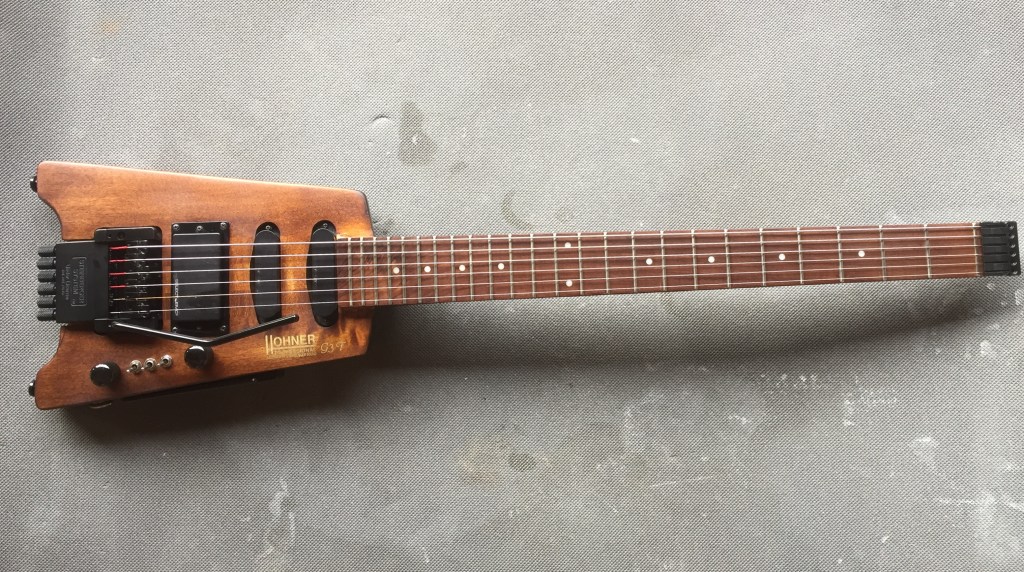
Let’s start with the obvious—this guitar doesn’t have a headstock because, well, it’s headless. And that single characteristic defines the entire identity of this instrument. Headless guitars first gained prominence in the 1980s. Brands like Steinberger led this movement with revolutionary designs. They aimed at improving balance, tuning stability, and portability. Around the same time, more accessible models from Hohner became available. Innovative offerings also came from Kramer, Washburn, and Aria Pro II. These made headless guitars a notable part of the decade’s guitar scene. Players like Eddie Van Halen, Allan Holdsworth, and Geddy Lee helped give these futuristic-looking instruments a place in guitar history. With tuner-integrated bridges and their minimalistic, radical aesthetics, headless guitars became synonymous with innovation and experimentation.
Nonetheless, after the ‘80s boom, their popularity fizzled out by the ‘90s. In recent years, the headless guitar is making a strong comeback. This resurgence is largely thanks to Strandberg. Their ergonomic, innovative designs have sparked renewed interest. As a result, we’re now seeing more brands joining the movement. Ibanez has jumped on board with its Quest series. They are adding their own spin to the headless guitar concept.






The headless design can stir mixed reactions. Some players are fascinated by the sleek, stripped-down look. Others find it too radical. There’s no middle ground: people either love headless guitars or outright hate them. What’s certain is that headless guitars are conversation starters. They are special. They are truly different. They are unique. Let’s be honest; they are a little weird. They might even steal the spotlight from you as a player. So if you dare to play a headless guitar, be prepared for people to focus—at least at the beginning—more on your guitar than your playing. Whether this is beneficial or detrimental depends entirely on your goals.
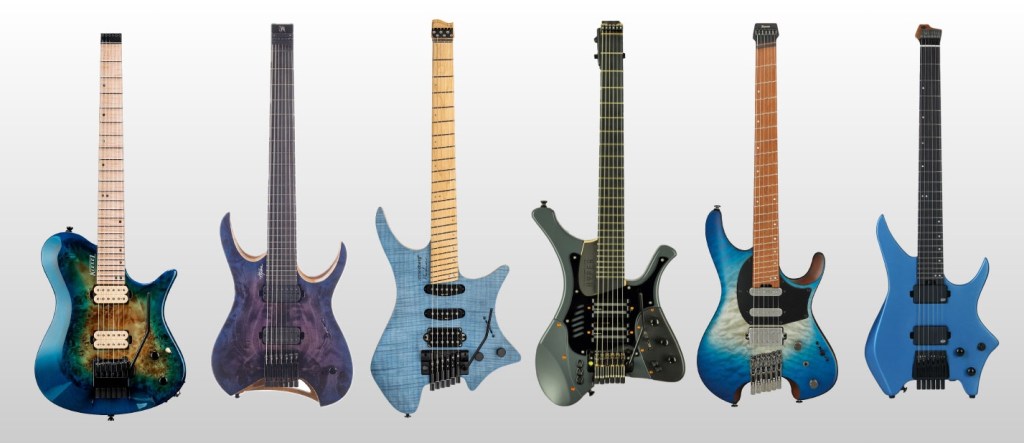
Headless guitars break tradition. This includes the Ibanez Q line. They are all about stepping into something different. They’re not for everyone. However, if you like to push boundaries, try a headless guitar. It might be exactly what you need to shake things up.
Size & Weight
I usually don’t focus too much on a guitar’s size or weight unless it’s really noticeable—like the hefty feel of a Les Paul or the substantial body of a hollow Gretsch. But the Ibanez QX54QM stands out for being both compact and lightweight. From the moment you pick it up, you can feel the difference—it’s smaller and lighter than your average guitar. And it’s not just perception; at 5 lbs 2 oz (2.32 kg) and a total length of about 32″ (80 cm), this guitar is compact, indeed.
What’s more, it comes with its own custom gig bag—a thoughtful addition, as most standard gig bags or cases would be far too large for it. Once you’ve spent some time with this guitar, going back to regular-sized instruments can feel like confronting ocean monsters. The difference is so stark that many players even use the QX54QM as a travel guitar, and it’s straightforward to see why—it’s the epitome of portable.
Neck
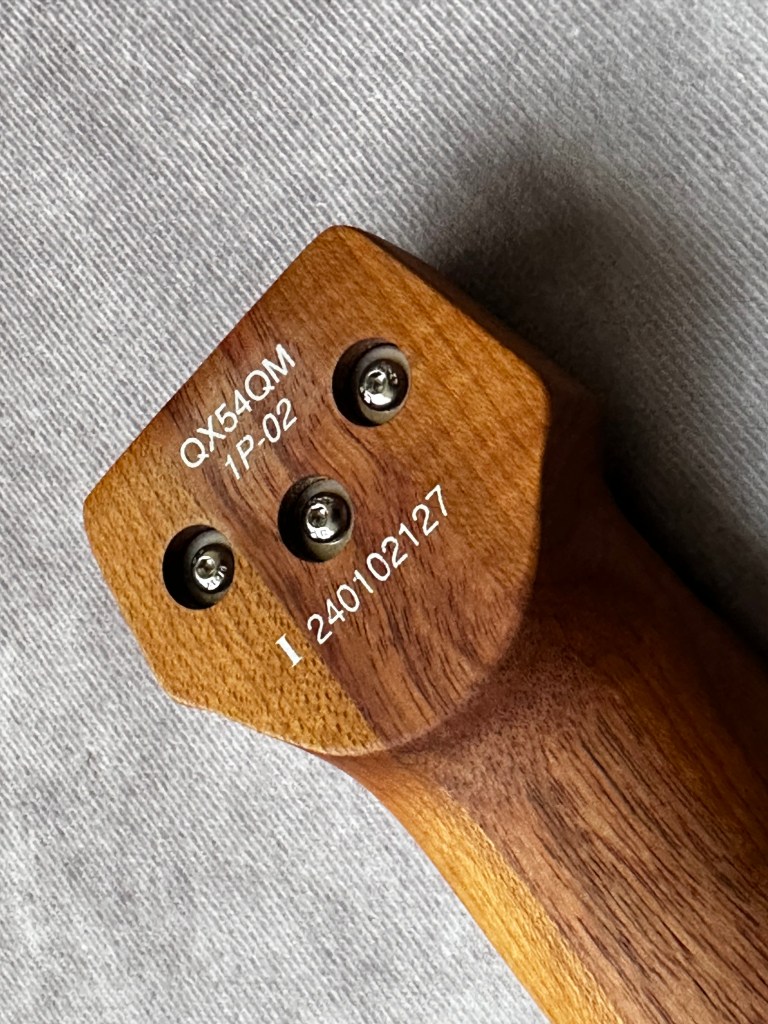
The neck on this guitar stands out in several ways. It’s not as the asymmetrical, polyhedral, trapezoid-style necks you’d find on a Strandberg. Instead, it features a more traditional Wizard “C” shape, which strikes a comfortable middle ground—neither super thin nor overly chunky. It’s made from a sturdy three-piece combination of roasted maple and bubinga. This provides it with a solid feel. It also gives a visually appealing, high-end aesthetic. The satin finish is a thoughtful touch. It makes the neck fast and smooth to play. This is true whether you’re shredding or gliding through complex chord shapes.
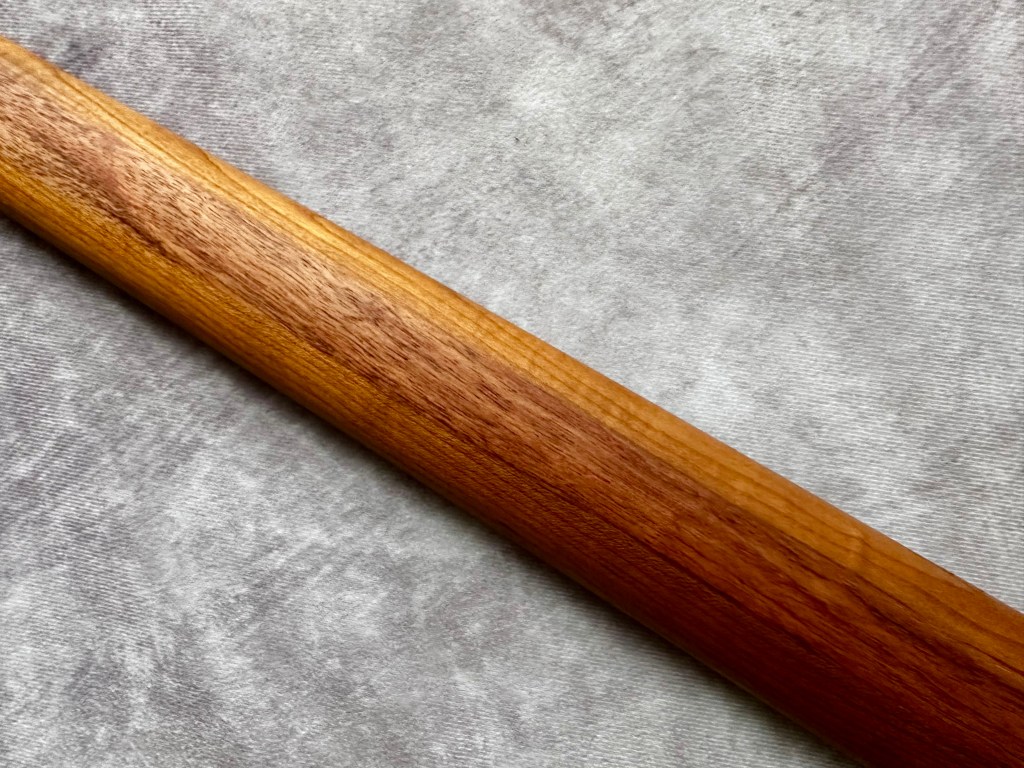
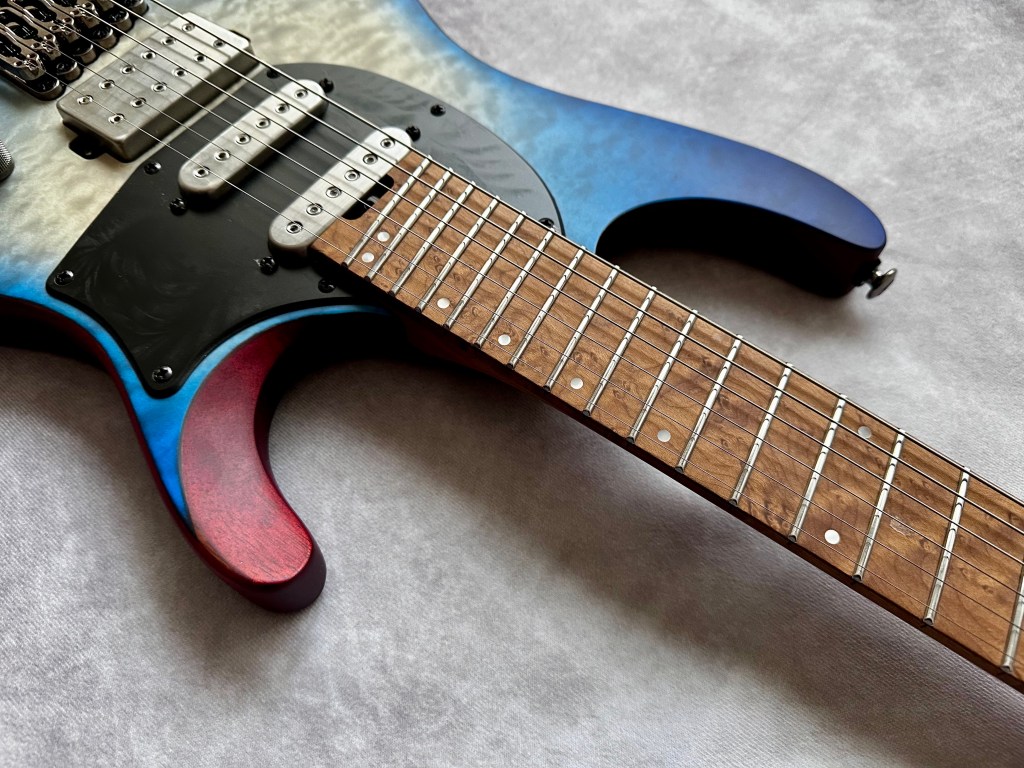
The roasted birdseye maple fretboard is another highlight, both in terms of aesthetics and feel. It’s beautifully figured, and there’s something undeniably special about playing on wood that looks this unique. Nevertheless, the 24 stainless steel frets really grab attention here. They set the QX series apart with an 8º angled multiscale design.
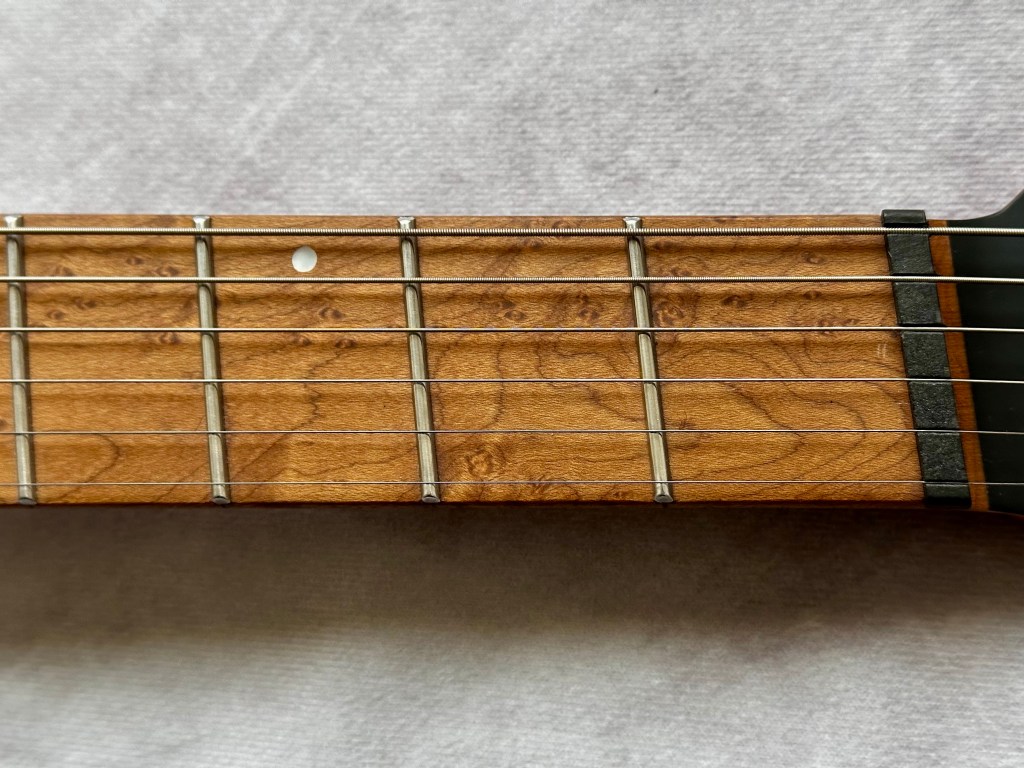
The stainless steel fretwork is flawless. Everything is well-polished, leveled, and plays beautifully right out of the box. However, the multiscale has presented a mixed experience for me. The idea behind the angled frets is to improve ergonomics. It also aims to enhance intonation across the entire fretboard, particularly when playing higher up. I can attest that it does feel very natural once you stop thinking about it or looking at it. However, there is definitely a learning curve involved. Initially, I found it disorienting—especially when I glanced down at the fretboard mid-play. The angled frets visually confused me, leading me to play incorrect notes due to my hands being in the wrong position, despite my eyes suggesting otherwise.
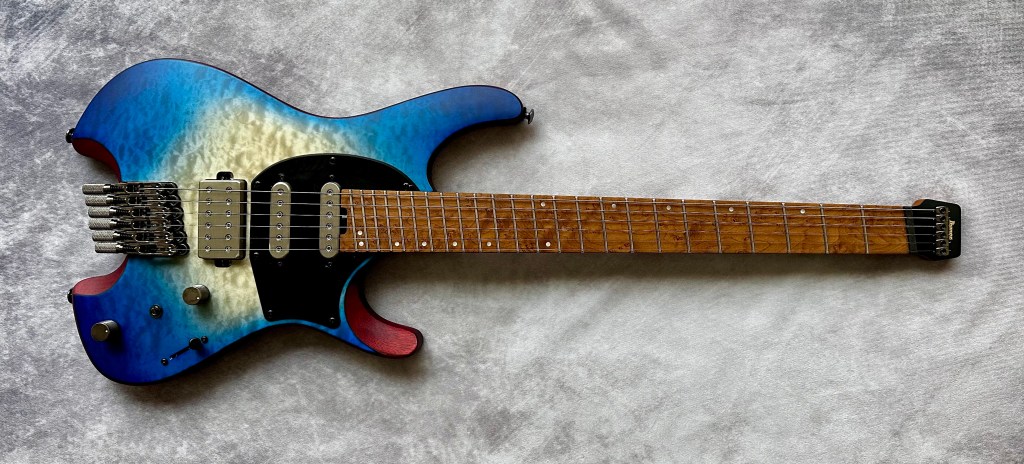
That said, there’s another element that added to my initial discomfort: the inlays. On the plus side, the Luminlay side markers are fantastic for visibility in low-light situations (although they fade away fairly quickly). This is a practical and much-appreciated feature. However, the small dot inlays on the fretboard itself felt less intuitive for me. The dark, roasted birdseye maple and the angled frets added to the clutter. This combination made my playing experience feel visually cluttered. It was also a bit confusing. This might not be an issue for younger players. Those with sharper eyesight might not face this challenge. But for me, as someone whose eyes aren’t as sharp as they once were, it was a real adjustment. This guitar has 24 frets. I’m accustomed to playing guitars with 22 frets. Therefore, the whole neck layout became something I had to work to get comfortable with.
At first, it felt like a nightmare—I panicked, wondering if I’d just wasted $1,100 on this guitar. But over time, I’ve learned the importance of patience and not jumping to conclusions based on first impressions. Then something unexpected happened—something unique, strange, and even magical, if you will. I adjusted my playing habits, and suddenly, everything clicked. Let me explain.
First, I had to stop playing seated and switch to standing with a strap; then everything seems completely natural, and viewing the frets at an angle, the whole geometry of the multiscale vanishes. Yes, it looks kind of odd if you view the guitar right from the front or if you are seated and have a weird angle, but standing up, everything fits and feels, actually, surprisingly natural to the point of thinking: why don’t all the guitars have this? Second, and perhaps more importantly, I started playing with my eyes closed. Yes, I know it sounds odd, but fortunately, I’ve spent enough time practicing my repertoire to realize how well I know it. When I trust my fingers to find their way on the multiscale fretboard, everything changes.
When I stopped relying on sight and focused on feel and sound—just trusting that my fingers already know where to go—the whole multi-scale fretboard concept stopped mattering. It wasn’t a distraction anymore. Instead, I noticed my playing became more fluid, less mechanical, with subtle variations naturally emerging. It reminded me of Santana, how he can take a familiar tune and elevate it, creating something even better than what’s on the record. It made me think, “Wow, how does he do that?”
For me, the Ibanez QX54QM unlocked that kind of experience. It encouraged me to just flow with the guitar. I know that sounds a bit zen—and if you’ve read my blog, you know I have a section on the Tao of the Guitarist—but this took me completely by surprise. Over time, I’ve started to notice the benefits: more freedom, more expression, and an overall deeper connection to my playing.
Now, I get that this might not work for every guitarist—playing with eyes closed isn’t for everyone. But I wanted to share my personal, subjective experience rather than just regurgitate the specs and throw in a few generic comments. This guitar goes beyond its specs. It’s hard to explain, but it’s true.
After several months with this guitar, the learning curve is over, and I can confidently say the angled frets feel fantastic. They’ve become second nature—I don’t notice them at all, even when switching to other guitars. Everything feels natural, and the playing experience is simply smooth and comfortable. My initial panic faded completely, and I can say that if you give this guitar time to grow on you, it truly delivers—especially in terms of comfort.

I bought the Ibanez QX54QM because I wanted something that would push me out of my comfort zone. It definitely delivers on that front. If adapting to a new playing feel frustrates you easily, be aware. This guitar isn’t just another “plug and play” experience. There’s a learning curve here, especially if you’re not used to multiscale fretboards or non-standard inlay designs.
Ergonomics is a big deal for me. The guitar design has some quirks. For example, the tuners are at the bridge, and there’s a cutout in the middle. Once you overcome the unique ergonomics, the guitar truly excels. The guitar is an ideal instrument for shredders, enabling you to play fast, fluid lines with minimal effort. My fingers glide effortlessly across the fretboard. You don’t need to press down hard to get a clean sound. It’s no surprise that many younger, technically skilled players choose this guitar. They use it for advanced techniques. These include popping and slapping the 5th and 6th strings. Players also use tapping and even execute tap harmonics. It seems tailor-made for these modern, high-speed playing styles.
For me, it’s been both challenging and rewarding. I can’t deny that it’s refreshing to play something so different. It keeps me on my toes, and that’s exactly what I wanted when I picked up this guitar.

Body
Shape
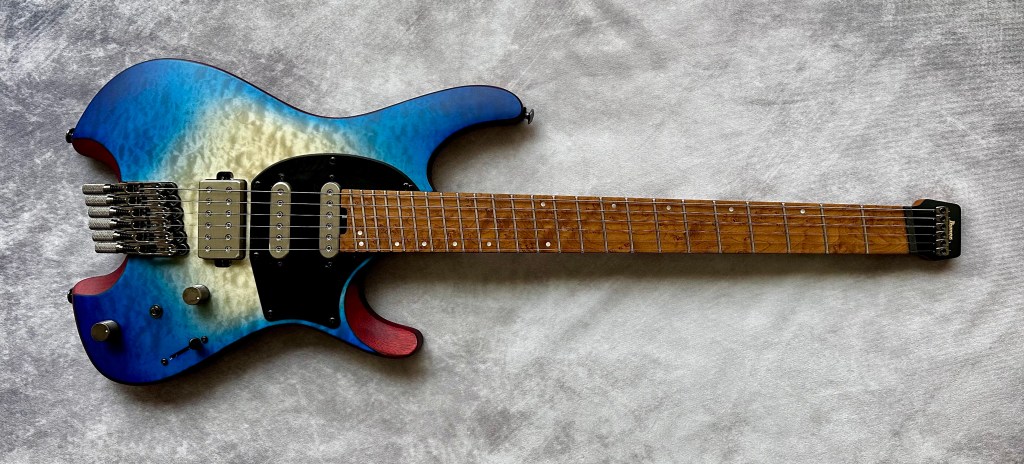
The body shape of the Ibanez QX54QM feels both familiar and entirely new. On the one hand, it has the classic Strat-style double-horned form, complete with a contoured body and a belly cut, which will feel immediately comfortable to anyone used to playing a Stratocaster. On the other hand, there’s a distinct cut near the bridge that aligns it more closely with other headless guitar designs, such as those from Strandberg or HILS. This cut gives it a modern, minimalist look, which is quite different from your average strat-style guitar but very much in line with the aesthetic of headless instruments.
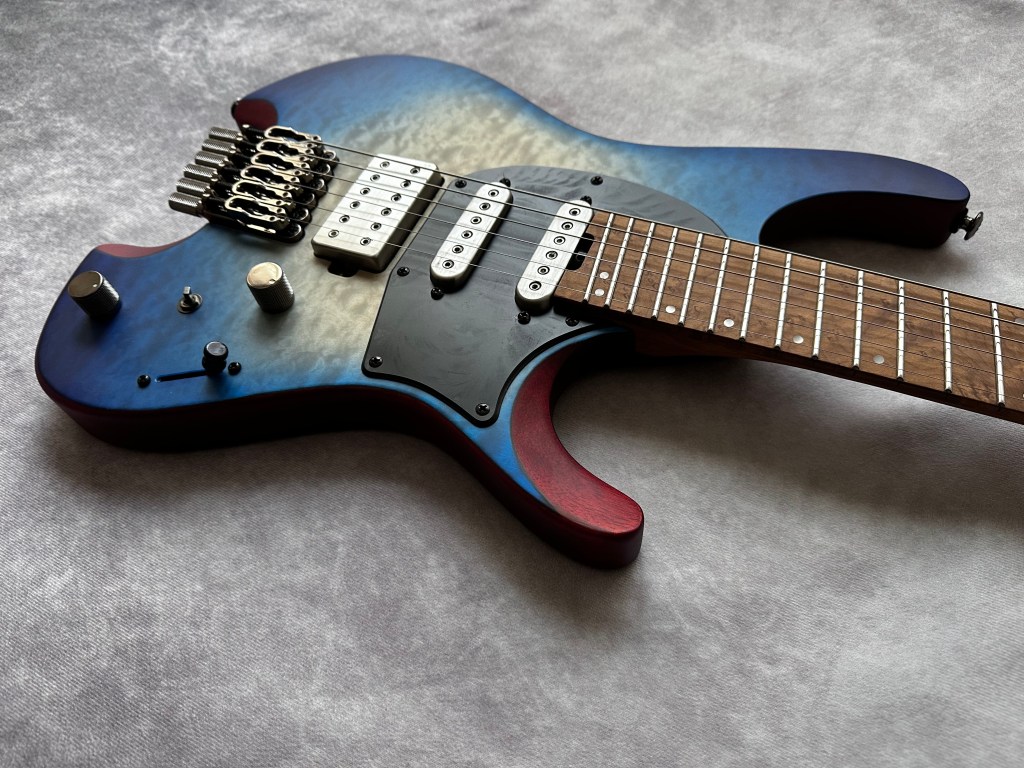
The QX54QM has a unique ergonomic difference compared to other headless models—unlike Strandberg or HILS guitars, it lacks a secondary lower-body cut. This design choice significantly affects seated playing comfort, especially for those like me who prefer the classical position, resting the guitar on the left leg. In this stance, the bridge sits uncomfortably close to the right thigh near the crotch, making it awkward without adjustments. To improve the experience, I had to shorten the strap and rely less on my legs for support. However, if you prefer resting the guitar on your right leg, you’ll likely find it more comfortable. Ultimately, this guitar feels optimized for standing play.
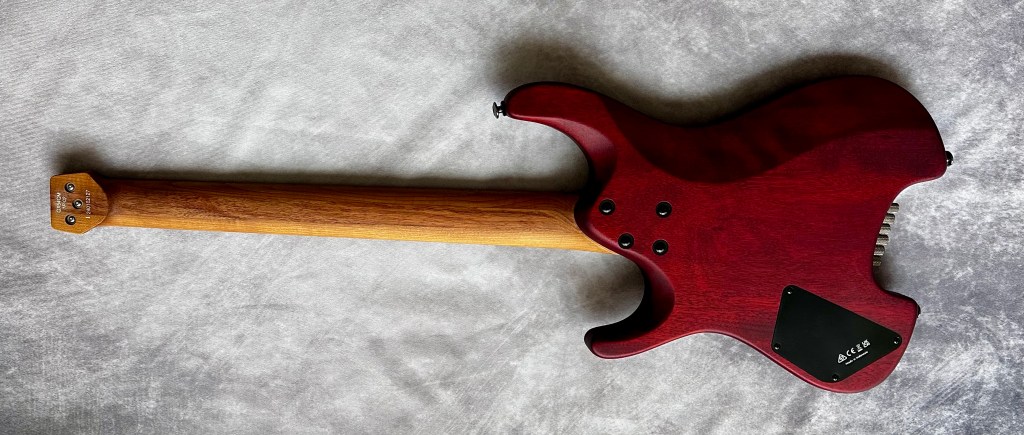
The ergonomics of this guitar are anything but conventional. It’s not your typical off-the-shelf instrument—it has a distinct feel that heavily depends on how you position it while playing. If you’re considering this model, I strongly recommend trying it out in person first. It could either be a perfect match or a frustrating challenge, depending on your preferred playing posture. This isn’t a guitar you can adapt to instantly; it requires time, adjustments, and patience to fit your style.
If buying online, be absolutely sure of the return policy. In some regions, returning an item can be far more complicated (not to mention expensive) than simply receiving it. While this advice applies to any guitar, it’s especially critical here, as the likelihood of needing to return it due to ergonomic mismatches is higher compared to a standard guitar. Proceed with extra caution to ensure it meets your needs before committing.
Upper Fret Access
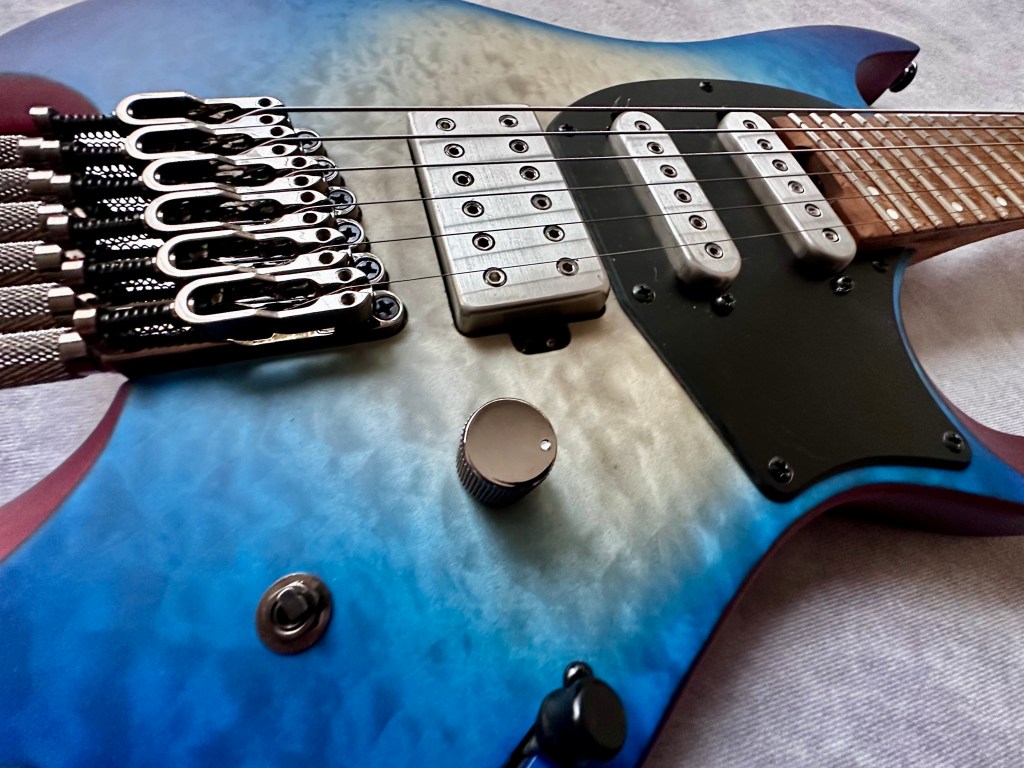
One area where the QX54QM truly shines is upper fret access. Thanks to the thoughtful design of the body and the multiscale fretboard, reaching the 24th fret is a breeze. The angled frets work well in this regard, making it easier to move fluidly across strings when playing high up on the neck. If you’re someone who loves to shred or experiment with lead lines in the higher register, you’ll appreciate just how accessible the upper frets are.
Controls
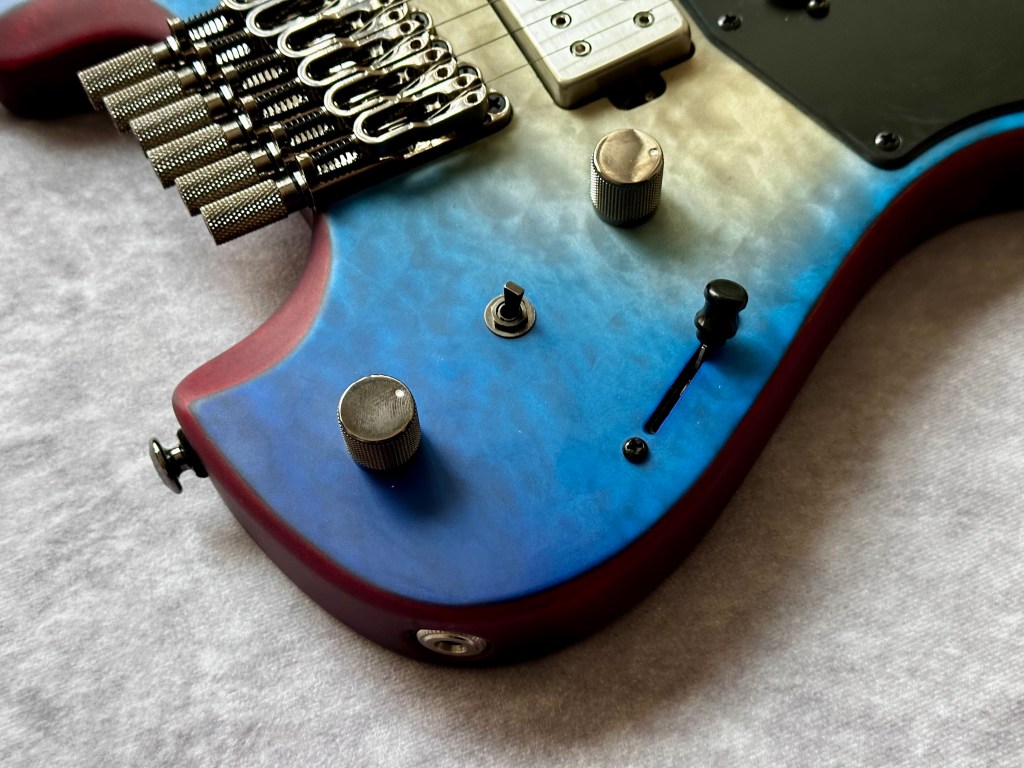
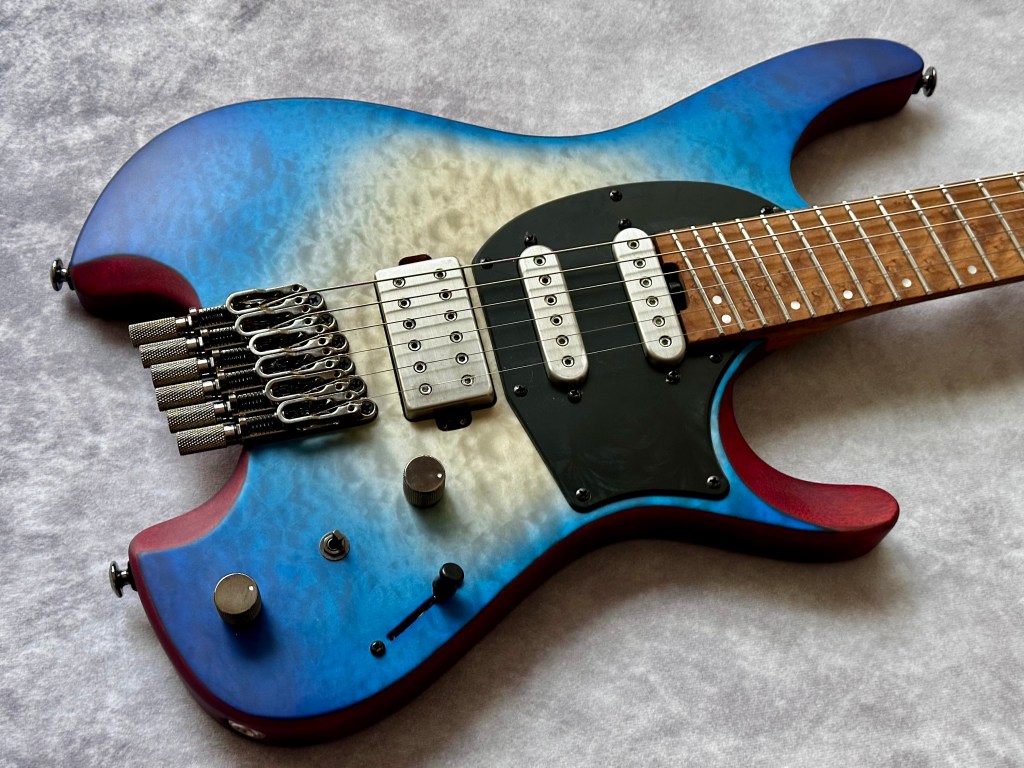
The controls are well-placed and easy to use. The 5-way pickup selector switch and the Alter switch are both within easy reach, making it simple to switch tones on the fly without disrupting your playing. The volume knob is conveniently positioned and easy to adjust mid-performance, while the tone knob, though slightly farther away, is still accessible without too much effort. A small but thoughtful touch is the use of metal knobs with markers, which makes it easier to see and remember your settings. This is a nice detail, as many dome-style knobs lack any kind of visual indicator, which can be annoying when you want precise control over your tone.
The Nyatoh Body
The QX54QM is not exactly a budget guitar, coming in at around $1,100 USD, so the choice of Nyatoh wood for the body might raise some eyebrows. On the positive side, Nyatoh is incredibly lightweight, and that’s immediately noticeable—this guitar weighs in at 4 pounds 15.6 ounces (about 2.25 kilograms), making it a joy to play during extended sessions or long gigs, especially when standing. The reduced weight helps with fatigue, and if you’ve ever spent hours strapped into a heavier guitar, you’ll quickly appreciate just how light and comfortable this one feels.
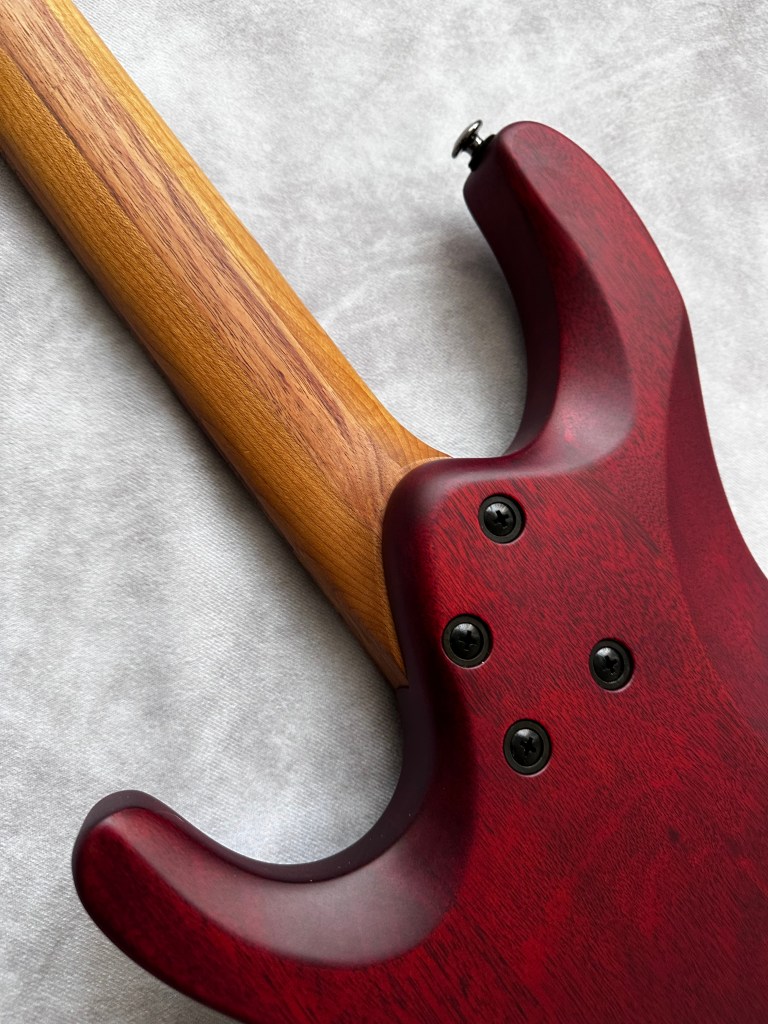
Now, about sustain—this is where things aren’t as great. Despite the lightweight advantage, Nyatoh doesn’t deliver much in the way of natural sustain, and you’ll notice that pretty quickly. Combined with the bolt-on neck construction, the result is below-average sustain compared to guitars with more traditional tonewoods like mahogany or alder. If you’re someone who values long, ringing notes or relies on sustain for your style of play, you might find this to be a bit of a letdown.
Nyatoh wood often gets a bad reputation among guitar purists for its uneven grain and perceived lower quality. However, in the case of my QX54QM, I was pleasantly surprised—the grain is even, and the overall finish looks quite good. It doesn’t have the high-end visual appeal of something like figured maple or ash, but it doesn’t feel cheap either. Still, given the price point, it’s hard not to wish that Ibanez had used a more premium tonewood or at least something that delivers better sustain.
In the end, while Nyatoh keeps the guitar lightweight and comfortable, it does come with trade-offs. If weight and comfort are your top priorities, you’ll probably be happy with it. But if you’re looking for something that offers richer sustain and a more premium feel, the choice of Nyatoh might leave you feeling a little underwhelmed considering the cost.
The Finish
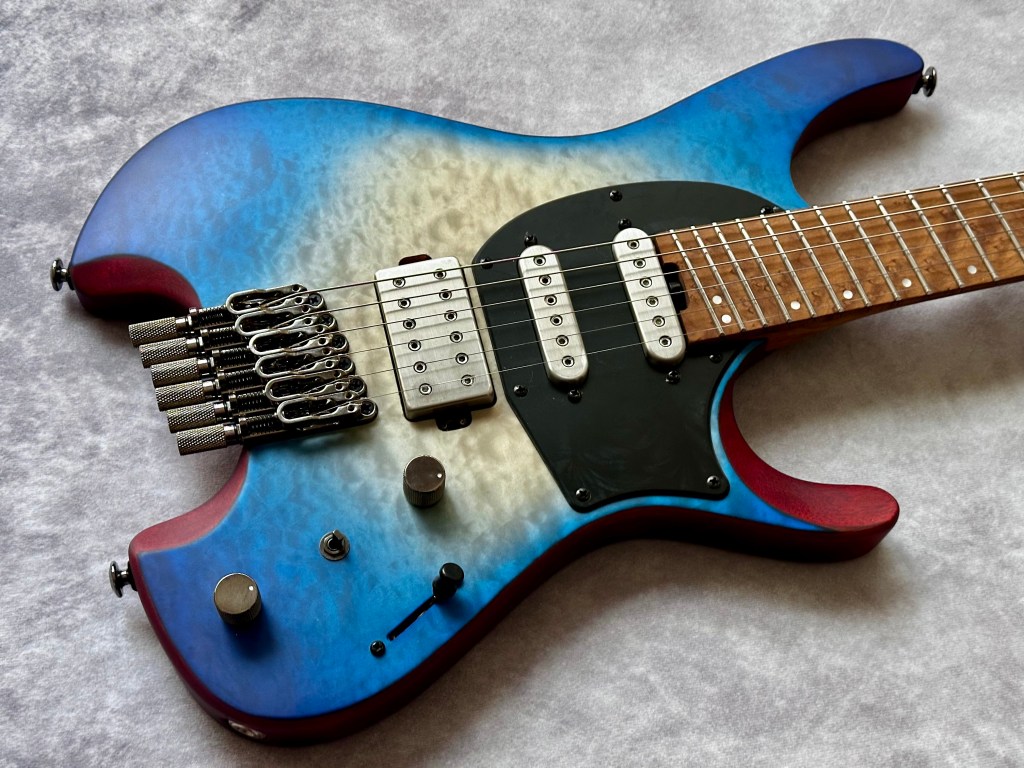
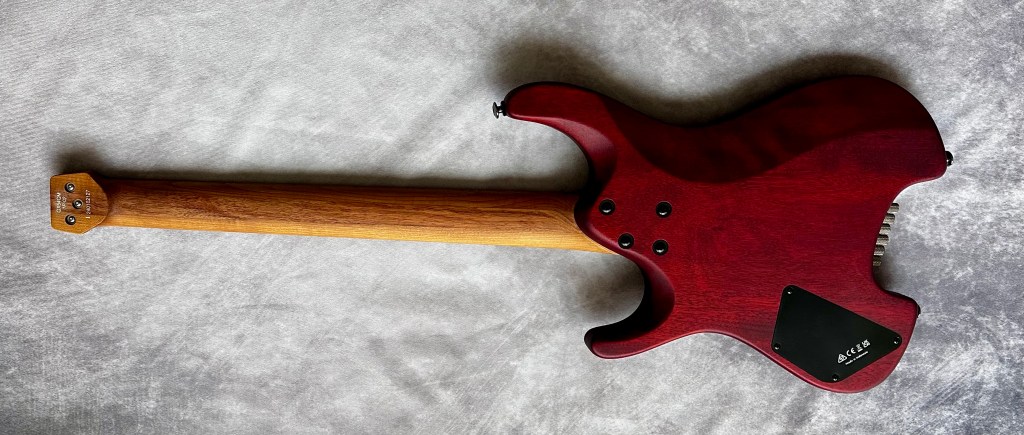
The QX54QM features a satin polyurethane finish that gives it a somewhat understated, muted appearance. It doesn’t immediately scream “spectacular instrument,” but there’s a certain elegance in its subtlety. The Blue Sphere Burst color is flawless in its execution, though whether or not it’s visually appealing comes down to personal taste. I wouldn’t call it particularly striking, but aesthetics are always subjective. What I do appreciate is the quilted maple top, which adds some visual depth, and the back of the body, finished in a transparent dark red that nicely showcases the wood grain.
I must admit that this specific model, which features a black pickguard and a reddish back on the body with a satin finish, doesn’t appeal to me in terms of aesthetics. But the other day my youngest son, who’s all into heavy metal and prog, said to me, “Hey Dad, I really love the look of this Ibanez,” and I asked, intrigued, why. The reasons are the opposite of my gripes, so beauty is subjective.

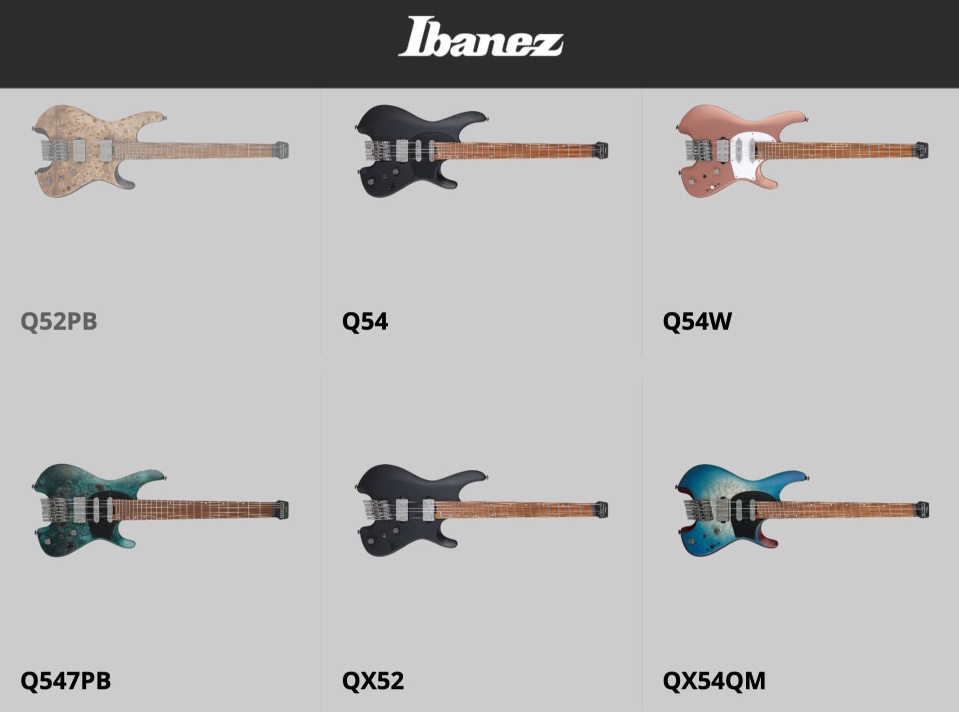
Initially, I considered the Q52 solid blue model—also with a satin finish—which is a more affordable option featuring an HH pickup configuration. However, I ultimately went for this higher-end model because I wanted the HSS configuration with single coils. There’s also a black model, but it lacks the defining feature of the 8º angled frets, making it less appealing to me. The QX52 offers the angled frets but comes with an HH configuration instead. So, if you’re specifically after the HSS layout with multiscale frets, this is your only option, whether or not you love the Maple Burst aesthetic.
Another element worth mentioning is the pickguard. Personally, I prefer pickups mounted directly to the body without a pickguard—it gives the guitar a cleaner look—but, again, that’s purely subjective. The shape of the pickguard here is quite different from a typical Strat-style guard, contributing to the unique vibe of the instrument, but to me it feels odd— like desperately trying not to look like a Strat. Whether you see that as a design win or a miss really depends on your own preferences.
Ultimately, while the finish and design elements may be polarizing, they’re cohesive with the guitar’s modern, unconventional identity. It’s not trying to be flashy or traditional—it’s trying to be different. Whether that difference appeals to you or not is something you’ll have to decide for yourself.
The Hardware
The hardware on this headless guitar is one of its defining features, with a custom bridge and locking nuts located at the top of the neck. All tuning adjustments are performed at the bridge, thanks to its proprietary design. It’s worth noting that while this system is more complex to set up compared to a standard fixed bridge, it’s noticeably easier to work with than a typical Floyd Rose. Once you get the hang of it, tuning and adjustments become relatively straightforward.
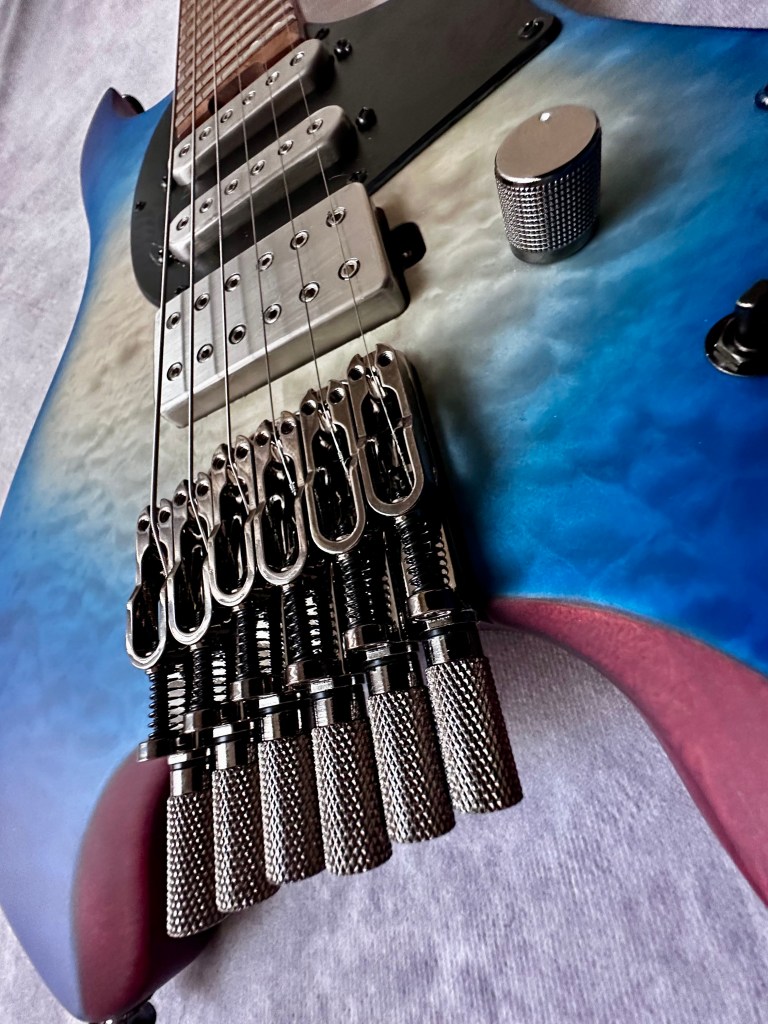
The design of the bridge itself is fascinating—it’s an ingenious piece of engineering that feels well-conceived, sturdy, and precise. While it might not reach the same level of engineering excellence as Strandberg’s system, it’s not trying to imitate it either. Instead, Ibanez has crafted a solution tailored specifically for their headless line, and in that sense, it deserves credit for originality and functionality. It looks, feels, and operates like a well-built machine. The locking mechanism at the top of the neck feels really very good—tight and precise.
One important advantage of the QX54QM is that it accommodates conventional strings, unlike the double-ball end strings typical of headless guitars from the 1980s. This is a major plus because, despite the seemingly complex design, changing strings on the QX54QM is surprisingly quick and easy, making maintenance a hassle-free experience.

I should also mention that the QX54QM features a fixed bridge, not a tremolo system. For some players, this won’t be an issue, but I have to confess—I love using a whammy bar for everything from subtle vibratos to dramatic dive bombs, so I definitely miss that aspect on this guitar. It’s worth noting that Strandberg offers models with tremolo systems, so if that’s a key feature for you, it’s something to consider. That said, for today’s shredders or djent enthusiasts, a fixed bridge is often preferable, offering greater tuning stability and eliminating the hassle of dealing with floating bridges. On that note, one major plus is that this guitar stays in tune exceptionally well, which is always a huge win in my book.
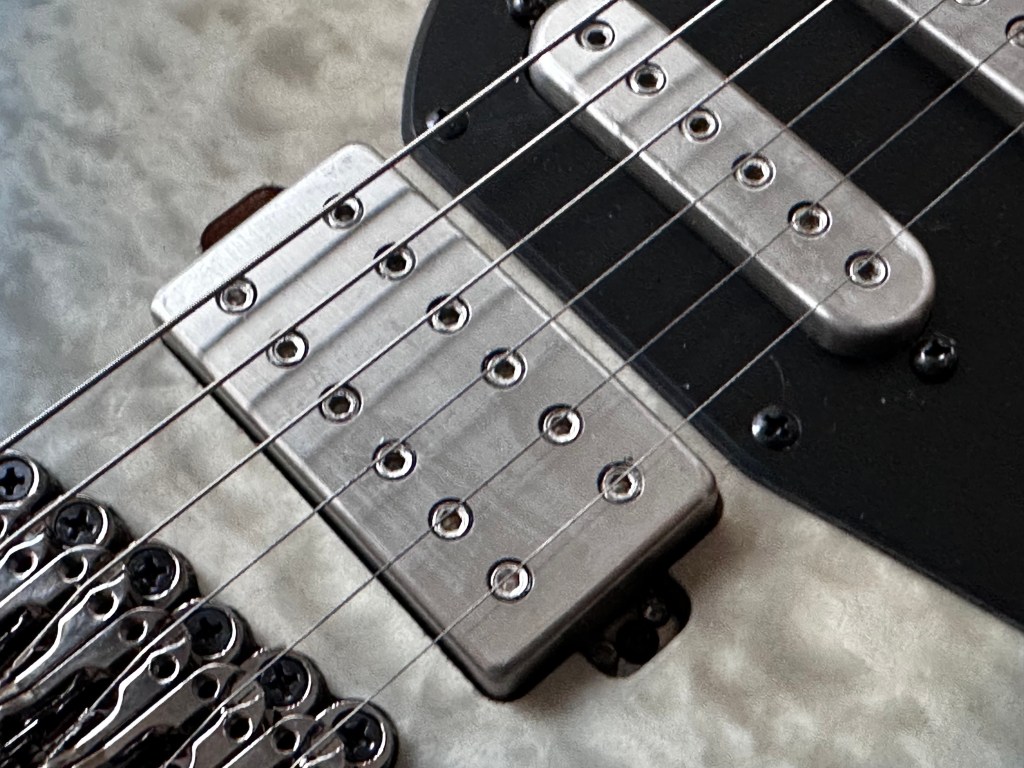
Now, moving on to the pickups—and I’m not talking about their sound just yet, but their design and aesthetics. The pickups have an unusual look, with adjustable magnet poles that can be fine-tuned using an Allen key. It’s a bit different from the norm and adds an extra level of customizability. However, the finish of the pickup covers feels industrial and somewhat rough. They give off a utilitarian, no-frills vibe. While the design is functional and original, it’s not exactly what I’d call attractive or polished. It serves its purpose well, but it’s more about function than form. Whether you find it appealing will depend entirely on your personal taste, as beauty is always subjective. For me, it’s not particularly handsome, but I can appreciate the bold, industrial aesthetic it brings to the table.
In short, the hardware is a mixed bag—ingenious and well-thought-out in terms of design, with solid functionality, but not quite premium in terms of execution. It’s unique and original, and while it may not win any beauty contests, it gets the job done and adds to the guitar’s distinct personality.
A Closer Look at the QX54QM’s R1 Single-Coil and Q58 Humbucker Pickups
If the headless design, proprietary tuning hardware, and 8º angled stainless steel frets aren’t enough to set this guitar apart, hold on for the main course: the custom pickups, specifically crafted for Ibanez’s headless Q series.

Ibanez chose a combination of the R1 single-coil in the neck position and the Q58 humbucker in the bridge, a pairing that, according to the company, aims to deliver both versatility and tonal balance. While the marketing pitch highlights their ability to cover everything from sparkling cleans to heavy distortion, the real-world performance deserves a closer inspection.
R1 Single-Coil Pickup: Clean, Balanced, and Surprisingly Quiet
The R1 single-coil is Ibanez’s attempt to offer a vintage-style pickup with modern noise reduction and improved balance across the frequency spectrum. The result? A single-coil that aims to produce a clear, articulate tones without the typical sharpness or overly bright attack that plagues some other pickups in this category. Compared to more traditional single-coils, the R1 feels smoother in the upper frequencies, making it well-suited for clean and lightly driven tones.
One thing worth mentioning is that Ibanez claims the R1 is designed to reduce the noise typically associated with single-coils. In practice, this works reasonably well—though it doesn’t eliminate hum entirely, it’s noticeably quieter than vintage-spec single-coils. This makes it practical for live settings or recording sessions where you want that clean single-coil sound without excessive interference.
Tonally, the R1 shines in genres where note clarity is key. Clean tones are chime-like but not overly bright, with a slightly fuller midrange that lends warmth to jazz chords and funk rhythms. It also responds well to modulation effects like chorus, delay, and reverb, making it a great choice for ambient and indie players. However, under high gain, it still exhibits a bit of the brittleness typical of single-coils, so it’s best suited for clean and mid-gain applications.
Q58 Humbucker Pickup: A Modern Powerhouse with Clarity
The Q58 humbucker is where things get more interesting. This pickup isn’t just about raw power—though it certainly has plenty of output—it’s also designed to maintain clarity even under high-gain distortion. Unlike some high-output humbuckers that can sound muddy or compressed when pushed hard, the Q58 retains note definition, making it ideal for intricate riffing or fast, technical playing.
Ibanez markets the Q58 as having a broad dynamic range, and that’s evident when you play. The pickup responds well to changes in picking intensity, allowing for expressive playing that doesn’t feel overly compressed. Clean tones from the Q58 are full and rich, though they lack the glassy sparkle of the R1. For crunch and high-gain tones, the Q58 excels, offering tight lows, a punchy midrange, and a clear high end without any harshness.
The “Alter” Switch: More Than a Gimmick?
One of the standout features of the GX54QM is the Alter switch, which seamlessly blends single-coil and humbucker tones, offering an impressive range of versatile sounds.
If you’re the type of guitarist who loves experimenting with different sounds, you’ll appreciate the added tonal variation. But for those who prefer straightforward pickup configurations, the Alter switch may feel more like a nice-to-have than a game-changer.
Modern Versatility Meets Precision: A Contemporary Player’s Dream, But Not Without Compromises
The GX54QM, with its modern, polished sound, excels in metal, progressive rock, and high-gain styles, making it a perfect choice for contemporary players. While it lacks the distinct character of a classic Gibson humbucker or the nasal bite of a Fender single-coil, it remains capable of producing a wide variety of tones with some tweaking. Genres like funk, blues, or jazz are possible, but I don’t feel like that is its primary focus; I may be wrong, of course.
For fans of Tim Henson or Ichika Nito, this guitar is a perfect match. Jazz and blues players may need to experiment with the volume, tone controls, and Alter switch to find their sound.
The guitar’s tonal flexibility is a standout feature. Position 4 (neck R1 single-coil with split Q58 humbucker) delivers bright, scooped tones ideal for clean rhythm work, while the middle position provides a balanced, rich sound suited for bluesy leads or classic rock. The Q58 humbucker shines with clarity under gain, and the R1 single-coil offers smooth, balanced tones for clean settings.
Though it leans heavily toward modern tones, the GX54QM remains a versatile instrument capable of handling both pristine cleans and aggressive high-gain sounds, even if it doesn’t completely live up to the marketing hype.
For many guitars, the first upgrades that come to mind are the pickups, followed by the tuning pegs and sometimes the bridge—especially with tremolo models. But with this guitar, the good news is that there’s virtually nothing to upgrade. The tuning stability is superb, so there’s no need to swap the tuning machines (and since they’re a proprietary custom design, there aren’t upgrade options anyway). The pickups are incredibly versatile—powerful when needed—and the guitar offers a wealth of usable tones. Yes, you’ll be spending over a thousand bucks, but you won’t have to spend a single penny more on upgrades. This guitar is as good as it gets, and that’s something you can’t say about many others.
The Price
The Ibanez QX54QM isn’t exactly a bargain, retailing at $1,100 USD. It’s a unique instrument with impressive features like stainless steel frets, pickups that are genuinely distinctive (and likely won’t have you rushing to replace them), and proprietary hardware that’s both clever and functional. However, it’s paired with a cheaper wood selection for the body, and while the headless design is undeniably striking, the overall finish and aesthetics leave a mixed impression.
If you’re after a taste of the headless experience, you’ll need to pay a premium, though this feels more like a ticket for a quirky, experimental ride than front-row luxury (I suspect a Strandberg may be better for that). At this price point, you could opt for something like a Charvel Pro Mod San Dimas with Floyd Rose and Seymour Duncan pickups, which offer more traditional, high-end specs.


Pros and Cons of the Ibanez QX54QMPros and Cons of the Ibanez QX54QM
Pros:
- Unique and Innovative Design – A true departure from traditional electric guitars, featuring an 8º angled multiscale fretboard and a headless design for a fresh playing experience.
- Incredibly Lightweight & Portable – At just over 5 lbs (2.32 kg), this guitar is compact and easy to transport, making it a great travel companion.
- Stainless Steel Frets – Super smooth, durable, and resistant to wear, ensuring long-term playability with minimal maintenance.
- Surprisingly Comfortable Ergonomics – While it takes some adjustment, the guitar feels incredibly natural when played standing up.
- Versatile Pickup Configuration – The HSS layout combined with the Alter switch offers 9 different tonal options, all of which are usable.
- Well-Designed Hardware – The custom bridge and tuners provide excellent tuning stability and allow for easy string changes.
- No Need for Major Upgrades – The guitar is well-built right out of the box—you won’t have to change pickups or hardware like with many mid-range instruments.
- Excellent Upper Fret Access – The design allows easy reach to all 24 frets, ideal for shredders and technical players.
- Great for Modern Playing Styles – Perfect for techniques like tapping, slapping, and advanced high-speed playing due to its ergonomic neck and fret design.
- A Headless Alternative to Strandberg – Provides a more affordable way to experience a high-quality headless guitar, especially in regions where Strandbergs are hard to find.
- Extremely Stable Tuning – The proprietary tuning system is solid, holds tuning exceptionally well, and doesn’t require double-ball-end strings.
Cons:
- Not a Budget-Friendly Option – Despite its great features, some may find that the price is too close to entry-level Strandbergs, which have a more refined ergonomic design.
- Steep Learning Curve – The angled frets and compact design require an adjustment period, making it a challenge for those accustomed to traditional guitars.
- Unconventional Ergonomics for Seated Playing – The lack of a lower-body cut makes it uncomfortable for seated playing, especially in the classical position.
- Limited Sustain – The Nyatoh body does not provide the sustain found in mahogany or alder guitars.
- No Tremolo System – Unlike some Strandberg models, the fixed bridge design may be a dealbreaker for those who love whammy bar techniques.
- Aesthetically Polarizing – The pickguard shape, dark inlays, and headless design might not appeal to everyone.
- High Price for the Materials Used – At $1,100 USD, the guitar features an economy-tier wood choice (Nyatoh), which feels underwhelming at this price point.
- Inlay Visibility Issues – The dark dot inlays on a dark birdseye maple fretboard can be hard to see, especially in dim lighting.
- Not Ideal for Vintage Tones – While versatile, the guitar’s sound leans heavily toward modern genres like metal, prog, and fusion, making it less suited for classic blues or vintage rock.
- Uncertain Resale Value – For this unusual guitars it’s unclear how well it will hold its value in the long run.

Conclusion
The Ibanez QX54QM is not your typical guitar—it’s a bold leap into the world of headless design, modern engineering, and tonal versatility. It excels in providing a lightweight, comfortable option for standing play and delivers a truly unique playing experience, thanks to its angled stainless steel frets, proprietary hardware, and custom pickups. The guitar invites experimentation and rewards players who enjoy pushing boundaries, making it an exciting option for shredders, progressive players, and anyone looking for something outside the ordinary.
However, it’s not without its drawbacks. The Nyatoh body compromises sustain, the ergonomics can be hit-or-miss for seated players, and while the hardware is innovative, it doesn’t always feel premium relative to the price. The $1,100 USD price tag reflects the cost of offering something so unconventional, but it places the guitar in a competitive price range where more traditional high-end options are available.
In the end, whether the QX54QM is right for you depends on what you’re after. If you want a guitar that challenges convention, pushes you out of your comfort zone, and provides a fresh, modern playing experience, this might be your perfect match. But if you’re more inclined toward classic designs and familiar tones, you might find the quirks and price point a bit hard to justify. Either way, the Ibanez QX54QM stands out as a fascinating and distinctive addition to the guitar world—one that will spark conversations and inspire a love-it-or-hate-it response. If you’re ready for an adventure, this guitar just might be your ticket.
Ibanez QX54QM Specifications
General
- Model: Ibanez QX54QM
- Series: Quest (Q) Series
- Year: Introduced in 2022
- Country of Manufacture: Indonesia
Body
- Body Shape: Q (Headless)
- Body Material: Nyatoh
- Top: Quilted Maple
- Finish: Satin Polyurethane
- Colors Available: Blue Sphere Burst
Neck
- Neck Type: Wizard C (3-Piece)
- Neck Material: Roasted Maple / Bubinga
- Scale Length: 25.5″ (648mm) on high E → 25.0″ (635mm) on low E (Multiscale)
- Neck Finish: Satin
- Fretboard Material: Roasted Birdseye Maple
- Fretboard Radius: 12″ (305mm)
- Frets: 24, Stainless Steel
- Fret Size: Medium
- Fretboard Inlays: Small Dots
- Side Markers: Luminlay (Glow-in-the-dark)
- Nut: Plastic Locking
Hardware
- Bridge: Ibanez Mono-Tune Fixed Bridge (Headless)
- Tuners: Integrated into the bridge (Headless system)
- String Spacing: 10.8mm
- Nut Width: 42mm (1.65″)
- Factory Strings: D’Addario EXL110 (.010 – .046)
Electronics
- Pickup Configuration: HSS (Humbucker – Single – Single)
- Neck Pickup: Ibanez R1 (Single-Coil)
- Middle Pickup: Ibanez R1 (Single-Coil)
- Bridge Pickup: Ibanez Q58 (Humbucker)
- Controls: Volume, Tone, 5-Way Blade Switch, Alter Switch
- Alter Switch Function: Expands tonal options by modifying coil configurations
Weight & Dimensions
- Weight: Approx. 5.2 lbs (2.32 kg)
- Total Length: Approx. 32″ (80 cm)
Additional Features
- Headless Design – More compact and ergonomic for modern playstyles
- Multi-Scale Fretboard – 8º angled frets improve ergonomics and intonation
- Custom Ibanez Bridge – Proprietary fixed bridge with tuner-integrated system
- Enhanced Upper Fret Access – Unobstructed reach to 24 frets
- Gig Bag Included – Custom-designed to fit the compact body
Price (as of 2025)
- Retail Price: Around $1,100 USD

 oscaronguitars.com
Leave a comment