

Have you ever experienced love at first sight? Have you ever been so captivated by pure beauty that every flaw simply vanished? Have you ever acted on an impulse—perhaps even a reckless one—just because you were overwhelmed by attraction? That’s exactly how I felt about the Ibanez SA360NQM, affectionately known as The Black Mirage. She ensnared me with her irresistible allure, and I couldn’t help but surrender.
Backstory
It was my birthday—a day that deserved to be celebrated in a special way. I’ve learned that if you want a truly meaningful gift, you must give it to yourself. After all, no one knows what you love better than you do, and no one else will ever offer you exactly what you desire—even if it seems ridiculously expensive or impractical. It’s all about self-respect. Over the years, as the family provider, I’ve worked long hours under relentless pressure, meeting impossible deadlines and overcoming seemingly insurmountable challenges. Taking care of myself isn’t selfish—it’s essential.
On that birthday, I headed to a guitar store with my sights set on a particular headless guitar. I ended up purchasing it, and I later shared that experience on my blog. However, while trying out my new Ibanez headless, I stumbled upon another instrument: The Black Mirage. The moment I picked it up, I couldn’t help but exclaim, “Oh my, hello, beautiful!” Even though I was there to try the Ibanez “Q”, I found myself continually drawn back to the Black Mirage.
Eventually, I decided to buy the Q Ibanez—a model that wasn’t cheap at all, costing around $1,100. I even hesitated, wondering if it was a mistake to spend so much money on something I wasn’t entirely in love with. I returned home with my headless guitar and later joined my family for a birthday dinner. Yet, throughout the meal, my mind was fixed on the Black Mirage. I barely knew its full name—just that it was some SA-something Ibanez model. Suddenly, I grabbed my phone and called the store: “Hey, remember that Ibanez headless guitar I just bought? Well, I was also checking out another Ibanez. Could you hold it for me? I’ll be there as soon as dinner is over.” And just like that, my decision was set.
That night, I walked away with not one, but two guitars as birthday gifts. Extravagant? Absolutely. Any regrets? Well, I had some initial doubts about the Q Ibanez, but over time, it became my go-to instrument. The Black Mirage, though? Let’s just say the honeymoon phase is over, and now that the initial excitement has faded, there are a few issues I need to address.
Thank you for sticking with my lengthy backstory. Now, let me share with you the experience of playing the SA360NQME, The Black Mirage.
If Looks Could Kill
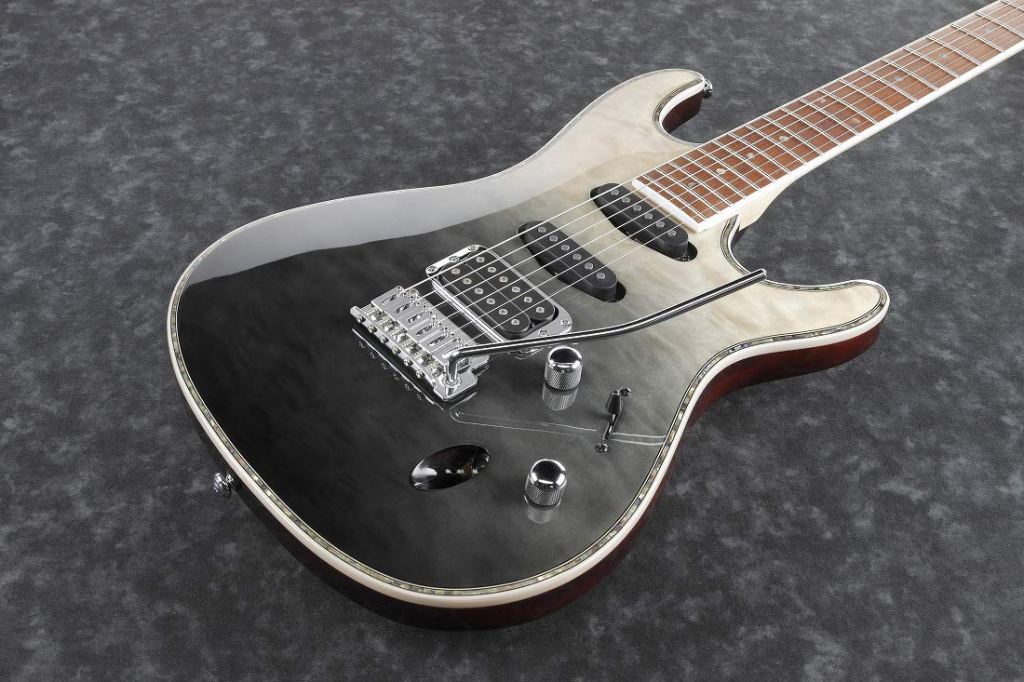
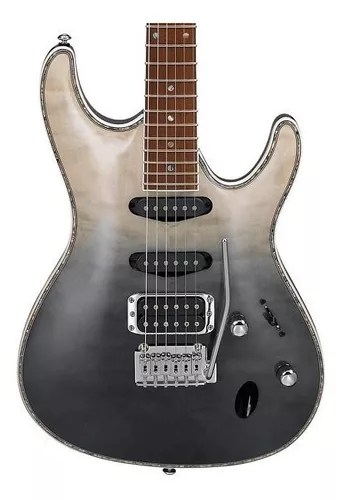
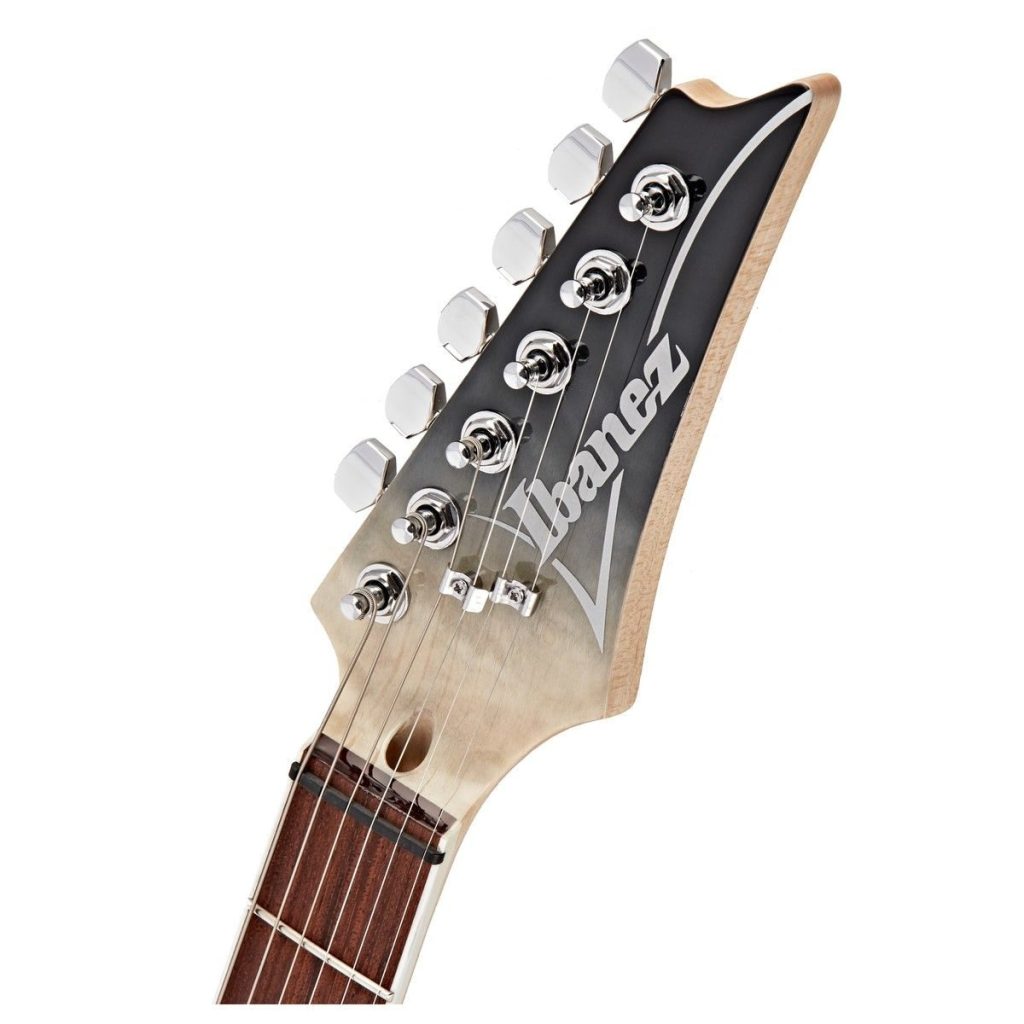
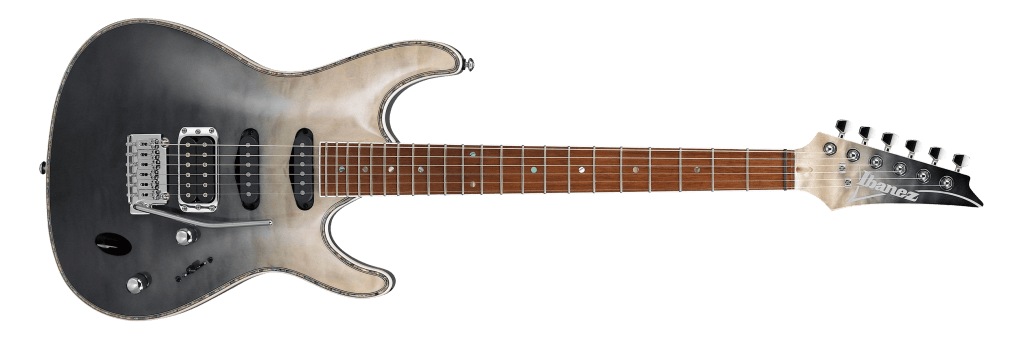
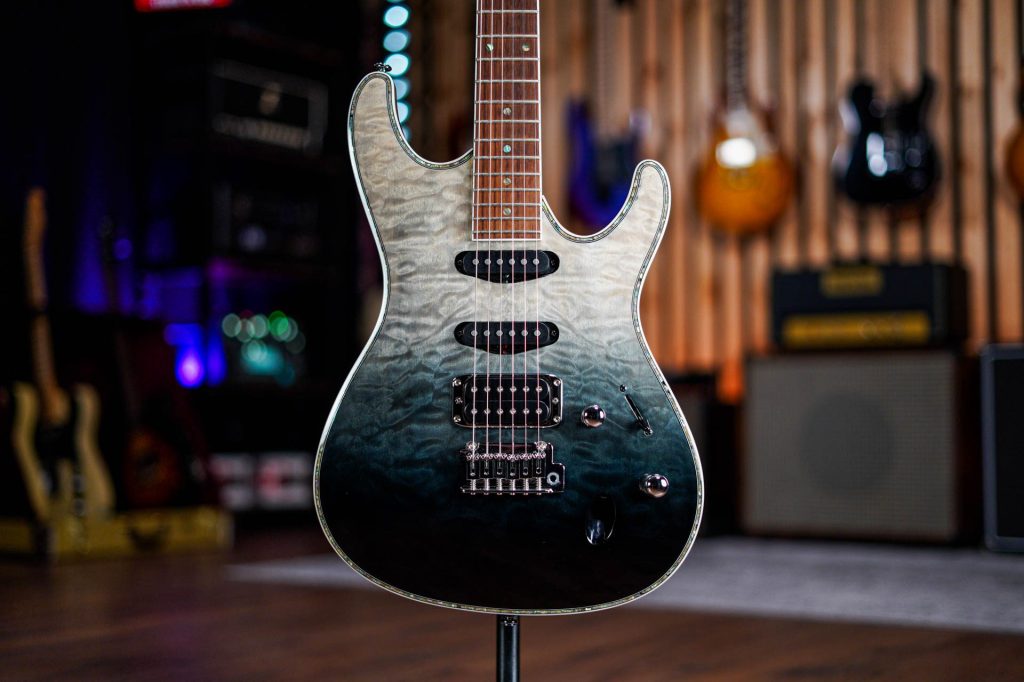
The Black Mirage instantly captivates with a design reminiscent of a Strat-style double-horn body, complete with 6-inline tuning pegs. Yet, it’s the stunning aesthetic details that set this guitar apart. The front features a gradient finish that transitions gracefully from a soft white/cream to a deep, pitch-black hue. Adorning the lighter section is a beautifully quilted maple top veneer that extends onto the headstock, creating a mesmerizing visual effect. This is further enhanced by a mother-of-pearl filet and multi-ply binding, details typically reserved for ultra-expensive custom shop models.
On the downside, the headstock is relatively modest, marked only by a simple solid white Ibanez logo. The neck, however, does receive extra attention with its binding and abalone inlays, adding a touch of elegance. At the rear, the body boasts a red translucent finish that transforms the okoume wood into something reminiscent of rich, flowing red wine. The back of the neck, made from two pieces of satin-finished maple, is less remarkable, and the fretboard—crafted from jatoba wood with a reddish tint—is a feature I find less inspiring.
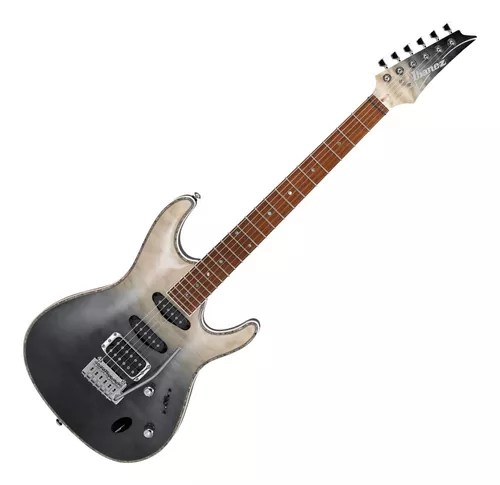
Overall, this guitar is a true eye-catcher. When I first tried it, I marveled at its visual appeal and found it to be quite playable, though I must admit the sound was merely adequate. The real clincher, however, was the price: at $599, the exquisite finish and luxurious details make it an incredible bargain. I own far more expensive instruments, such as the aforementioned Ibanez Q headless, yet none are as visually striking as the Black Mirage.

While sound quality is crucial, I believe that a guitar’s beauty plays a significant role in the joy of playing. For example, my Polar White Charvel San Dimas is a superb instrument in every technical aspect, but its lack of visual excitement makes it feel uninspiring. A beautiful guitar not only pleases the ear but also ignites the imagination—much like PRS guitars, whose stunning aesthetics have contributed to their legendary status.
In my world, a guitar should be as visually inspiring as it is sonically competent. When you look at an instrument as breathtaking as the Black Mirage, every time you play, you’re reminded that beauty matters—a lot.
That said… What about everything else?
As you look closer, it’s clear where Ibanez made some cost-cutting compromises. First off, the guitar is manufactured in China—a more economical option compared to places like Indonesia. That said, the craftsmanship and overall quality are really good for a China-made instrument.
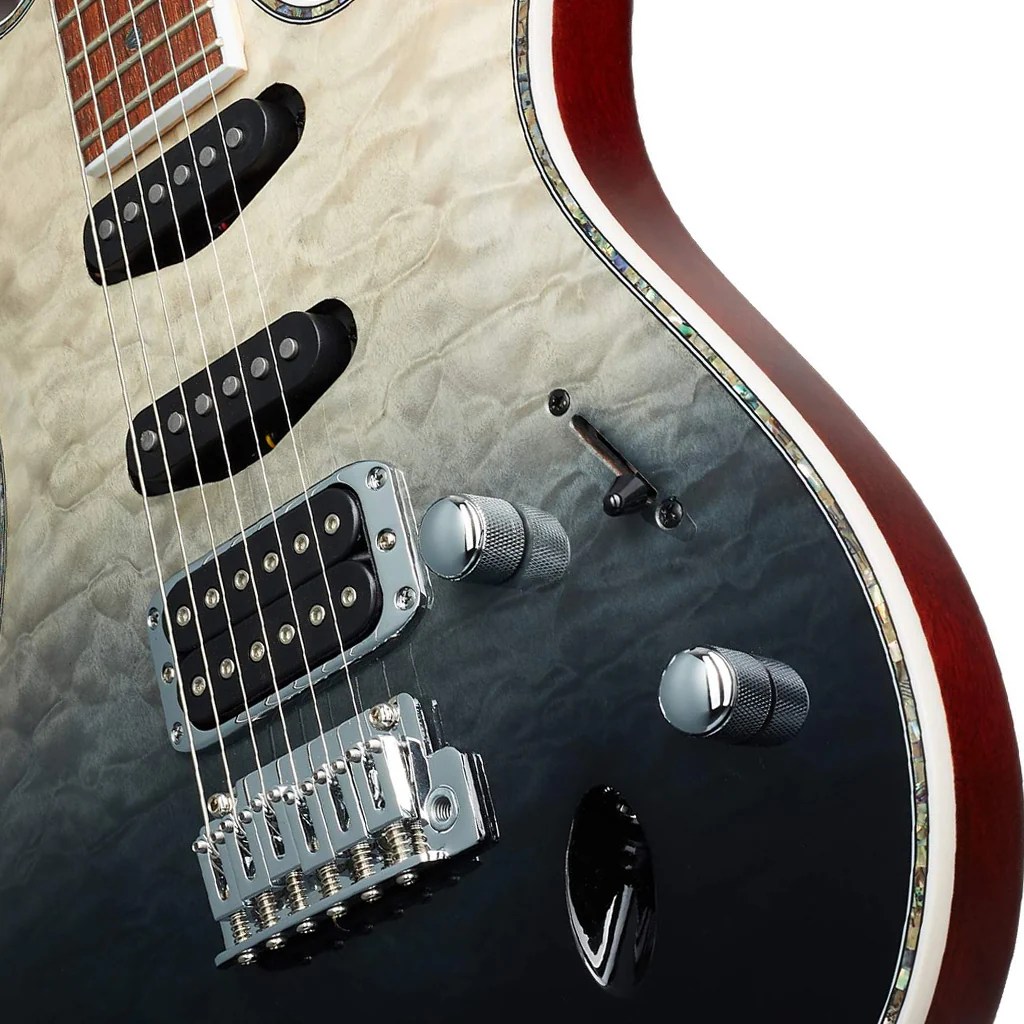
The biggest savings are evident in the hardware. The sealed tuners are only passable, the nut appears to be basic black plastic, and the string retainers are standard metal. Most notably, the Ibanez T102 Tremolo bridge falls short of expectations, often struggling to maintain tuning stability. When you engage the whammy bar, the Black Mirage can quickly devolve into what might best be described as a “Black Nightmare.”
And Then, There Are the Quantum & Resolution Pickups
I must give credit to the Ibanez marketing team for branding these pickups with names like “Quantum” and “Resolution”—names that promise something truly special. Unfortunately, the reality falls short. All three pickups in this configuration are passive ceramic models rather than the more expressive Alnico types. The result is a noticeably underwhelming performance.
The HSS setup does offer some sonic versatility. However, the single coils, while expectedly noisy, lack the sparkle and clarity you’d hope for. Instead, they deliver a muddy tone that leans heavily on the lower frequencies, resulting in an overall dark sound with low output that struggles to drive the amp effectively. For those craving a gritty, dynamic tone, an overdrive pedal (such as the legendary Ibanez Tube Screamer) becomes almost essential.
The 5-way blade switch does provide a range of tonal options—from a Fender-esque, nasal sound on the neck pickup to some intriguingly funky settings in positions 4 and 2. Yet, the Quantum humbucker at the bridge, which is supposed to cater to shredding and metal, also suffers from disappointing output. In short, while the pickup configuration offers versatility on paper, its performance leaves much to be desired.
Playability and Out-of-the-Box Experience
The Black Mirage is a very comfortable instrument that begs to be played. Its contoured body fits naturally in your arms, while the neck—striking the perfect balance between chunky and slim—caters to a variety of playing styles. The urethane glossy finish on the body not only looks fantastic but also adds to the overall smooth feel, and the neck’s satin finished surface makes for effortless, fast playing.
The fretwork is respectable. Although the frets aren’t perfectly smooth and the edges aren’t flawless, they’re a notable improvement over what you might expect from a typical mass-produced instrument.
Straight out of the box, setting aside its stunning appearance—which, admittedly, is this guitar’s main attraction—the Black Mirage is essentially a mid-tier instrument priced accordingly. Without its striking binding, mother-of-pearl inlays, maple veneer, and gradient finish, it would blend easily into the crowd. In other words, strip away the makeup, and you’re left with just another Strat-style wannabe that offers very little that’s new.
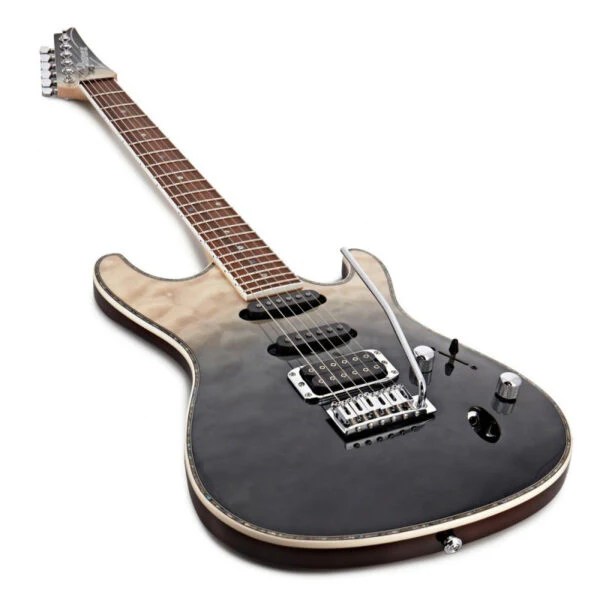
But here’s the thing: its stunning aesthetics provide a superb platform for a custom mod project. For instance, if tuning stability is your priority, consider upgrading to Gotoh Magnum locking tuners, Tusk string retainers and nut, paired with a high-quality Gotoh tremolo bridge. With roughly $250 invested in these enhancements, you can transform it into a rock-solid, reliable instrument.
Then there’s the matter of the pickups. The stock Quantum and Resolution pickups are, frankly, subpar. They may suffice for casual use, but serious players will likely want to replace them. Whether you’re chasing a crisp, Fender-like tone or need high output for aggressive riffs and searing solos, there’s a wide array of premium aftermarket options available, such as Seymour Duncan pickups, usually around $300.
In short, while the Black Mirage dazzles visually and offers commendable playability right out of the box, it does require a significant upgrade to match its aesthetic appeal with sonic excellence and dependable tuning. If you’re willing to invest roughly as much on hardware upgrades as you did on the guitar itself, you can transform this beauty into a truly unique and high-performing instrument. Admittedly, the Jatoba fretboard is a compromise you’ll have to accept, and as for the okoume body—take solace in knowing that even my much pricier $1,700 Jackson Soloist features the same wood. So, okoume matata!
Ultimately, whether spending around $1,100 on this guitar is worthwhile depends on your personal priorities, particularly when it comes to aesthetics. For me, the Black Mirage is one of the most beautiful guitars I’ve ever owned—a bold, character-rich instrument that inspires every time I play it. It may require an extra investment to reach its full potential, but for those who value beauty as much as a mod project with tons of potenial, it’s a choice that’s hard to resist.
Pros
- Stunning Aesthetics:
- The gradient finish—from a white/cream base to a deep, pitch-black tone—creates an eye-catching look.
- Luxurious details like the quilted maple top, mother-of-pearl filets, and multi-ply binding give it a custom, high-end appearance.
- Its bold design makes it a constant source of inspiration, proving that looks can significantly enhance the joy of playing.
- Comfortable Playability:
- The contoured body and smooth neck finish contribute to a very comfortable playing experience.
- The neck design strikes a balance—not too chunky, not too slim—catering to a wide range of playing styles.
- While the fretwork isn’t flawless, it’s notably better than what you might expect from a similarly manufactured instrument.
- Excellent Customization Platform:
- The Black Mirage serves as an ideal starting point for a mod project.
- Upgrading hardware (like tuners, the nut, and the tremolo bridge) and replacing the stock pickups can transform it into a top-tier instrument.
- Even with its initial modest performance, the potential for enhancements makes it a worthy investment for enthusiasts who love to tinker.
- Great Value for Visual Appeal:
- At $599, its price is a bargain considering the luxurious finish and eye-catching design.
- For those who prioritize aesthetics, this guitar offers a uniquely beautiful presence that’s hard to match—even by more expensive models.
Cons
- Compromised Hardware Quality:
- The sealed tuners and plastic nut reflect cost-cutting measures that affect overall durability and performance.
- The Ibanez T102 tremolo bridge is underwhelming, often leading to tuning instability—especially when the whammy bar is used.
- Lackluster Stock Pickups:
- The Quantum and Resolution pickups are passive ceramic types rather than the more dynamic Alnico versions.
- This results in a tone that can feel dark and muddy, with low output that may require additional pedals (like an overdrive) to push the amp effectively.
- While versatile in a HSS configuration, the overall sound doesn’t match the instrument’s visual allure.
- Fretboard and Sound Quality Issues:
- The fretboard is made of jatoba wood, which is unimpressive compared to the rest of the instrument.
- Although the guitar looks spectacular, its sound is only “okay” out of the box, necessitating potential upgrades to fully match its visual impact.
- Overall Investment Considerations:
- While the initial price is attractive, additional modifications (which may cost an extra $500-$600) are often needed to achieve the desired sound and tuning stability.
- The disparity between its stunning appearance and its moderate performance might not satisfy players who prioritize tone over looks.
Conclusion
In the end, the Ibanez SA350NQM—The Black Mirage—is a testament to the power of aesthetics in the world of guitars. Its breathtaking gradient finish, luxurious detailing, and unique personality captivated me from the very first moment, proving that sometimes, love at first sight is real. For those who prioritize a visual masterpiece that inspires creativity and passion, this instrument stands out as a true work of art.
However, as with any love affair, there are complexities. The guitar’s stock hardware and pickups fall short of the high standards set by its stunning appearance. But if you’re the type of player who enjoys customizing and fine-tuning your instrument, The Black Mirage offers a perfect foundation for a transformative mod project. With an additional investment, you can elevate its performance to match its visual allure.
Ultimately, whether the Black Mirage is the right choice depends on your priorities. If a guitar’s beauty and the promise of personalization are key to your playing experience, then surrendering to its spell might be the best decision you ever make. If pure out-of-the-box tone and reliability are non-negotiable, be prepared to invest further to unlock its full potential. For me, the enchantment of its design was irresistible—and that, in itself, made all the difference.
 oscaronguitars.com
Leave a comment