
Why Didn’t I Get One Before?
I’m not going to repeat how and why the JEM became one of the most important guitars in history. I already wrote about it. But I want to tell you: I wanted some piece of the action, so allow me to share my experience with the Ibanez JEM JR.
Why didn’t I get one before? Good question. First, because the JEM was ridiculously expensive—signature, collectible, and, did I mention, expensive? And when it was first announced, I was just an 18-year-old teenager who had barely started playing guitar and had no idea who Steve Vai was. It took me three or four years to even get my hands on a copy of Passion and Warfare—and when I finally did, it completely blew my mind. The sheer virtuosity, the otherworldly sounds… Was it even humanly possible to play like Steve Vai? Even with ten lifetimes, I wouldn’t get close to his level. So, why even try?
Discovering the JEM JR
Many years went by—25, to be exact. Then one day, while casually browsing online, I stumbled upon a brand-new JEM at an unbelievably low price. At first, I thought it was a mistake. But after digging a little deeper, I discovered that Ibanez had released a JEM model for regular players like me. The JEM JR was surprisingly affordable—just $499. So I thought, why not?
For the sake of variety I will spare you the complete specs breakdown (I’ll put the full specs at the end) and I’ll share how do I feel and think about this guitar.
First Impressions: Aesthetics and Build
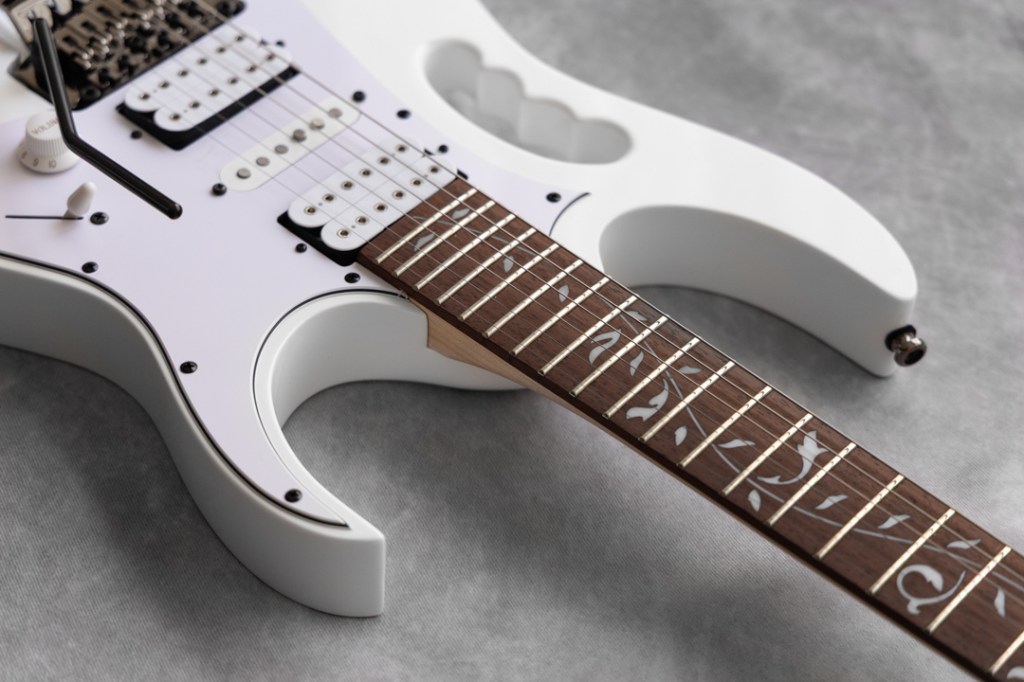
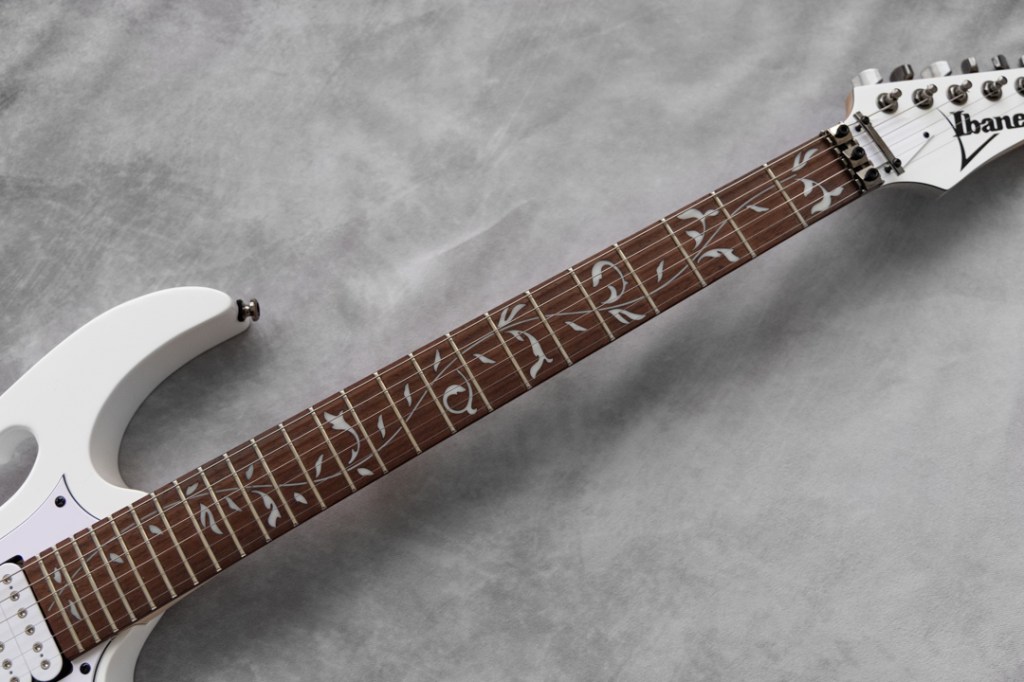
First of all, I’m not a fan of white guitars—I usually find them a bit dull. But this one? Anything but boring. Even in white, the JEM stands out. One of its most striking features is the insane Tree of Life inlay. Decades ago, such craftsmanship would have cost hundreds, if not thousands, of dollars. But fast-forward 40 years, and thanks to CNC machines, this intricate work is now more precise than ever—without adding much to the cost. What a time to be alive!
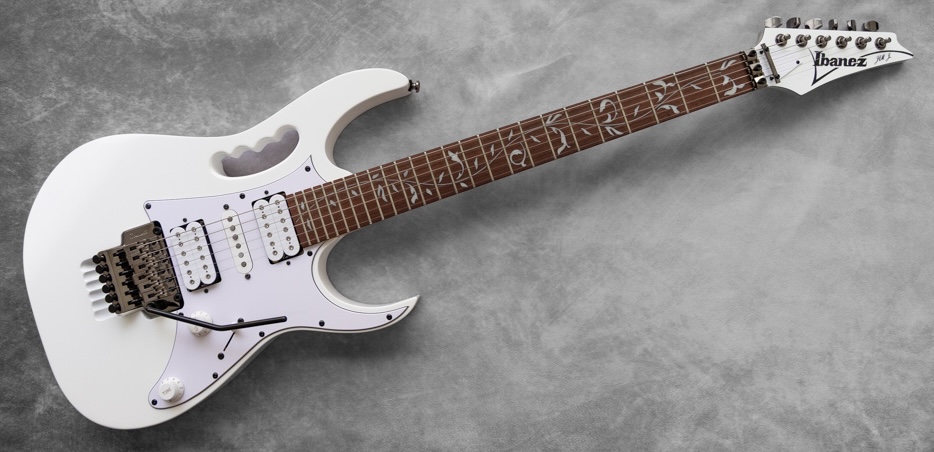
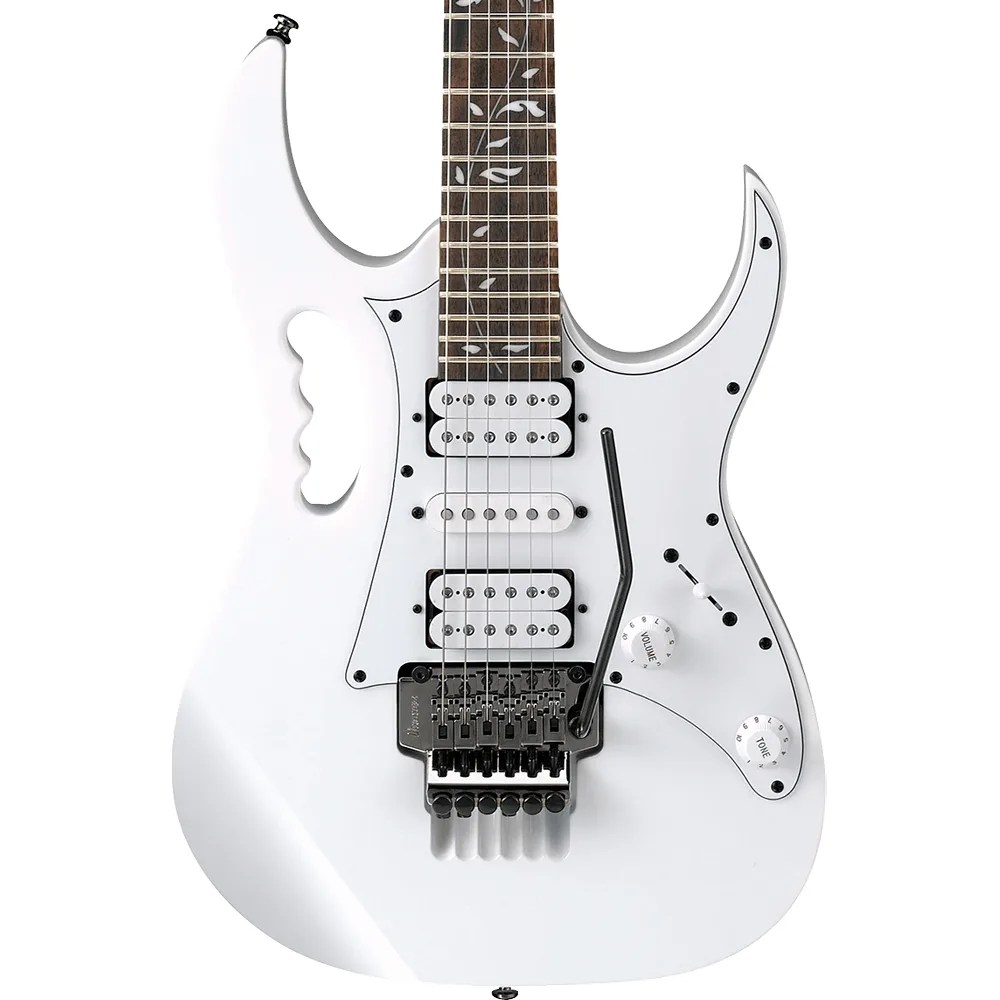
Then there’s the sculpted Superstrat body—sleek, refined, and absolutely stunning. Imagine how revolutionary it must have seemed four decades ago when it was hailed as the Lamborghini Countach of guitars. I’ve always loved the Stratocaster’s shape and ergonomic design, but the JEM takes it to another level. As Jean-Luc Godard once said, “It’s not where you take things from, but where you take them to.”
And of course, there’s the Monkey Grip—a defining feature of the JEM. One glance, and even people who know nothing about guitars can tell this is something special.
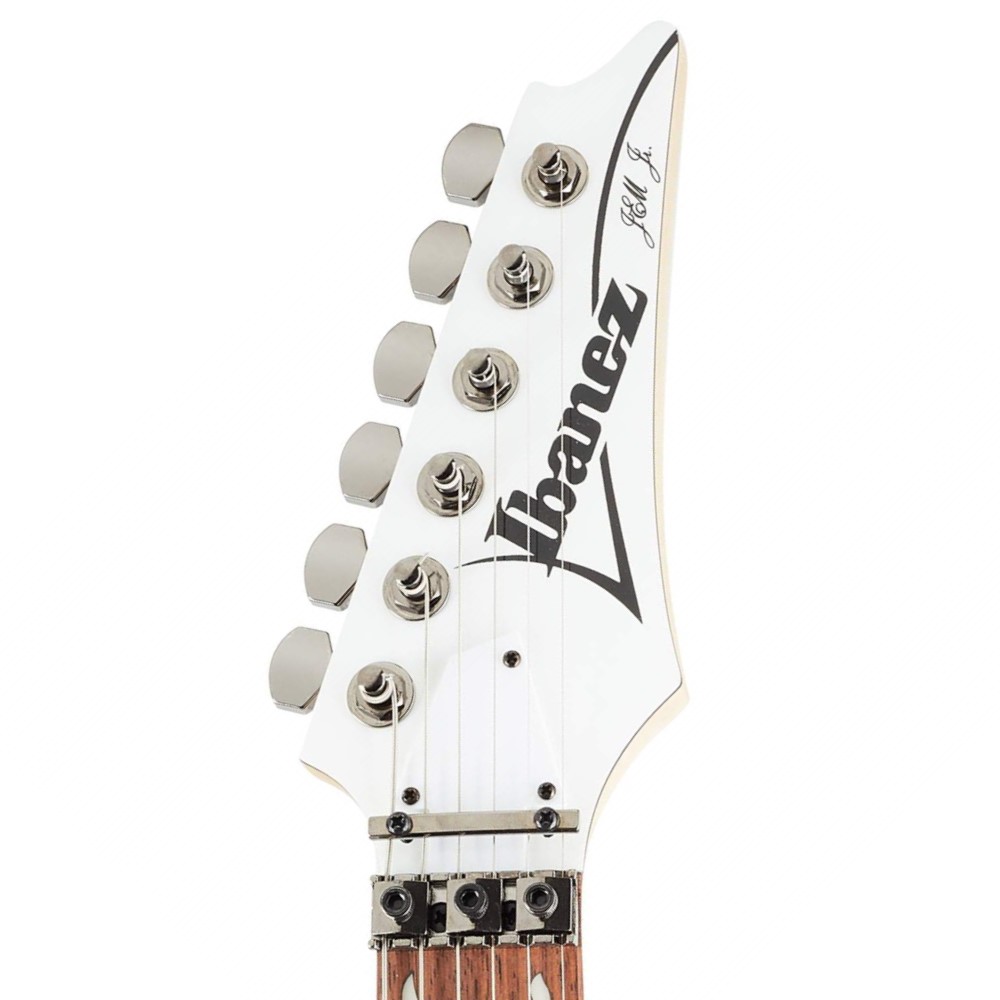
In terms of appearance, this magnificent guitar still feels as fresh and exciting as it did when it debuted at the 1987 NAMM show. I’ve always appreciated a great-looking guitar—it draws me in, makes me want to pick it up, and fuels my inspiration. And this one? It’s wonderful in every way, at least for me. Even in a color as seemingly plain as white, it shines with undeniable character and charm.
Is there anything I don’t like? Yes. And while it’s not a dealbreaker, it’s definitely worth mentioning.
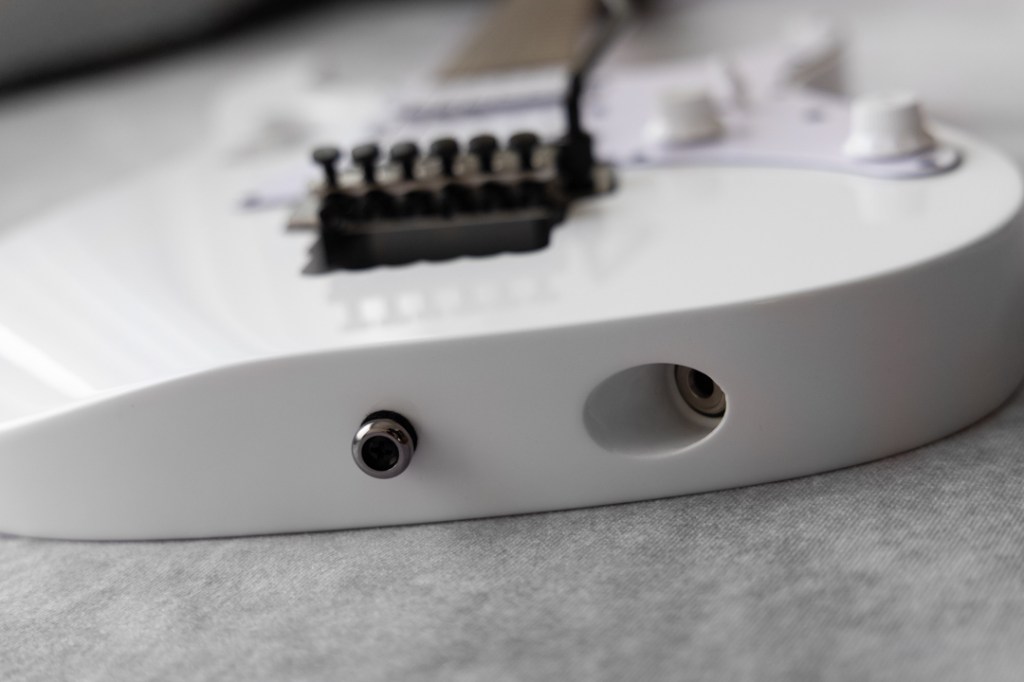
The routing inside the lion’s claw cavity and the areas around the floating tremolo feel a bit rough—clearly, some corners were cut there. While the rest of the guitar is well-made and neatly finished, this “under-the-hood” detail doesn’t quite match the overall quality.
That said, the fretwork is surprisingly outstanding. The frets are perfectly polished, and the edges are soft and smooth—something I’ve seen neglected on much pricier guitars. I’ve played Epiphones and Squiers with some truly awful fretwork, so I really appreciate the attention to detail where it actually matters.
Playability
Then there’s playability—the real dealbreaker in my book. I’m fortunate to own many beautiful guitars, but some just don’t quite click with me in terms of comfort. Take my Epiphone Les Paul Custom Black Beauty, for example—stunning to look at, but like any Les Paul, it’s heavy, and I never truly feel at home with it.
That’s why I’ve always found Superstrats incredibly comfortable. However, neck profiles can be tricky. I’m not a fan of chunky necks, I notice them—and that slight awareness can sometimes get in the way when I’m playing.
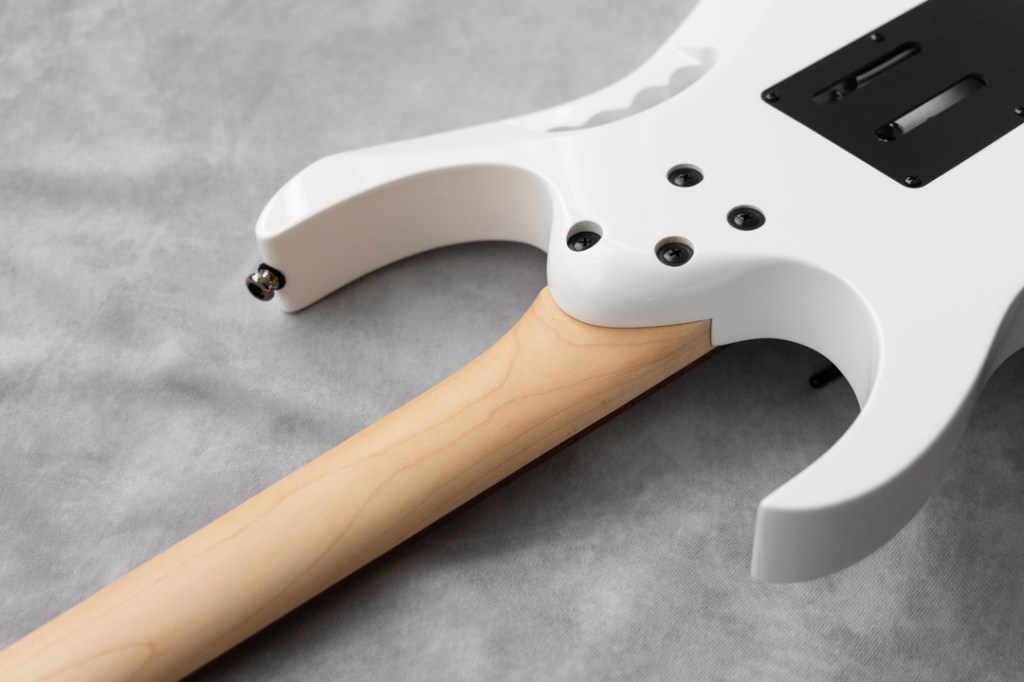
So, what about the JEM? For me, it’s transparent—and that’s absolutely perfect. The moment I pick it up, the neck disappears. I’m not thinking about whether it’s too thick, too thin, a D shape, or a C. I just play, and it feels right. That, to me, is a fantastic deal.
At first, I thought the Tree of Life inlay might be distracting, but honestly? It’s not—at least not for me. Strangely enough, I did find the bird’s-eye roasted maple on the Ibanez Quest QX54QM incredibly distracting. Why? I have no idea.
But the floral pattern on the JEM actually makes sense. The big leaves mark the 3rd, 5th, 7th, 9th, and 12th frets, while the small leaves cover the 2nd, 4th, 6th, 8th, and 10th. It might not seem logical at first, but when playing, it just works—and that’s what really matters.
Then there’s the fretboard radius: absolutely perfect. Not too wide, not too narrow—just effortless. Once again, it feels transparent. And having 24 fully accessible, actually usable frets? That’s a game-changer. Wow!
The Tremolo System: A Pleasant Surprise
For the longest time, I didn’t care about whammy bars or floating tremolos at all. But over the past few years, I’ve found myself using them more and more—so much so that when I play a fixed bridge guitar, I often miss the ability to add that extra sauce, as Jennifer Batten would call it.
Now, having a good tremolo system is a must for me. And, of course, it’s not just about having one—it has to stay in tune, even after some deep-dive tremolo madness.
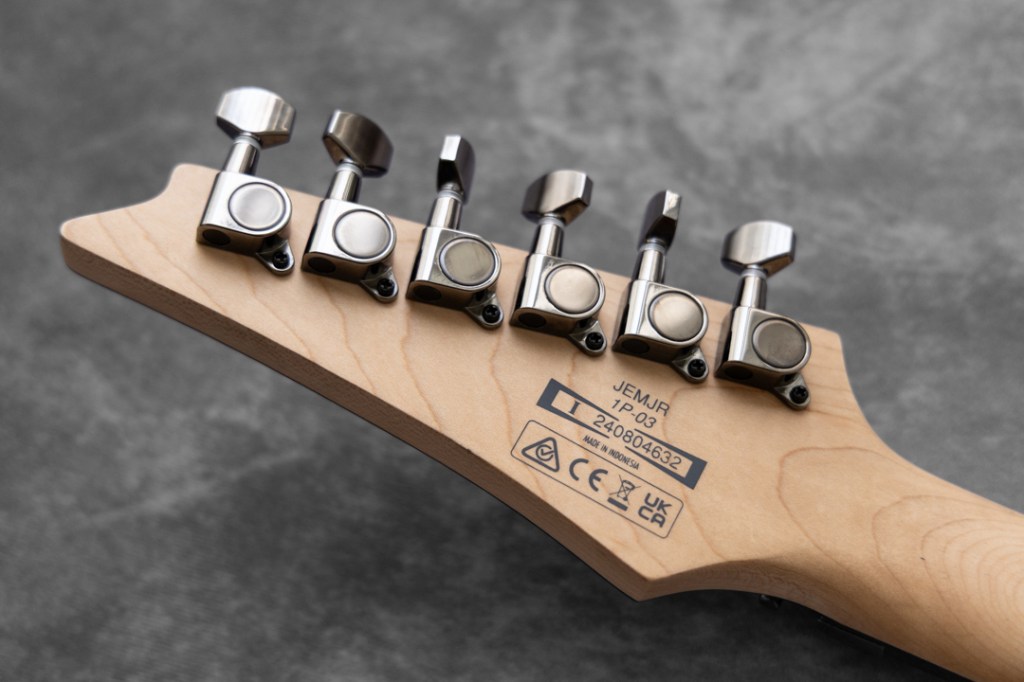
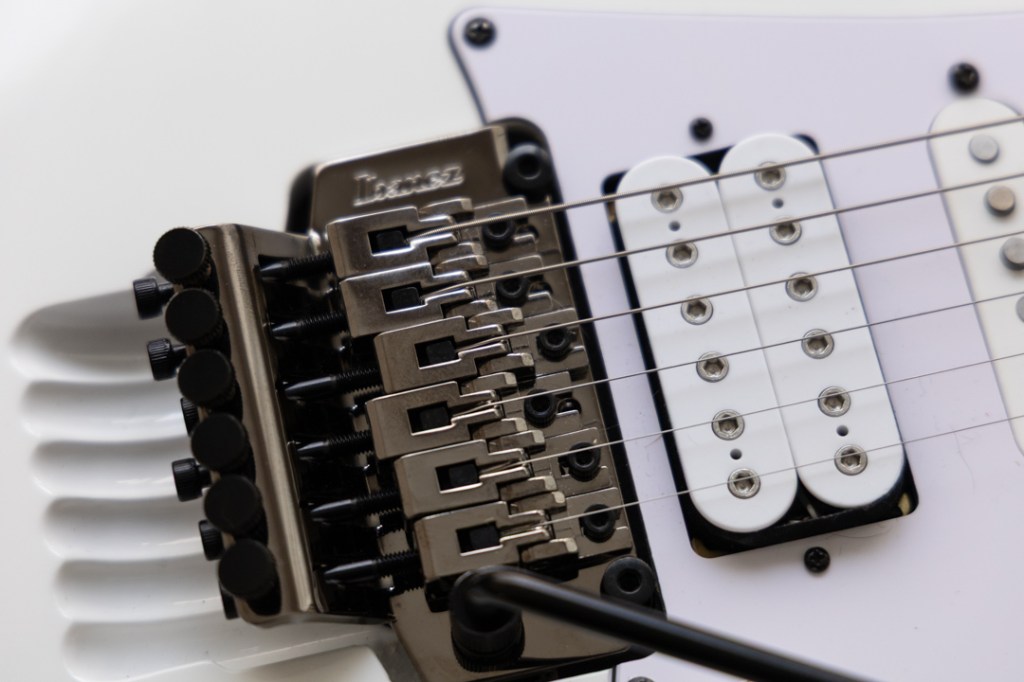
This JEM comes with an Ibanez-designed take on a Floyd Rose. At first, I wasn’t sure if it would be up to par or just another budget-friendly compromise. But to my surprise? I actually prefer it over the Floyd Rose Special, the EVH-branded version, the Jackson-branded one, and even the 1000 series. In fact, I’d put it on par with a Floyd Rose 1500 series—which is no small feat.
Of course, the real test will be its long-term durability. That’s always the question with mid-tier hardware. Let’s be real: finding top-tier components on a $499 guitar is a tough ask. But for its price range, the hardware is solid. Not exceptional, but reliable enough to get the job done.
So, kudos to Ibanez! And yes, the iconic lion’s claw routing beneath the bridge isn’t just for show—it allows for some truly insane bends and dive bombs.
So, we’ve covered a lot of ground with this JEM JR, and so far, it’s ticked all the right boxes. But then came the real test: the sound.
Sound Quality
I have to admit, I expected some compromises. This is, after all, a more affordable version of the JEM, with meranti for the body and a jatoba fretboard. Meranti (also known as Lauan and Philippine Mahogany), is often found in budget-friendly guitars, is a lightweight, porous wood with a balanced but somewhat neutral tone, lacking the resonance of mahogany. It’s commonly used in entry-level instruments due to its affordability and easy workability. Jatoba, also known as Brazilian cherry, is much denser and harder, often used for fingerboards. It offers bright, articulate tones with strong sustain and durability, making it a solid alternative to rosewood or ebony. While jatoba enhances attack and clarity, meranti provides a more subdued tonal foundation.That didn’t really bother me. But when I saw the pickup specs, I was skeptical.
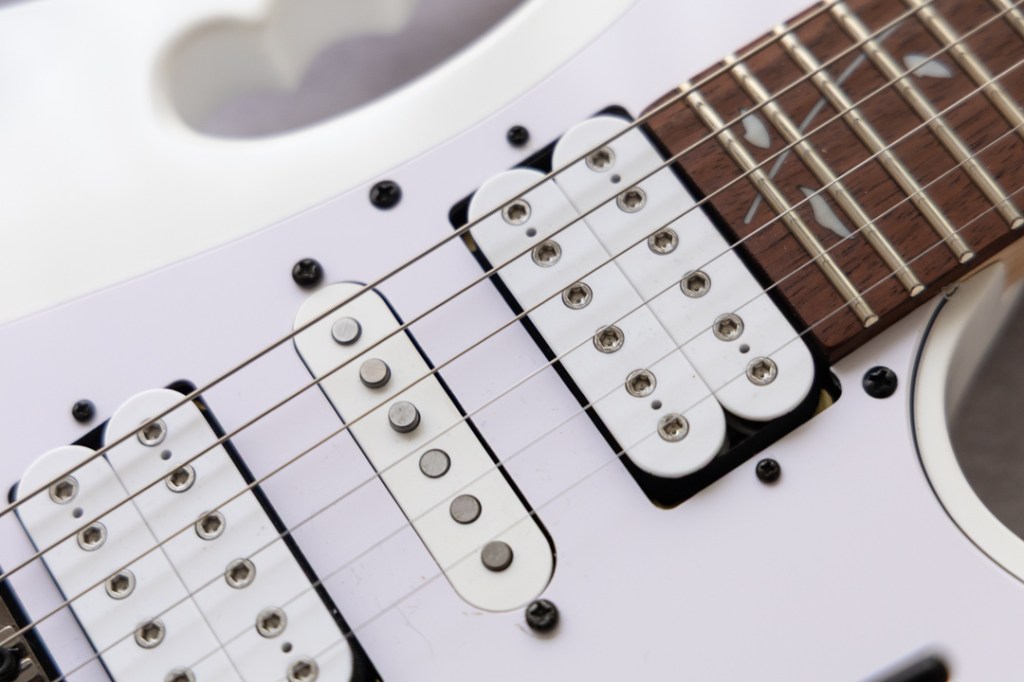
Ibanez equipped this guitar with Quantum pickups—their in-house brand. And let’s be honest, Ibanez has a tendency to oversell their stock pickups with fancy names and glowing descriptions that don’t always translate into great tone. So the big question was: How could these possibly hold up against the real DiMarzio Evolution set?
The sound completely won me over. These pickups pack more punch than I expected, and with the five-way blade switch, the split-coil positions (2 and 4) blend beautifully with the middle single-coil, delivering a remarkably versatile sonic palette.

Yet, when it comes to pinch harmonics and dive-bomb pyrotechnics, the ceramic pickups rise to the occasion. They’re powerful, high-output, and hot enough to push an amp into a satisfying overdrive without any extra help.
Yes, this is a shredding machine built for metal—no doubt about that. But if you’re after something a bit more controlled and refined, just roll back the volume and tweak the tone, and you’ll find a surprising range of usable sounds right out of the box. That said, it’s not exactly ideal for vintage tones. The ceramic pickups deliver high output with a modern edge, so if you’re chasing classic blues, jazz, or vintage rock tones, you might need to put in some extra work. In some cases, it still won’t quite match what a vintage-voiced PAF or traditional Fender single coils can offer. So while this guitar isn’t a one-trick pony, its real strength lies in modern tones, shredding, and high-gain metal—just don’t expect it to nail the vintage vibe perfectly.
When I bought the JEM JR, I thought, “If the construction and playability are solid, I can always upgrade the pickups to DiMarzios.” But guess what? I don’t feel the need to upgrade them at all. And I say that with total honesty.

The Price is Right
It looks great, plays great, and sounds great. What more could I ask for? I don’t want to overspend—and with this guitar, I don’t have to.
You know, when you own a really expensive guitar, you often find yourself hesitating to take it out too much. There’s always that lingering fear—what if it gets damaged, lost, or something totally out of my control happens to it?
So, while having a stunning, high-end guitar is amazing, in my case, I’ve realized that I actually don’t play them as much as I should. More often than not, they end up sitting in their cases, admired but untouched.
But this JEM JR? My friend, it’s just $499, not $4,999. If it gets stolen, damaged, or something catastrophic happens to it, guess what? I’d just buy another one. Immediately. No hesitation.
So, yes, there are a couple of rough spots, but they’re in places no one will ever see or touch. And for the price? Totally acceptable.
Why Upgrading the JEM JR Might Not Be Worth It (And What to Buy Instead)
Upgrading the Ibanez JEM JR might seem tempting at first—swap the pickups, replace the tremolo, maybe even refinish it—but once you start adding up the cost of quality components like a Gotoh bridge and a full DiMarzio set, plus professional installation, you’re quickly approaching—or even surpassing—the price of a much better guitar.
For around $1,500 USD, you can get incredible alternatives like the Jackson Pro Series Dinky DK1 or the Charvel Pro-Mod So-Cal Style 1 HSS FR M. These guitars come loaded with Seymour Duncan pickups, Floyd Rose 1000 or 1500 series tremolos, and alder or mahogany bodies with maple or rosewood fretboards—all wrapped in sleek, stage-ready finishes. They’re fast, comfortable, and designed for serious players. Compared to upgrading the JEM JR, choosing one of these ready-to-rock models is a smarter investment that gets you pro-level performance right out of the box.
Above All, a Guitar That’s a Joy to Play
From a spec sheet perspective, the JEM JR is impressive. Sure, some components—like the hardware, pickups, or types of wood—might not be top-tier, but honestly, for the price, you really can’t ask for more. But beyond that, there’s something else—something more subjective—that I feel is important to say: the overall playing experience with this guitar is genuinely different.
At any level, the JEM JR delivers value. Visually, it’s stunning. Historically, it carries weight. Sonically, it sounds fantastic. And in terms of comfort, it’s incredibly easy to play. Altogether, it adds up to a guitar that’s not only comfortable and fun, but one you’ll actually want to keep playing.
As I write this, I’m preparing for a mini-concert, and most of the setlist is Carlos Santana tunes—so the tone of my PRS SE DGT fits the bill perfectly. And yet, while I’m playing it, I find myself missing the JEM. I keep wondering: couldn’t I get a similar sound out of the JEM?
That’s the thing—this guitar excites me. It makes me want to play. And that, I think, is crucial. It becomes your instrument. The one that feels like an extension of you. That’s not something easy to explain, but the JEM has it. It’s rare. It goes far beyond specs—it’s something you connect with on a deeper level.
I don’t know if it would happen the same way for you, but for me, that connection has made all the difference in the world.
Pros and Cons of the Ibanez JEM JR
Pros
- Affordable Price
At $499, it brings the legendary JEM experience to the masses without sacrificing essential features. - Iconic Aesthetics
The Tree of Life inlay, Monkey Grip handle, and sculpted Superstrat body make it instantly recognizable and visually stunning—even in plain white. - Fantastic Playability
The Wizard III neck is slim, fast, and feels completely “invisible” in your hands—exactly what you want in a shred-friendly guitar. - Surprisingly Good Pickups
The Quantum pickups punch above their weight class with high-output performance, sweet coil-split tones, and plenty of versatility. - Great Tremolo System
The Ibanez-designed double-locking tremolo holds tuning surprisingly well and delivers smooth, responsive action for expressive dive bombs and flutters—at least for now. - Great Fretwork
Smooth edges and polished frets make for a comfortable playing experience, even better than some higher-priced guitars. - Built for Real-World Use
It’s a joy to play, not a case queen. You won’t lose sleep gigging or traveling with it. - Touches of History
It offers a taste of one of the most iconic guitars in modern history, without requiring a collector’s budget.
Cons
- Not Ideal for Vintage Tones
The ceramic humbuckers are voiced for high-output modern sounds, so blues, jazz, or classic rock tones may require extra effort—or remain just out of reach. - Budget-Level Tonewoods
Meranti and jatoba are serviceable but lack the tonal richness and resonance of higher-end woods like mahogany or rosewood. - Stock Pickups May Not Please Tone Purists
While surprisingly capable, the Quantum pickups might leave DiMarzio fans wanting more. Swapping them out adds to the cost quickly. - Tremolo Durability Is Uncertain
The Ibanez double-locking tremolo performs admirably for now, but its long-term durability is a question mark. A Gotoh GE1996T is a premium alternative, but installing it requires extra drilling—definitely not a beginner-friendly mod. And once you start adding up the cost of upgraded pickups and a better trem, you’re in territory where it might make more sense to consider other options from Jackson, Charvel, EVH—or even a higher-tier Ibanez model. - Not an Ideal Mod Platform
While tempting to upgrade, the JEM JR’s tonewoods and mid-range build quality place a natural ceiling on how far mods can take it. Investing heavily in pickups and hardware may not yield results that justify the cost, especially when excellent alternatives in the $1,200–$1,500 range already come with premium components out of the box. - No Case Included
You’ll need to budget for a gig bag or sturdy case separately. PRS, for example, includes attractive gig bags even with guitars of similar price and quality.
Final Thoughts: A Guitar That Just Makes Sense
That’s what makes this guitar perfect for me—it sounds great, plays effortlessly, and is built for speed. And let’s be honest, it looks absolutely killer without breaking the bank. But even more importantly, it’s not just a one-trick pony.
Sure, it’s a Vai-inspired machine, and if you start playing For the Love of God, you’ll get that signature sound instantly. But here’s what I realized—the true magic of Vai’s tone isn’t just in the guitar; it’s in his expressiveness and technique. That means you’re not locked in to just his sound.
Even if you never play a single Steve Vai song—or don’t even like his music—this guitar still delivers. It’s incredibly versatile, capable of handling blues, jazz, funk, heavy metal—you name it, although with its own limitations. It’s an all-around fantastic instrument, no matter what style you play.
And there’s one last layer I want to add—something that’s really important to me: historical significance.

There’s something special about owning a guitar that makes you think, “Wow, this instrument changed everything.” The JEM wasn’t just a turning point for Steve Vai’s career (and bank account)—it was a game-changer for Ibanez, solidifying the brand as a top-tier manufacturer. It completely redefined what a Superstrat could be.
Maybe today, we don’t see it as revolutionary because we’ve grown accustomed to many of its features. But if you rewind 40 years, you’ll realize that things like the monkey grip, ultra-accessible 24 frets, and high-performance trem systems were once exotic, cutting-edge innovations. The JEM set the standard.
So, the cherry on top of owning this JEM JR is that it lets me hold a piece of that history—a guitar almost dangerously close to the one Steve Vai has used as his go-to instrument for nearly four decades.
And as it stands right now, I think I’ve found a new lifelong companion. It just makes me happy. That simple.
And at the end of the day, that’s what guitar playing is all about for me.
Could it be for you? I don’t know. But you’d have to try it for yourself.

Body
- Material: Meranti
- Features: “Monkey Grip” handle, “Lion’s Claw” tremolo cavity
Neck
- Type: Wizard III
- Material: Maple
- Scale Length: 25.5 inches (648mm)
- Neck Width:
- At Nut: 43mm
- At 24th Fret: 58mm
- Thickness:
- At 1st Fret: 19mm
- At 12th Fret: 21mm
- Fingerboard Radius: 400mm (15.75 inches)
Fingerboard
- Material: Jatoba
- Inlay: Tree of Life
- Frets: 24 Jumbo
Bridge
- Type: Standard DL Tremolo (Double Locking)
- String Spacing: 10.5mm
Hardware
- Color: Cosmo Black
- Nut: Locking
Electronics
- Pickup Configuration: HSH (Humbucker/Single-Coil/Humbucker)
- Pickups:
- Neck: Quantum Humbucker (Passive/Ceramic)
- Middle: Quantum Single-Coil (Passive/Alnico)
- Bridge: Quantum Humbucker (Passive/Ceramic)
- Controls:
- Master Volume
- Master Tone
- 5-Way Pickup Selector Switch
Additional Features
- Factory Tuning: Standard E (1E, 2B, 3G, 4D, 5A, 6E)
- String Gauge: .009/.011/.016/.024/.032/.042
- Recommended Case: Ibanez M300C

 oscaronguitars.com
Leave a comment