

A Towering Force in Every Sense
Albert King wasn’t just a blues guitarist—he was a force of nature. Standing at 6’4” and weighing over 250 pounds, King was every bit the “Velvet Bulldozer”—a nickname earned not just from his stature and smooth vocal style, but also from his early years driving a bulldozer in Osceola, Arkansas. But his true power came from the way he made a guitar speak: growling, howling, crying, and laughing all at once.
Albert King, born Albert Nelson on April 25, 1923, in Indianola, Mississippi, would go on to become one of the most influential electric blues guitarists of all time. He’s widely regarded as one of the “Three Kings of the Blues Guitar,” alongside B.B. King (no relation) and Freddie King. Yet Albert carved out a singular identity through his unconventional playing style, his raw, minimalistic solos, and the deep emotional wellspring from which his music flowed.
Roots: Humble Beginnings and a DIY Spirit
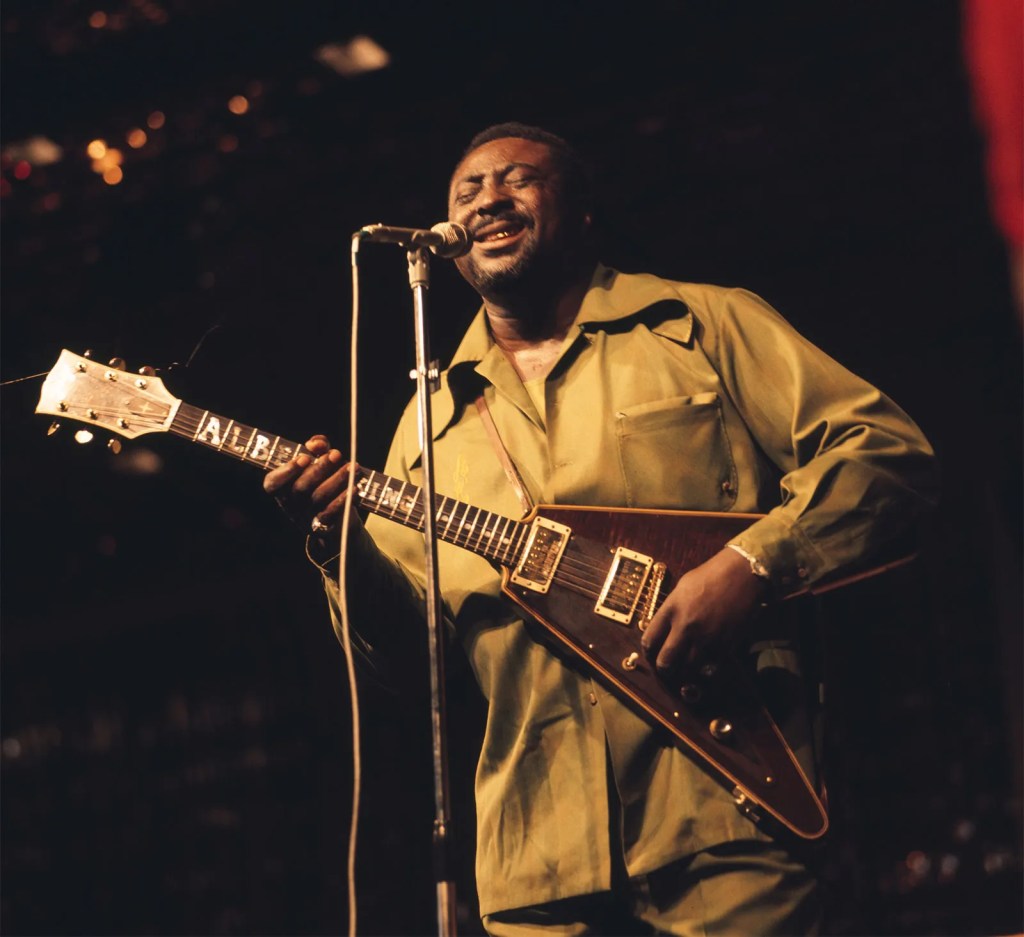
Born in the heart of the Mississippi Delta—a crucible of American blues—Albert Nelson grew up in a family steeped in gospel and blues traditions. Like many African American families of the era, the Nelsons were poor sharecroppers. Albert was one of thirteen children, and the family moved frequently in search of better opportunities, eventually settling in Forrest City, Arkansas.
King’s musical journey was largely self-taught. He began playing homemade instruments as a child—one of his earliest was a diddley bow (a single-stringed instrument made from wire attached to nails on a wall). Later, he would build his first guitar using a cigar box, a piece of broomstick, and a strand of wire. That DIY ethos would stay with him throughout his career—especially in how he approached the guitar.
The Inverted Genius: His Unorthodox Guitar Style
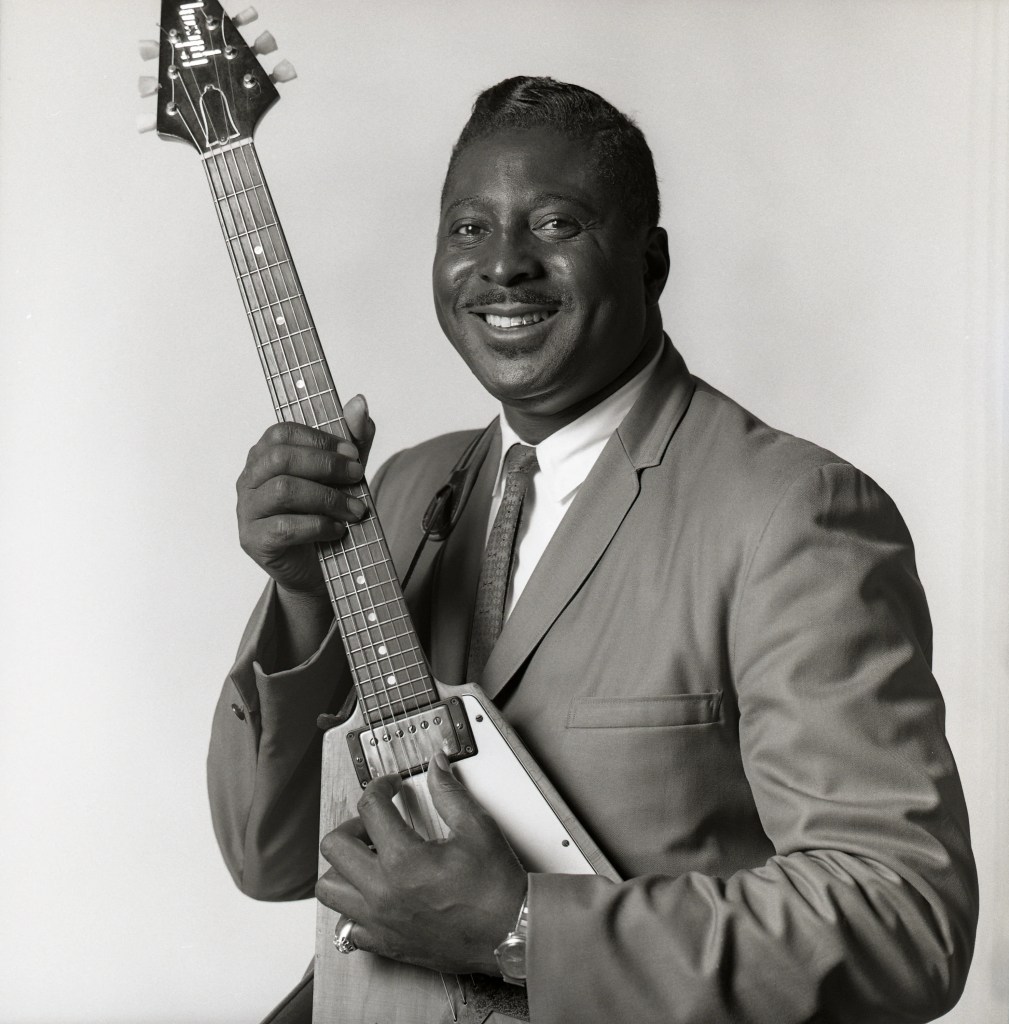
Albert King’s technique is the stuff of legend—and confusion for anyone who tries to emulate it. A natural lefty, he flipped a right-handed guitar upside down without restringing it. This meant the bass strings were on the bottom and the high treble strings were on top. He essentially played everything in reverse—pulling down on the strings for bends, rather than pushing up.
His primary guitar, a 1958 Gibson Flying V he named “Lucy,” became iconic. The instrument’s angular, futuristic design matched King’s cutting, modern tone. “Lucy” was fitted with extra-light gauge strings (.009–.050) to accommodate King’s massive bends and wide vibrato.
The result? A sound that could go from a whisper to a roar. He could hold a note and squeeze it until it broke your heart, all without playing fast or flashy. King proved that fewer notes, played with deep feeling and intention, could carry more weight than a thousand flurried runs.
St. Louis and the Road to Stax
Albert King’s career didn’t ignite in the Delta. He first gained traction after moving to St. Louis in the 1950s, working in clubs and cutting regional hits like “Don’t Throw Your Love on Me So Strong.” It reached #14 on the Billboard R&B chart in 1961 and introduced him to a wider audience.
But the real breakthrough came in the mid-1960s when King signed to Stax Records in Memphis—a label that was home to Otis Redding, Booker T. & the M.G.’s, and Isaac Hayes. This was a pivotal moment, placing him in a studio filled with top-tier musicians and producers who understood how to frame his sound in a fresh, dynamic context.
Born Under a Bad Sign: The Album That Changed Everything
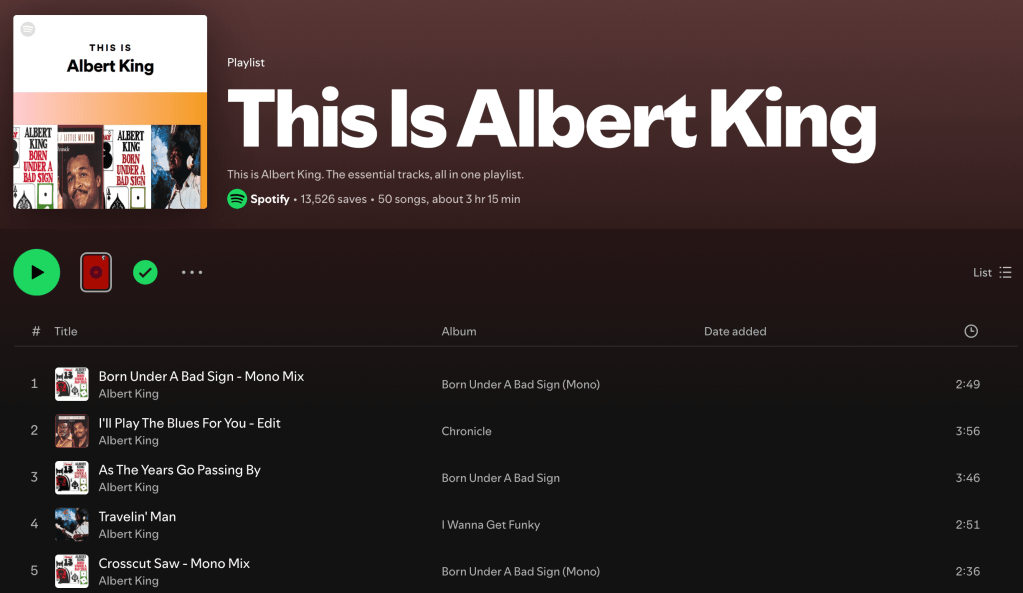
Released in 1967, Born Under a Bad Sign wasn’t just a milestone for King—it became one of the most influential blues albums ever recorded. Produced by Al Jackson Jr. and backed by the Stax house band, including Booker T. Jones and Donald “Duck” Dunn, the album bridged blues and soul in a way few had done before.
The title track, co-written by Booker T. and William Bell, features that ominous bassline and King’s signature piercing bends, delivering a message of fatalism with stoic resolve. It was a blueprint for blues-rock and later covered by Cream, cementing King’s influence on the British blues explosion.
The album also includes iconic tracks like:
- “Crosscut Saw” – An old blues tune reworked with funky syncopation and searing guitar work.
- “Laundromat Blues” – A slow burner where King’s voice aches with suspicion and jealousy.
- “The Hunter” – Later covered by Led Zeppelin, this track’s punchy rhythm and braggadocio fit perfectly into the evolving rock-blues vocabulary.

A Live Powerhouse
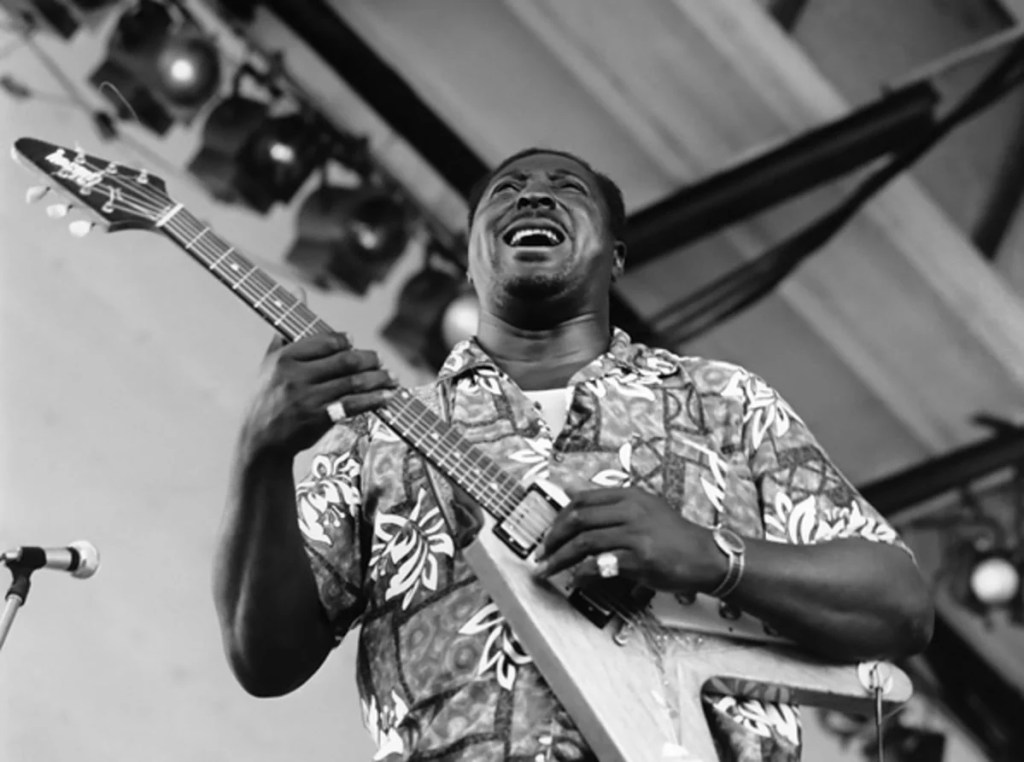
If Albert King was intimidating on record, he was downright ferocious on stage. He rarely followed setlists and often stretched songs into 10-minute sagas. His performances were raw, loose, and emotionally charged. He would often talk between songs, scolding the band or playfully interacting with the crowd, adding to his mystique.
Some of his finest moments were captured on Live Wire/Blues Power (1968), recorded at the Fillmore Auditorium in San Francisco. The live setting brought out the best in King—his guitar lines more exploratory, his vocals more impassioned.
Another essential performance is the 1983 In Session with a young Stevie Ray Vaughan. The chemistry between the two is electric. King towers over SRV, both figuratively and literally, but he also acts as a mentor—pushing, encouraging, and admiring the young Texan’s chops.
King’s Influence: More Than Just a Bluesman
Albert King didn’t just influence blues players—he shaped the very foundations of modern guitar playing. His phrasing, tone, and minimalist approach were studied and absorbed by legions of guitarists across genres.
- Jimi Hendrix admired King deeply and borrowed his string-bending and expressive vibrato.
- Eric Clapton cited King’s phrasing as a major influence on his soloing in Cream and beyond.
- Stevie Ray Vaughan arguably carried King’s legacy more faithfully than anyone else, even adopting a similar attack and tone.
His influence even stretched into funk (through his work at Stax) and early hip hop (many of his grooves were sampled). King’s ability to bridge raw Delta blues with slick Memphis soul created a sound that was both authentic and contemporary.
Beyond the Guitar: Albert King the Storyteller
Albert King was more than a guitarist—he was a storyteller. His lyrics weren’t always poetic in a literary sense, but they were deeply human. Songs like “I’ll Play the Blues for You” and “As the Years Go Passing By” touch on themes of love, betrayal, aging, and perseverance with simplicity and heart.
His voice, smooth but with a touch of gravel, carried authority. You believed him. Whether he was asking for love or warning someone to stay away, there was gravity in his delivery.

A Quiet End, A Loud Legacy
Albert King passed away on December 21, 1992, from a heart attack in Memphis, Tennessee. He was 69 years old. Despite his massive contributions, King remained humble and somewhat underappreciated during his lifetime, especially compared to his contemporaries. But the years since his death have only deepened appreciation for his genius.
He was inducted into the Rock and Roll Hall of Fame posthumously in 2013 and the Blues Hall of Fame in 1983. His music continues to be reissued, studied, and celebrated around the world.

10 Lesser-Known Facts About Albert King
- He learned guitar by watching others – Since he was left-handed and played upside-down, he often mimicked right-handed players in reverse.
- He didn’t read music – Like many blues greats, King played entirely by ear and feeling.
- He drove a bulldozer for years – Music wasn’t his first job; he was a working man with heavy machinery experience.
- He loved jazz – King admired guitarists like T-Bone Walker and even Wes Montgomery.
- He hated being called a bluesman early on – He often said he played “soul music with a blues feel.”
- He had multiple “Lucys” – There were several Flying Vs over the years, but all bore the name Lucy.
- He sometimes refused to rehearse – King often preferred spontaneity and raw emotion in his sets.
- He influenced metal guitarists – Players like Dimebag Darrell and Zakk Wylde have cited him as an influence.
- He used super-light strings – Sometimes as light as a .008 on the high E.
- He didn’t achieve real fame until his 40s – A late bloomer by industry standards, but he hit hard when he arrived.
Final Thoughts: A Blueprint for Soulful Guitar
Albert King proved that a guitar doesn’t need to be played fast to be powerful. In a world where flash and technical prowess often dominate, King reminds us of the importance of space, feel, and tone. He spoke through his guitar with raw honesty and emotional depth. His music remains a timeless reminder of the blues’ power to move the soul.
Whether you’re a guitar nerd, a blues aficionado, or a casual music lover, take time to revisit his catalog. You might not be able to bend strings like Albert King—but you’ll certainly feel them.
 oscaronguitars.com
Leave a comment