
In a world of instant gratification, learning guitar can feel like a long and winding path. Every player hits walls—technical plateaus, slow finger progress, the creeping thought that others advance faster. But what if true progress isn’t in the speed, but in the stillness? There’s a saying: “Patience is the science of peace.” It isn’t just poetic—it’s deeply practical. Let’s explore what this means for guitar players and why embracing patience might be the most radical upgrade your playing will ever get.
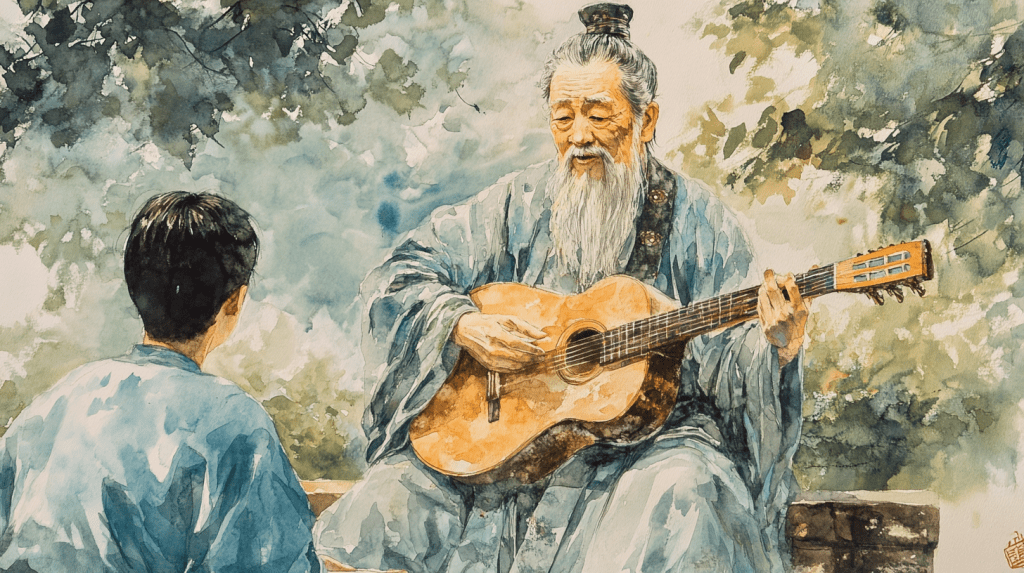
A Zen Story: The Student and the Master’s Garden
A young student once approached a Zen master, frustrated with his slow progress.
“Master, how long will it take me to reach enlightenment?”
“Ten years,” the master replied.
“But what if I try harder than anyone, practice day and night, and push myself to the limit?”
The master thought for a moment.
“Then twenty years.”
Confused, the student asked, “Why longer if I try harder?”
The master smiled, “If one eye is fixed on the goal, there is only one left to guide you along the path.”
What This Means for Guitar Players
This story beautifully illustrates a paradox every guitarist faces: the more you obsess over progress, the more you block it. Patience is not passivity—it’s presence. It’s staying rooted in today’s practice instead of chasing tomorrow’s solo.
When you rush, you build tension—mental, physical, even musical. You speed through scales without internalizing their sound. You memorize songs but forget the feel. You compare yourself to others and lose the joy of your own sound.
But when you let go, trust the process, and allow time to do its work, your playing grows deeper. Cleaner. More intentional. You stop fighting the music—and start becoming it.
The Science of Peace: What Patience Does for Your Playing
Think of patience not as a virtue, but as a strategy. It is literally the “science of peace”—a method to reduce internal noise so real learning can happen.
Here’s how it transforms your playing:
- Physically: Tension kills tone. Patience teaches your fingers to relax. You stop overgripping the neck, your vibrato becomes fluid, your bends more expressive.
- Mentally: You stop panicking over plateaus. You see them as part of the terrain, not signs of failure.
- Emotionally: You reconnect with why you play. The joy returns. So does the curiosity.
- Musically: You hear more. You notice space between the notes. You feel time.
Examples from the Guitar World
- B.B. King: Known for saying, “I try to play the notes that count.” His patience with phrasing made his solos unforgettable.
- David Gilmour: Famously slow and expressive, letting notes breathe. It’s the waiting that gives his bends weight.
- Joe Satriani: Even as a shredder, he practices slow. “If I can’t play it slow, I can’t play it fast,” he’s said.
These greats knew that playing isn’t about filling time—it’s about feeling it.
Tips and Advice: How to Practice Patience on the Guitar
- Slow It Down—Way Down
Play your fastest lick at half-speed. Focus on tone, timing, touch. This rewires your muscle memory with intention, not anxiety. - Focus on One Thing at a Time
Don’t jump between solos, scales, and chords in the same hour. Choose one focus and go deep. Shallow dives don’t reveal treasure. - Daily Ritual, Not Chore
Treat practice like meditation. Begin with breathing. Set a timer, not for results, but for time spent being with your guitar. - Embrace the Boring
Repetition is not a flaw in practice—it is the practice. Boring things build beautiful technique. Do them with presence. - Record Yourself Weekly
You won’t notice daily growth. But like a plant, time reveals change. Recording helps you see progress that your memory forgets. - Celebrate Small Wins
Got that chord change clean? Nailed that one tricky bend? That’s growth. Don’t wait for “perfection” to feel proud. - Trust the Process
Improvement happens in the background. What you practice today blossoms weeks from now. Faith is part of the science.
Conclusion: Stillness, Not Speed, Is Mastery
A Zen monk once said, “Sitting quietly, doing nothing, spring comes, and the grass grows by itself.” That’s also how music takes root. Patience is not waiting around—it’s tending the soil. Practicing daily, not desperately. Being present with the guitar in your hands.
So when frustration creeps in, remember this: Patience is the science of peace. It’s your shield against burnout, your bridge to deeper tone, and your silent companion as you walk the path to mastery.
Play slow. Play often. Play with peace.
 oscaronguitars.com
Leave a comment