
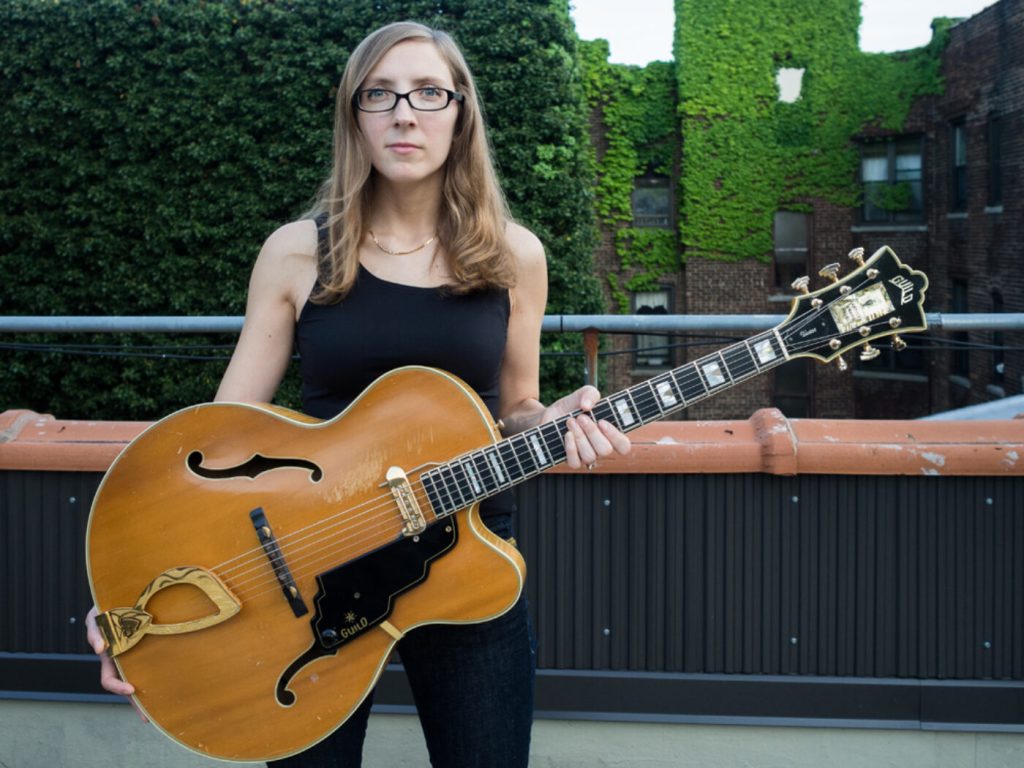
Mary Halvorson is one of the most distinctive voices in contemporary jazz guitar, known for her bold and innovative approach to the instrument. With a style that blends experimental techniques, unconventional harmonies, and a deep connection to jazz tradition, Halvorson has become a major force in pushing the boundaries of what is possible on the guitar. Her work has not only earned her widespread critical acclaim but also made her a key figure in the New York City avant-garde and jazz scenes.
In this article, we’ll dive into Halvorson’s musical background, her signature style, her influence on modern jazz, and the techniques that make her guitar playing so unique.

Early Life and Musical Journey
Born in 1980 in Brooklyn, New York, Mary Halvorson showed an early interest in music, particularly in classical piano. However, she switched to guitar during her teenage years, finding herself drawn to the instrument’s versatility and expressiveness. After high school, she attended Wesleyan University, where she studied under legendary jazz guitarist and composer, David “Tashi” Jermyn, and deepened her understanding of jazz theory and improvisation.
It was during her time at Wesleyan that Halvorson began to develop her voice as a guitarist, experimenting with free jazz, avant-garde, and experimental music. Following graduation, she quickly became involved in New York’s vibrant underground music scene, where she worked with avant-garde jazz figures like William Hooker and Jon Irabagon. By the early 2000s, she had already made her mark as a creative force in the jazz world.

Mary Halvorson’s Unique Musical Style
Halvorson’s music is often described as challenging, unconventional, and exciting. Her style combines elements of traditional jazz with modern experimental sounds, creating a sonic world that is both adventurous and accessible. Here are some key elements that define her playing:
1. Harmonic Complexity
One of Halvorson’s trademarks is her unconventional use of harmony. While she often draws from traditional jazz harmonic principles, she is not afraid to stretch or break them. She frequently employs dissonance, unusual chord voicings, and chromaticism to create unexpected harmonic tension. This harmonic approach allows her to build layers of complexity in her compositions, offering listeners an engaging and thought-provoking listening experience.
2. Unorthodox Guitar Techniques
Halvorson’s playing is characterized by a wide range of unorthodox guitar techniques. She often employs extended techniques, such as prepared guitar (where objects are placed on or inside the guitar to alter the sound), fingerpicking, and the use of effects pedals to manipulate her sound. These techniques allow her to produce a vast array of textures, from sharp, percussive sounds to ethereal, shimmering tones.
Halvorson is also known for her unconventional use of fingerboard positions, often using wide intervals and stretching her fingers across the neck in ways that create a unique voice for her solos. Her command of alternate tunings and her ability to create unusual chord voicings give her playing an unmistakable signature sound.
3. Rhythmic Innovation
Rhythm is a central aspect of Halvorson’s playing. Her ability to combine complex, syncopated rhythms with off-kilter phrasing gives her solos a distinctive momentum and drive. She frequently experiments with shifting meters and polyrhythmic structures, making her solos unpredictable and rhythmically exciting. This rhythmic flexibility allows her to create tension and release, keeping her performances fresh and engaging.
4. Non-Traditional Use of Effects
Halvorson is known for her creative use of effects, which contribute to the unique atmosphere of her music. She is a master at manipulating her guitar sound through pedals like delay, reverb, and distortion, using them to transform the tone and texture of her playing. This ability to shape her sound with effects allows her to achieve sonic landscapes that are often far removed from traditional jazz guitar sounds.
5. Complex Yet Accessible Melodies
Despite her avant-garde approach, Halvorson’s melodies are often unexpectedly lyrical. She has the ability to weave simple, memorable melodies into the midst of complex harmonic and rhythmic structures. Her improvisations, while highly technical, are often grounded in the sense of melody, making them accessible to listeners even when her compositions push the boundaries of traditional jazz.

Notable Albums
Mary Halvorson’s discography reflects her growth as an artist and her exploration of new sonic territories. Each album showcases her ability to reinvent jazz guitar, making her an important figure in contemporary music. Here are some standout albums in her career:
1. “Dragon’s Head” (2008)
Dragon’s Head is Halvorson’s debut album as a bandleader, and it immediately captures her bold approach to the guitar. The album features a mix of original compositions and improvisation, with Halvorson’s distinctive style evident throughout. The intricate melodies and harmonic experiments in tracks like “The Thicket” and “Dragon’s Head” set the tone for her future work.
2. “Bending Bridges” (2012)
Bending Bridges sees Halvorson pushing her compositional boundaries further, incorporating more complex harmonic structures and intricate arrangements. The album features a standout rhythm section with bassist John Hébert and drummer Ches Smith, which allows her to explore more adventurous territory. Tracks like “The Window” and “Bending Bridges” highlight her ability to balance complexity with accessibility, blending elements of free jazz, post-bop, and avant-garde.
3. “Meltframe” (2015)
In Meltframe, Halvorson collaborates with drummer Tomas Fujiwara, further developing her harmonic ideas and improvisational language. The album is both experimental and highly musical, exploring textures and rhythms in new ways. Tracks like “Chasing the Sun” and “Abacus” showcase Halvorson’s skill at creating atmospheric soundscapes and complex melodic lines, demonstrating why she is considered one of the most inventive guitarists of her generation.
4. “Code Girl” (2018)
Code Girl is a culmination of Halvorson’s work as both a composer and performer. The album features her band Code Girl, which includes some of the most exciting young musicians in jazz, such as Michael Formanek and Tomas Fujiwara. The album showcases her innovative approach to composition and improvisation, blending elements of rock, jazz, and experimental music. “Pussy’s In The Well” and “The Heat Of The Night” are standout tracks that highlight Halvorson’s rhythmic complexity and creative use of effects.
5. “Art of Time” (2020)
Art of Time is another bold step forward for Halvorson, with compositions that are deeply intricate yet full of heart. The album blends elements of avant-garde jazz with rich harmonic explorations, giving listeners a deeper understanding of her voice as a composer. Tracks like “The Map” and “Spindle” showcase her ability to balance complexity and emotional depth in her work.
Halvorson’s Influence and Legacy
Mary Halvorson has influenced a new generation of guitarists who are pushing the boundaries of jazz guitar. Her unique style, which incorporates elements of free jazz, post-bop, rock, and experimental music, has set her apart as one of the leading figures in modern jazz guitar.
Halvorson’s approach to the guitar—grounded in harmonic exploration, rhythmic innovation, and textural experimentation—has inspired countless musicians to rethink how they approach the instrument. She is highly regarded for her ability to bridge the gap between the avant-garde and more traditional forms of jazz, making her one of the most significant voices in contemporary jazz.
As both a performer and a composer, Halvorson continues to challenge the conventions of jazz guitar, creating work that is both deeply challenging and beautifully musical. Her willingness to experiment with sound and form has not only made her a standout in the jazz world but has solidified her place as one of the leading avant-garde guitarists of her generation.

Conclusion
Mary Halvorson is a guitarist who has redefined the role of the instrument in modern jazz. With her innovative use of harmony, rhythm, and extended techniques, she has created a distinctive and influential voice that continues to shape the evolution of jazz guitar. As both a soloist and collaborator, Halvorson has demonstrated time and again that she is not afraid to push the limits of her instrument, making her one of the most exciting figures in contemporary jazz.
 oscaronguitars.com
Leave a comment