
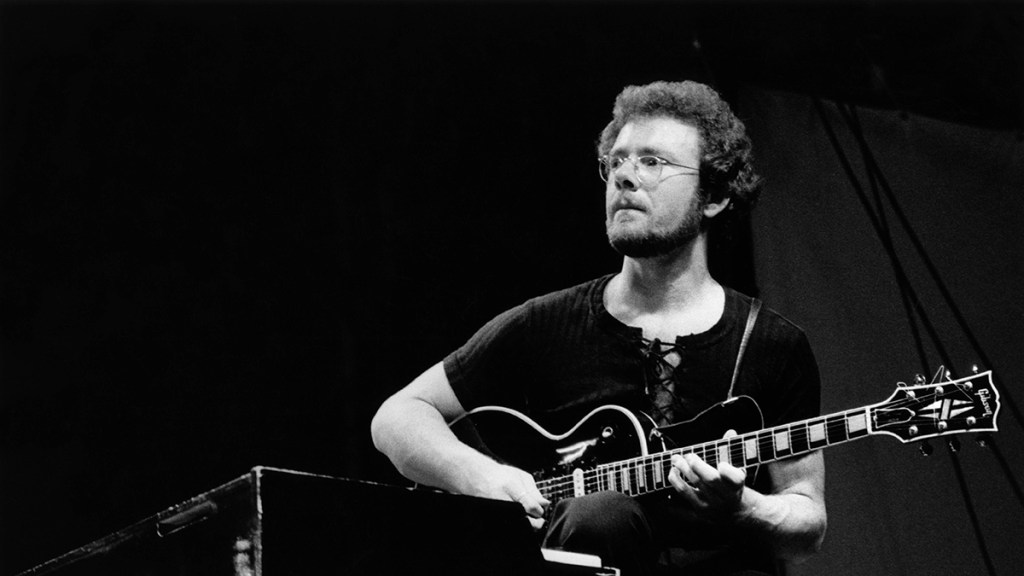
From Bournemouth to King Crimson’s Innovator
Born on May 16, 1946, in Wimborne Minster, Dorset, England, Robert Fripp is best known as the guitarist, founder, and continuous member of the progressive rock band King Crimson. Fripp’s complex compositions and innovative guitar techniques have significantly influenced the development of progressive rock and have established him as one of the genre’s leading figures.
King Crimson and the Evolution of Prog Rock
Since founding King Crimson in 1969, Fripp has been the creative force behind some of the most enduring and avant-garde music in rock. Albums like In the Court of the Crimson King and Red feature a blend of jazz, classical, and rock elements, showcasing Fripp’s unique approach to music that often involves intricate melodies, complex time signatures, and a deep integration of technology and theory.
Iconic Tracks: Defining the Sound of Innovation
Robert Fripp’s work with King Crimson has produced numerous tracks that highlight his skill and innovation:
- “21st Century Schizoid Man” – Features Fripp’s abrasive guitar tones and challenging musical structure, making it a landmark in progressive rock.
- “Red” – This track exemplifies Fripp’s mastery of mixing heavy riffs with minimalistic, yet powerful, melodic lines.
- “Starless” – A composition that combines soft, melodic sections with powerful crescendos, reflecting Fripp’s ability to balance tension and release.
- “Fracture” – Known for its complexity, this track highlights Fripp’s use of intricate picking techniques and non-standard tunings.
Gear and Technique: The Fripp Sound
Robert Fripp is noted for his disciplined approach to the guitar. He frequently uses custom-built guitars, including his signature “Fripp Model” by Fernandes, which is designed to accommodate his New Standard Tuning (NST) that he developed to facilitate complex chord structures and polyphonic textures. Fripp’s use of guitar synthesizers and digital effects, as part of his Frippertronics and soundscapes, illustrates his pioneering use of technology in music.
Influence and Impact
Robert Fripp’s contributions to music go beyond his technical skill; his theoretical innovations, such as the development of New Standard Tuning and his concepts of soundscapes, have left a lasting mark on contemporary music. His influence can be seen in the work of many guitarists and bands across various genres, from progressive rock to ambient music.
Conclusion: The Lasting Legacy of Robert Fripp
Robert Fripp remains a seminal figure in the world of music, revered not only for his groundbreaking contributions to progressive rock but also for his explorations into the intersections of music, technology, and theory. His work continues to inspire and challenge musicians and listeners alike, cementing his status as one of the most innovative guitarists and composers in the history of rock music.
Bonus Track: 10 Facts About Robert Fripp
- Early Career: Played with various bands before forming King Crimson, including Giles, Giles and Fripp.
- Music Education: Studied guitar with Don Strike and later with various other teachers to refine his craft.
- Discipline and Philosophy: Known for his disciplined lifestyle and interest in the teachings of Gurdjieff, which influence his approach to music and performance.
- Collaborations: Worked with artists like David Bowie, Brian Eno, and Peter Gabriel, contributing to some of their most critically acclaimed works.
- Soundscapes: Developed a technique for solo performance that involves live looping and electronic effects to create rich, layered sounds.
- Guitar Craft: Founded Guitar Craft in 1985, a series of workshops aiming to teach his approach to guitar and personal discipline.
- Musical Innovations: Continues to experiment with musical forms, including the development of complex tuning systems.
- King Crimson Reformation: Has reformed King Crimson several times, each iteration introducing new elements and musicians.
- Solo Projects: Released several solo albums that explore different aspects of his musical interests, from classical compositions to experimental soundscapes.
- Legacy and Influence: Continues to be an influential figure in music, cited by countless musicians for his innovative techniques and philosophical approach to art.
 oscaronguitars.com
Leave a comment