
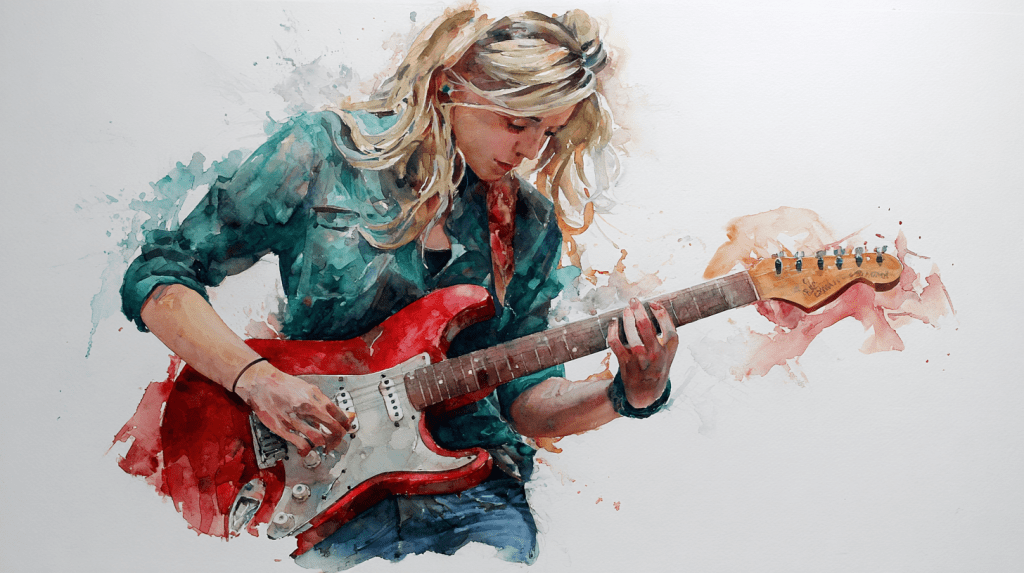
(No scales. No theory. Just pure hand skill.)
If you’ve been playing guitar for a while and can jam through songs but still feel your hands holding you back—this one’s for you. You don’t need more scales or harmony lessons right now. What you need is control. Smoothness. Precision. Speed that feels effortless, not forced.
This is the routine I’d give my best friend if they told me, “Man, I just want my hands to do exactly what I hear in my head.”
Step 0: Chill First (3 minutes)
Before touching the strings, take a deep breath—literally.
Sit with the guitar on your lap. Inhale for four counts, exhale for six. Do that five or six times. It tells your body, “Hey, we’re safe. Relax.” Because tension is the real enemy of dexterity.
Then gently shake out your hands, rotate your wrists, stretch your fingers a bit. You’re not warming up muscles, you’re waking up your coordination.
Quick tip: Notice your shoulders. If they’re creeping up toward your ears, drop them and breathe again. Loose shoulders = loose playing.
Step 1: Sync the Hands (8 minutes)
We’ll start with the most important thing: making your two hands work like one brain.
Pick a single string. Play four frets in a row—say, 5–6–7–8—and then back down. Use alternate picking (down-up-down-up). Go slow enough that each note clicks perfectly with your pick.
Listen carefully. If you hear a tiny flam—like the note and the pick are slightly out of sync—slow down until it’s dead-on. That’s where improvement happens.
Once it’s clean, turn up your metronome by 4 BPM. Think of it like weightlifting: perfect reps build real strength; messy reps just teach bad habits.
Step 2: Conquer String Crossing (10 minutes)
Ever notice how most mistakes happen when changing strings? That’s where good picking falls apart.
Try this on the D and G strings:
D|--5---6---|
G|----5---6-|
Play forward and back, focusing on keeping your pick movements tiny. You’ll notice two feelings:
- Inside picking: when the pick moves between the strings.
- Outside picking: when it moves away from them.
Work both directions—they feel different, and you want both under control.
After that, go across three strings with a little mini pattern like:
G|--5---6---7--|
B|----5---6---7|
e|------5---6--|
This one builds flow and endurance. Aim for zero extra string noise; if you hear a buzz, you’re probably digging in too deep.
Step 3: Learn to Shift Smoothly (6 minutes)
Position changes trip up a ton of players because we tend to “jump” instead of glide.
Try this: on any string, play 5–7–9, then slide up to 12–14–16. Keep one finger (your index or middle) as your “guide” on the string the whole way—like it’s tracing a rail.
If it squeaks, you’re pressing too hard. Lighten up. The idea is to move through the shift, not fight it.
Then practice random leaps: play a note on one string, then jump to another string far away. No repeating patterns. Train your eyes to look ahead before you move.
Step 4: Build Your Picking Engine (10 minutes)
Let’s talk speed. Not sloppy speed—controlled speed.
There are two parts: bursts and cruises.
Bursts: Pick one note and, after a short pause, fire off a quick burst—like a machine gun for one beat. Then stop. Reset your posture. Do it again. You’re teaching your brain how “fast” feels without tiring out your hand.
Cruises: Now pick continuously for two minutes straight at a tempo that feels easy but stable. The trick? The motion should come from your wrist, not your arm. If your forearm is burning, you’re gripping too hard or using too much motion.
Over time, you’ll find your “cruise speed” creeping higher—and it’ll feel way easier.
Step 5: Legato That Actually Sings (8 minutes)
Legato isn’t about hammering harder; it’s about control and consistency.
Try this on one string:
5h7p5h8p5h9p5...
(h = hammer-on, p = pull-off)
Drop your fingers from the knuckle—not by slapping. Keep them close to the string; the smaller the movement, the cleaner the sound.
Then do it across strings—pick the first note only, and let your fretting hand do the rest. Mute unused strings lightly with your picking hand. Your tone should stay smooth, not uneven or percussive.
If you can make the legato notes as loud as picked notes, congratulations—you’ve just joined the big leagues.
Step 6: Bends & Vibrato (6 minutes)
Dexterity isn’t just speed—it’s control down to the millimeter.
Grab a tuner and practice bending from the 6th fret to match the pitch of the 8th. Watch the tuner needle. When it’s in the center, hold it. That’s your goal. After a few tries, ditch the tuner and do it by ear.
Then work on timed vibrato—set a metronome at 60 BPM and pulse your vibrato in time: 8th notes, quarter notes, triplets. Smooth, even, relaxed. Your vibrato should breathe, not shake.
Step 7: Endurance & Cooldown (6 minutes)
Pick the two drills that gave you the most trouble today. Play them slowly and with perfect form for a couple of minutes each. That’s how your body memorizes good movement.
Then strum open strings gently while taking long exhales. Shake your hands out, stretch your forearms, and smile—you’ve just trained smarter than 90% of players online.
How to Track Progress (and Stay Motivated)
Keep a tiny notebook. Each day, jot down your metronome speeds for:
- One-string picking
- Cross-string drills
- Cruise tempo
- Cleanest legato speed
If you improved by even 3 BPM or got one drill cleaner—win. Don’t chase big jumps; chase consistency. That’s how pros are built.
And don’t forget rest: take two light days each week where you cut the time in half. Your muscles and nervous system need recovery to lock in what you practiced.
What “Advanced” Feels Like
You’ll know you’re getting there when:
- You can play 16th notes around 140 BPM for a full minute—clean.
- You can cross three strings without stray noise.
- You can sustain two minutes of alternate picking without feeling tense.
- Your bends land dead in tune on the first try.
- Your vibrato actually feels like singing, not shaking.
When those boxes start checking themselves, you’re in advanced territory—and you didn’t even touch a scale.
The Big Takeaway
Dexterity isn’t about grinding until your hands hurt—it’s about teaching your body how to relax under precision.
Take it slow, stay mindful, record yourself often, and trust that every clean repetition is money in the bank.
In two months, you’ll pick up your guitar and realize your fingers are finally doing what you always wanted them to. That’s the magic of a world-class routine done with heart and patience.
 oscaronguitars.com
Leave a comment