
There’s something quietly subversive about the Fender Duo-Sonic.
It wasn’t supposed to matter this much. When it arrived in 1956, it was conceived as a practical solution—a compact, affordable instrument designed to help beginners get started before eventually moving on to a Stratocaster or Telecaster. Smaller body, shorter scale, simple electronics. In Fender’s own logic, it was a starting point, not a destination.
And yet, over time, the Duo-Sonic refused to stay small.
It slipped into studios, onto stages, and into the hands of musicians who weren’t interested in following the expected path. It became one of those rare instruments whose supposed limitations turned into defining strengths. What began as a “student model” ended up shaping sounds, scenes, and entire approaches to guitar playing.
This is how that happened.
The Mid-’50s: Fender Builds a Ladder
To understand the Duo-Sonic, you have to start with a business idea.
By the mid-1950s, Fender had already changed the electric guitar forever. The Telecaster and Stratocaster were established, professional-grade tools, but they weren’t exactly accessible to beginners—especially teenagers caught up in the first wave of rock and roll.
Don Randall, Fender’s sales chief, saw the opportunity clearly. His idea was to create a “step-up” system: a range of instruments that would allow a player to start small and grow within the Fender ecosystem. It was both smart business and perfect timing. After “Rock Around the Clock” hit in 1955, demand for guitars exploded.
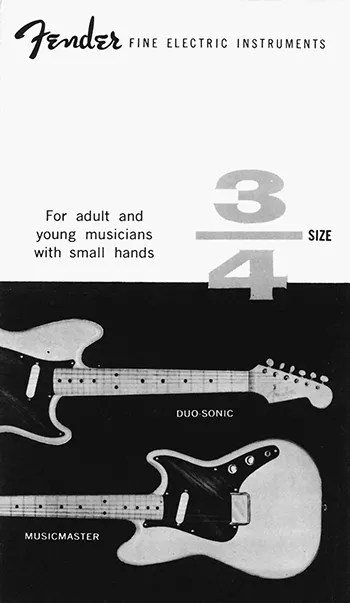
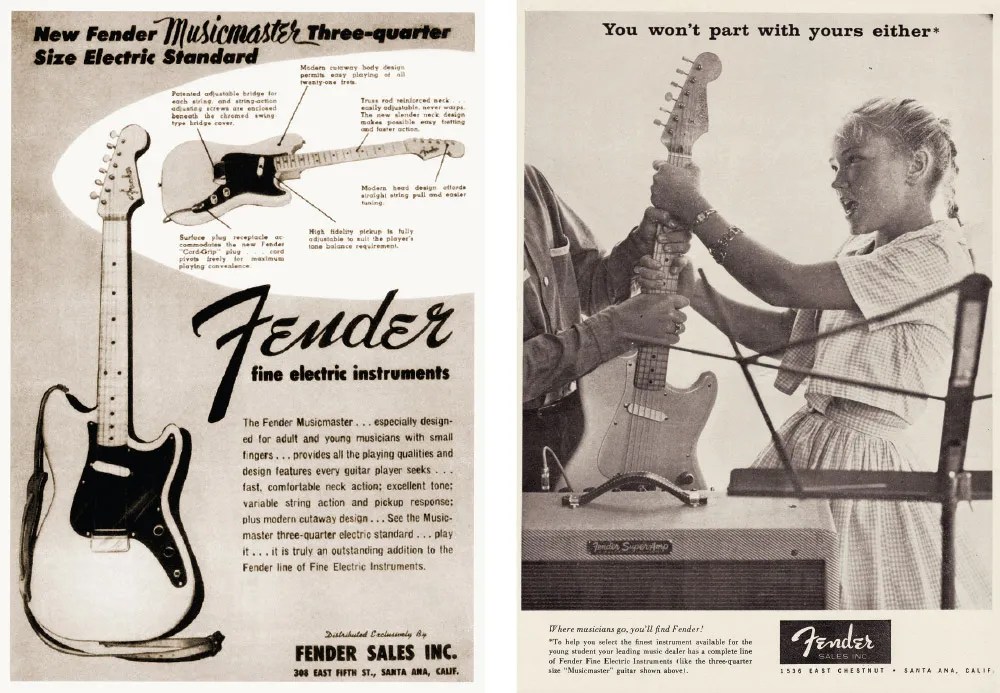
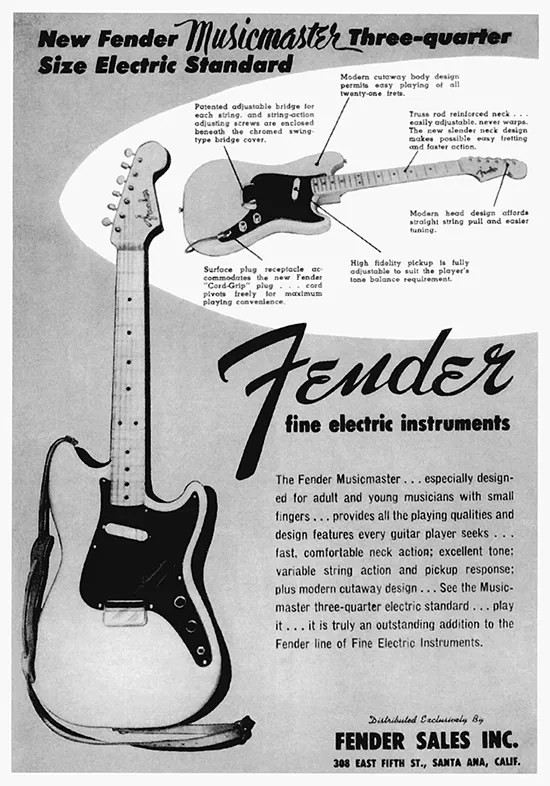
Leo Fender responded in the most direct way possible. In 1956, the company introduced two new models: the Musicmaster and, shortly after, the Duo-Sonic.
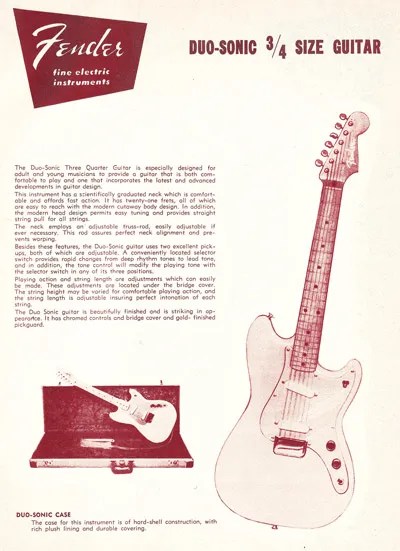
The Duo-Sonic was the more complete version. Where the Musicmaster had a single pickup, the Duo-Sonic offered two, along with a selector switch that gave players more tonal options. It looked and felt like a real Fender, just scaled down.
And that scale is the key to everything.
At 22.5 inches, it was noticeably shorter than Fender’s standard 25.5-inch scale. That change alone altered the entire playing experience. The strings felt softer, bends came easier, and the response was looser and more elastic. It wasn’t just smaller—it behaved differently.
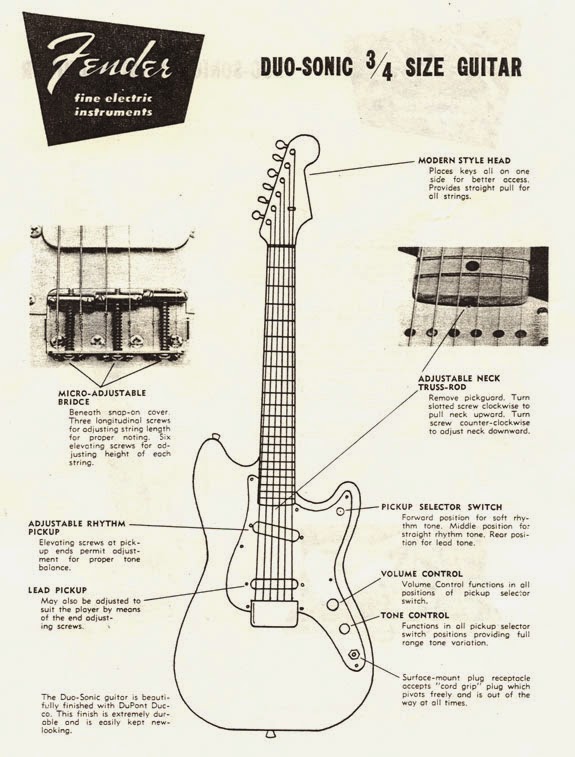
What’s important is that Fender didn’t cut corners. The Duo-Sonic was built with the same materials and philosophy as its larger siblings. Ash and alder bodies, bolt-on maple necks, solid hardware. This wasn’t a toy. It was a serious instrument with a different purpose.
Desert Sand and Gold: A Subtle Identity
The earliest Duo-Sonics have a very particular charm.
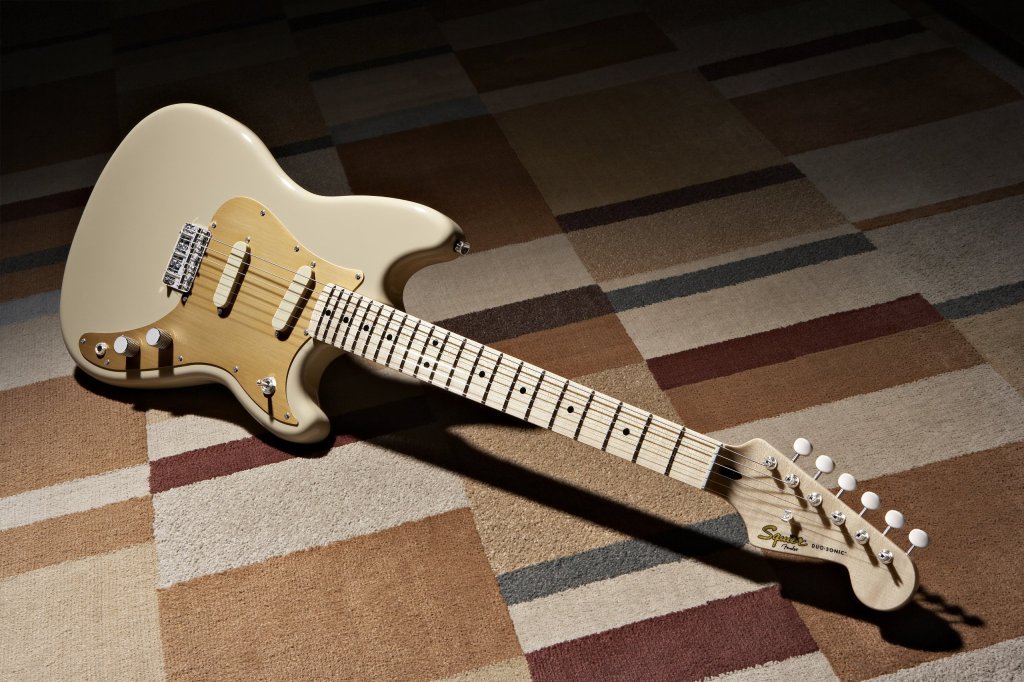
They came finished in Desert Sand—a pale, understated beige that set them apart from the flashier guitars of the era. The anodized gold aluminum pickguard added just enough contrast to give the instrument a distinctive presence without making it loud.
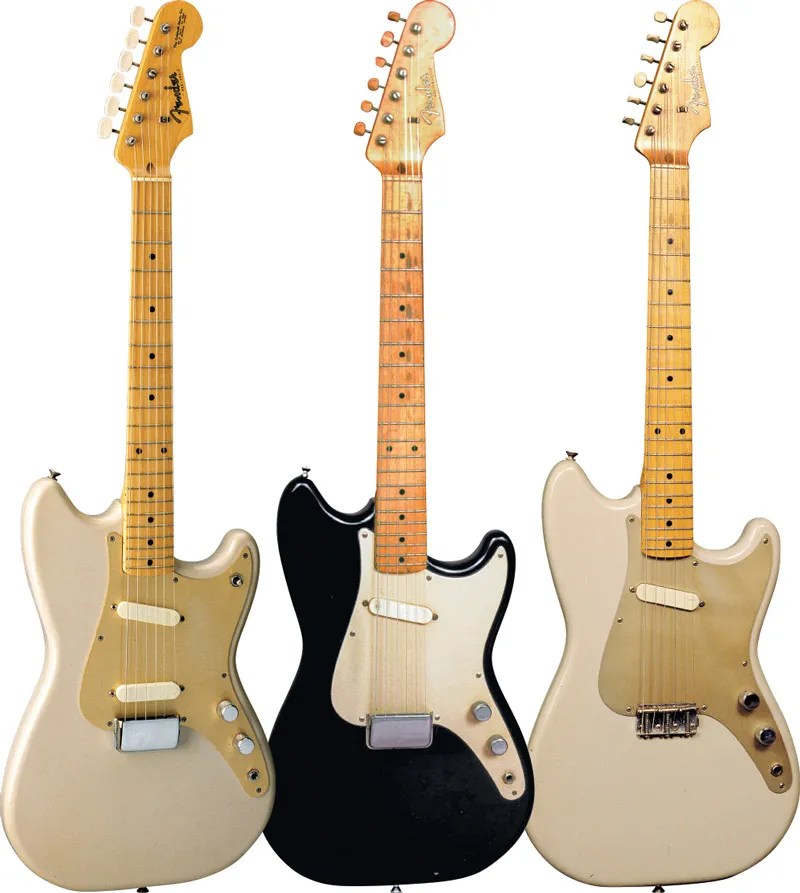
Everything about it felt restrained and functional.
Underneath that simplicity, though, was a sound that didn’t quite match anything else in Fender’s lineup. The short scale softened the attack and slightly thickened the low end. Notes had a different bloom, and the overall feel encouraged a more relaxed, expressive style of playing.
At the time, none of this was the selling point. The selling point was accessibility. But those subtle differences would later become the entire reason the Duo-Sonic endured.
1959–1963: Refinement Without Losing Its Character
As the 1950s gave way to the 1960s, Fender refined the Duo-Sonic without trying to reinvent it.
In 1959, rosewood fingerboards were introduced, aligning the model with broader changes across Fender’s lineup. Around the same time, the gold anodized pickguard gave way to plastic, and new finishes—most notably sunburst—entered the picture.
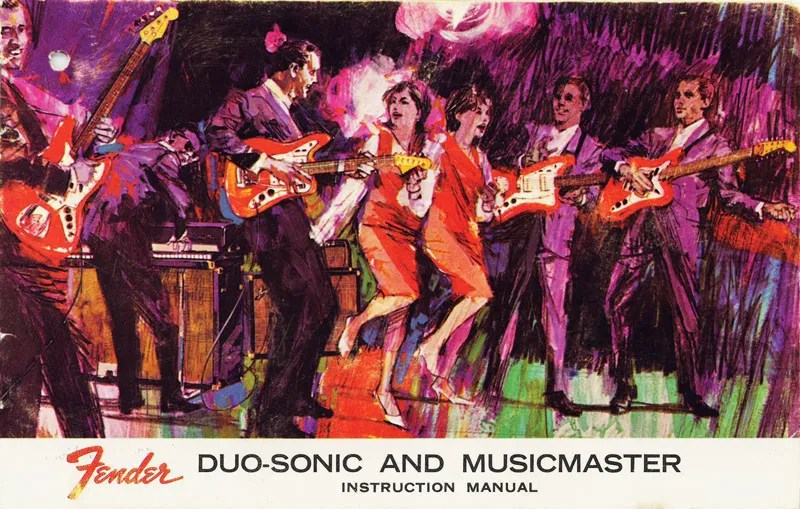
These updates made the guitar feel more contemporary, but they didn’t change its essence. It remained compact, simple, and unmistakably different under the fingers.
This period is often seen as a sweet spot. The instruments still reflect the precision and care of the pre-CBS era, and they represent the final stage of Leo Fender’s original vision before the company’s direction began to shift.
It’s also around this time that the Duo-Sonic quietly intersects with history. A young Jimi Hendrix, still years away from redefining the Stratocaster, played a late-’50s Duo-Sonic while working as a sideman. It’s a small moment, but it foreshadows the guitar’s strange trajectory—from beginner tool to professional instrument.
1964: The Mustang Overshadows Its Sibling
In 1964, Fender introduced the Mustang, and the balance changed almost overnight.
The Mustang was, in essence, an evolution of the Duo-Sonic concept. It added a vibrato system and adopted a new offset body design that felt more modern and visually aligned with Fender’s experimental models.
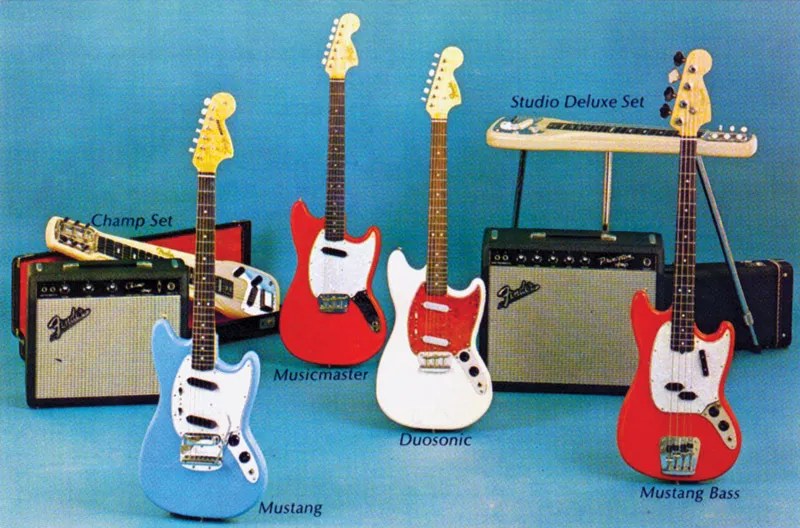
To keep things consistent, Fender redesigned the Duo-Sonic as well. The Duo-Sonic II adopted the offset body, introduced slider switches, and—importantly—offered a longer 24-inch scale alongside the original short scale.
It should have been a fresh start. Instead, it created competition.
The Mustang quickly became the more desirable instrument. It did everything the Duo-Sonic did, but added vibrato and a more contemporary feel. Players gravitated toward it, and the Duo-Sonic gradually faded into the background.
By 1969, it was discontinued.
Afterlife: The Guitar That Found the Right Hands
This is where the Duo-Sonic stops following the script.
After its discontinuation, it didn’t disappear—it drifted into a different kind of relevance. It became the guitar you found in pawn shops, rehearsal rooms, and secondhand stores. Affordable, reliable, and slightly overlooked.
And that made it perfect.
Jimi Hendrix had already passed through it early in his career. Later, players like David Byrne used it to shape the sharp, nervous textures of early Talking Heads records. Rory Gallagher, Liz Phair, and a range of alternative and indie musicians gravitated toward it for similar reasons.
The short scale changed the feel in a way that encouraged a different approach to playing. The simplicity made it dependable. And the tone—slightly off-center from classic Fender brightness—fit perfectly in mixes that needed character rather than polish.
By the time indie and alternative scenes embraced it in the ’80s and ’90s, the Duo-Sonic had become something else entirely: a quiet outsider with credibility.
The Squier Era: When the Duo-Sonic Became Accessible Again
If the Duo-Sonic survived through the ’70s and ’80s thanks to underground credibility, it was the Squier era that brought it back into broader circulation.
Fender’s first attempt at revival came in the 1990s with Mexican-made Duo-Sonics, but these were relatively modest reissues—useful, but not especially faithful to the originals.
The real turning point came through Squier.
In 1998, a short-lived Squier Affinity Duo-Sonic appeared, keeping the name alive at the entry level. It didn’t leave a major legacy, but it signaled something important: the Duo-Sonic still had a place in Fender’s ecosystem.
That idea fully matured a decade later.
The Squier Classic Vibe ’50s Duo-Sonic (2008–2011) is arguably one of the most important modern chapters in the guitar’s history. It wasn’t just a budget instrument—it was a thoughtful reinterpretation.
Visually, it went straight back to 1956:
- Desert Sand finish
- Gold anodized-style pickguard
- Maple neck
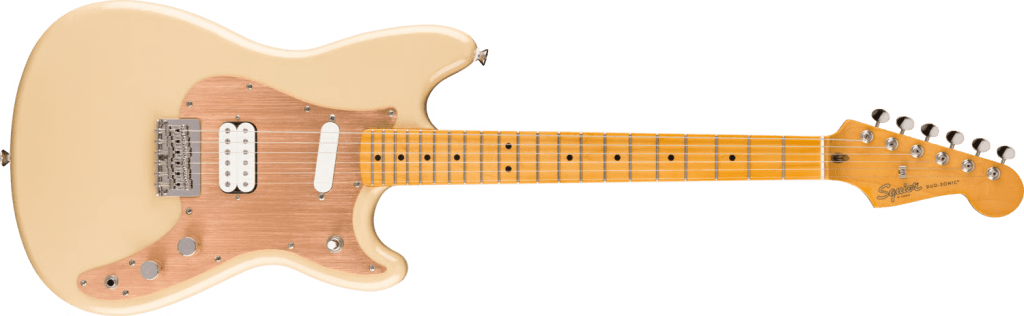
But under the surface, it made a crucial adjustment: a 24-inch scale instead of the original 22.5. That single decision made the guitar far more accessible to modern players without losing its identity.
The result was a guitar that felt vintage, but playable. Familiar, but distinct.
For many players, this was the first time the Duo-Sonic made sense—not as a curiosity, but as a genuinely usable instrument. Today, those Classic Vibe models are still sought after because they strike that balance so well.
What Squier did, perhaps unintentionally, was reframe the Duo-Sonic. It stopped being just a historical artifact and became a viable option again.
2016 to Today: A Small Guitar With a Clear Identity
When Fender reintroduced the Duo-Sonic in 2016 as part of its Offset Series, the narrative had shifted completely.
This was no longer a student guitar. It was positioned as a compact, character-driven alternative within the Fender lineup.
Modern versions feature a 24-inch scale, comfortable modern neck profiles, and configurations that range from traditional dual single-coils to HS setups with a bridge humbucker and coil-splitting capability.
What’s striking is how little the core idea has changed.
The Duo-Sonic is still simple. Still direct. Still defined more by feel than by features.
The difference is that now, it’s understood.
Why the Duo-Sonic Still Matters
If Fender had given the Duo-Sonic a full 25.5-inch scale from the beginning, it might have become a mainstream classic alongside the Telecaster and Stratocaster. But it didn’t—and that’s exactly why it matters.
The shorter scale gives it a different voice. The lower string tension changes the way the guitar responds, both physically and tonally. There’s a looseness, a slight thickness, a character that doesn’t try to replicate anything else.
For some players, it’s about comfort. For others, it’s about tone. For many, it’s about finding an instrument that doesn’t feel predictable.
And for collectors, it remains one of the most accessible ways to experience genuine vintage Fender DNA without entering the price range of a Strat or Tele from the same era.
Final Thoughts
The Fender Duo-Sonic was designed to be a beginning.
Instead, it became something much more interesting: a small guitar that refused to stay small.
It never competed directly with Fender’s flagship models, and it never needed to. It carved out its own space—quietly, steadily, and without trying to prove anything.
That’s the paradox at the heart of the Duo-Sonic.
It was built to lead players somewhere else.
And yet, for many, it turned out to be exactly where they wanted to stay.
 oscaronguitars.com
Leave a comment