
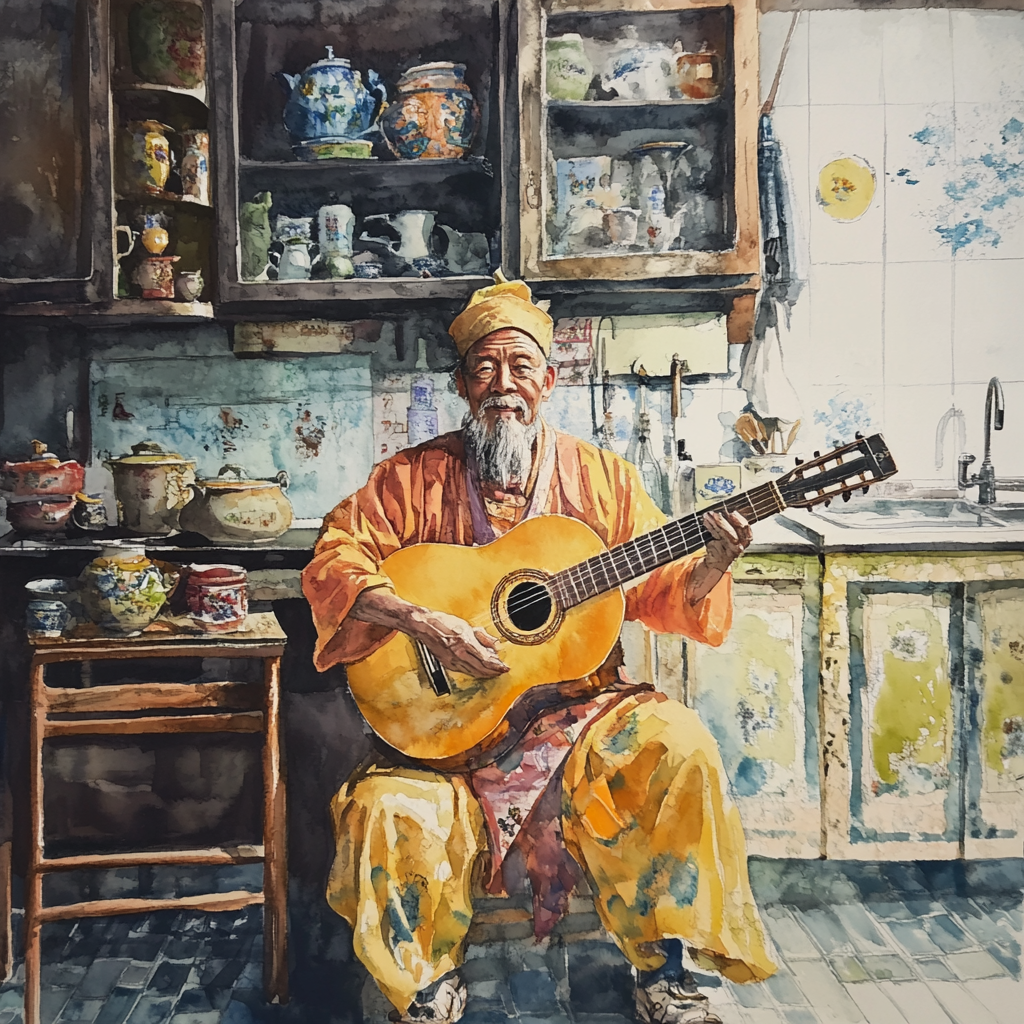
Prince Wan Hui’s Cook
Prince Wan Hui’s cook was expertly butchering an ox. He extended his hand, lowered his shoulder, positioned his foot, and leaned in with his knee. The ox was skillfully dismantled. With a whisper, the shining butcher knife murmured like a gentle breeze—rhythm and precision melding into a dance as sacred and harmonious as ancient rituals.
“Excellent work!” Prince Wan Hui exclaimed. “Your technique is flawless!”
“Technique?” the cook replied, setting aside his blade. “What I practice is the Tao, which transcends all techniques! When I first began butchering oxen, I perceived only a massive, undifferentiated whole. After three years, I began to discern its distinct parts. But now, I see not with my eyes but with my entire being. My senses rest while my spirit, unshackled by any rigid plan, follows its instincts along natural paths. Through the unseen openings and hidden spaces, my blade doesn’t force a path—it finds its way. I never sever joints or bones.
A proficient cook requires a new blade only once a year because it cuts precisely. A less skilled cook, who mutilates the meat, needs a new one each month. I have used this same blade for nineteen years, and it has butchered a thousand oxen. Yet, it still cuts as if newly sharpened. The blade is thin and sharp, finding its way into the spaces between joints—there’s ample room for it to pass through like a breeze. That’s why, even after nineteen years, it remains as sharp as ever!
Indeed, sometimes I encounter tough joints. I sense them approaching and pause. I watch carefully, hold back, barely move the blade, and—whump!—the part falls away, dropping like a clod of earth. Then, I remove the blade, stand still, and let the joy of the work fill me. I clean the blade and put it away.”
Prince Wen Hui reflected, “That’s it! My cook has shown me how I should live my own life!”
The Effortless Mastery of Prince Wen Hui’s Chef.
As Prince Wen Hui watched his chef skillfully butcher an ox, a masterful display unfolded, reminiscent of a sacred dance. The chef, through simple and deliberate movements, disassembled the ox, his knife whispering through the air like a gentle breeze. His method, transcending conventional technique, embraced the Tao—teaching us the beauty of flowing with the natural rhythm of life and work.
From Butchery to Music: Lessons in Effortlessness
The chef’s technique is a metaphor for guitar playing. Initially, the chef saw the ox as a single mass; similarly, beginners in music might see their instrument as just a tool. Over time, just as the chef began to see the distinctions in the ox, a guitarist begins to understand the nuances of music and their instrument. Eventually, the chef reaches a state where he no longer relies on sight but on an innate understanding, suggesting that a musician, too, can transcend technical skills to reach a deeper, intuitive connection with music.
The Path of Least Resistance
The chef’s method of not cutting through bones but finding the spaces between joints speaks to finding the path of least resistance. This principle can be applied to guitar playing—instead of forcing one’s way through a musical piece, finding the flow that allows the music to come forth effortlessly. When encountering difficult passages, like the chef’s hard joints, the musician learns to pause, assess, and proceed with gentle precision.
Sustainability in Craft
A noteworthy aspect of the chef’s story is his knife, which has lasted nineteen years due to his meticulous care and technique. This parallels the importance of maintaining one’s musical instruments and skills. Just as the chef does not need new knives, a guitarist does not need the latest equipment to produce beautiful music. What matters more is the skill, care, and connection with the instrument.
Contemplation and Reflection
After his work, the chef cleans his knife and reflects on the joy of his craft, a practice that musicians can emulate. It is vital to reflect on one’s performance and approach to continuously evolve and maintain a joyful engagement with the craft. This reflection is not about harsh self-criticism but about understanding and appreciating the journey of musical growth.
Conclusion: Living Music as a Transcendent Act
Prince Wen Hui’s realization that he should live as his chef works reminds us that music, too, should be approached as a transcendent act. For guitarists, this story teaches the importance of integrating mindfulness, respect, and a natural flow in their practice. By embracing these principles, musicians not only improve technically but also deepen their connection to their art, making every note and silence a part of a larger, harmonious dance with the universe.

 oscaronguitars.com
Leave a reply to Harmony in Craft: The Spiritual Journey of Mastery in Woodcarving and Music – OscarOnGuitars.com Cancel reply