

Important Note: This article is a bit longer than usual, but I’ve kept it intact to preserve the flow. I hope the extra length brings you valuable insights and techniques for your practice. If you’re short on time, you can check out the 5-minute version for a quick overview.
Have you ever wondered if something as intangible as energy could actually impact your guitar playing? As guitarists, we’re used to focusing on scales, riffs, and tone, so the idea of something like ‘chi‘ affecting our performance might seem far-fetched, and you’re probably thinking, “Chi? Seriously? That sounds like some mystical, eastern mumbo-jumbo.” But hear me out: there’s actually a practical side to this that could make a real difference.
Chi is about tapping into your inner energy to boost focus, relaxation, and emotional connection with your music. It’s not a shortcut or a substitute for practice but an enhancement that elevates your creativity, expression, and performance. By channeling this flow, your playing becomes more intentional and deeply connected, transforming your music into a more meaningful experience. And while it may sound mystical, there’s real science behind it—far beyond mere myth or speculation.
I. Understanding Chi
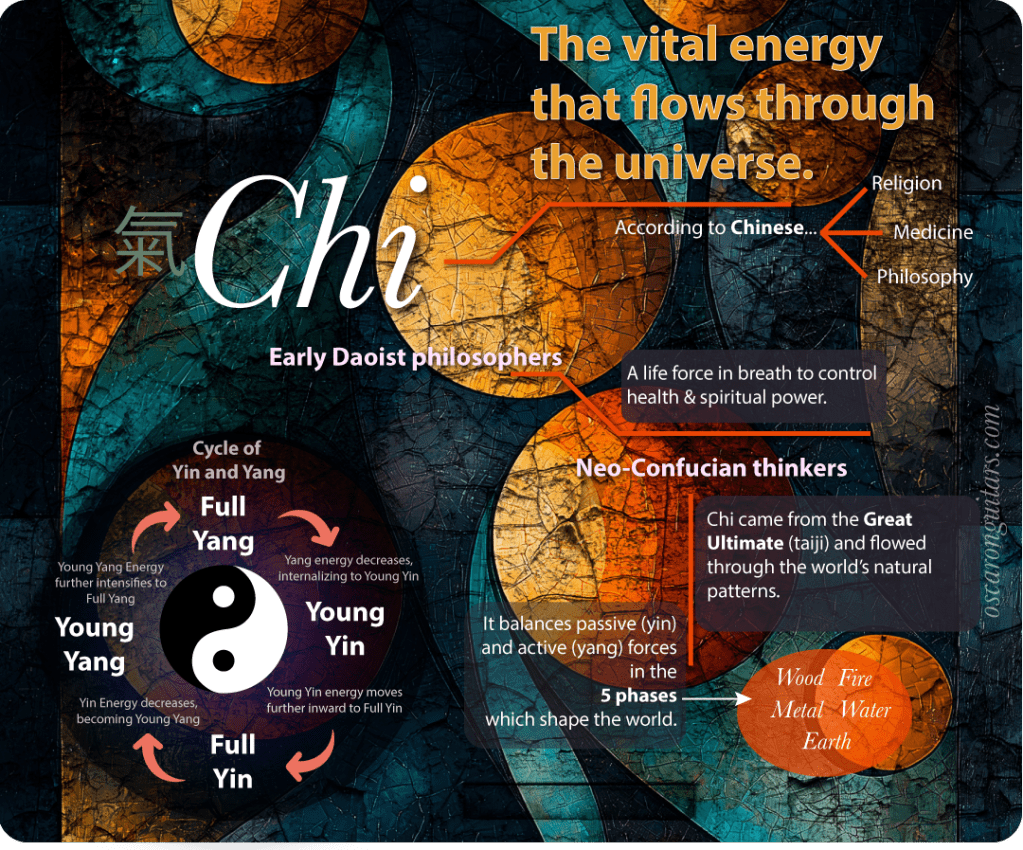
Chi (or “qi”) is the vital energy that flows through the universe, according to Chinese philosophy, medicine, and religion. Early Daoist philosophers saw it as a life force in breath and body fluids, developing ways to control it for health and spiritual power. Later, Neo-Confucian thinkers believed chi came from the Great Ultimate (taiji) and flowed through the world’s natural patterns. It balances active (yang) and passive (yin) forces and is connected to the Five Phases (wood, metal, earth, water, fire), which shape the world. (Britannica, 2024)
The concept of chi is connected to mindfulness, which has been shown to reduce stress, improve focus, and enhance fine motor skills—all crucial for musicians. Studies like those by Cole (2018) and Day (2022) highlight how meditation and mindfulness techniques can boost musical performance by unlocking subtle mental states, helping musicians play with greater intention and emotional depth.
Chi, as traditionally understood is the life energy that flows through us, influences everything we do. Guitar playing isn’t just physical; it’s emotional and spiritual too.
So, while you’re perfecting your technique, why not explore this energy flow? It could open up new levels of creativity and authenticity, making your playing feel more connected and powerful.
Takeaways:
- Mindfulness and Music: Practicing mindfulness reduces stress, improves focus, and enhances motor skills, elevating musical performance.
- Emotional Connection: Life energy connects physical, emotional, and spiritual aspects of guitar playing.
- Practical Creativity: Exploring chi-inspired techniques complements technical practice, unlocking creativity and expression.
Reflect: What techniques have you found help unlock your creativity?
Your Turn: How do you connect with your energy and emotions through your guitar playing?

II. Prepare to Liberate and Concentrate Your Chi
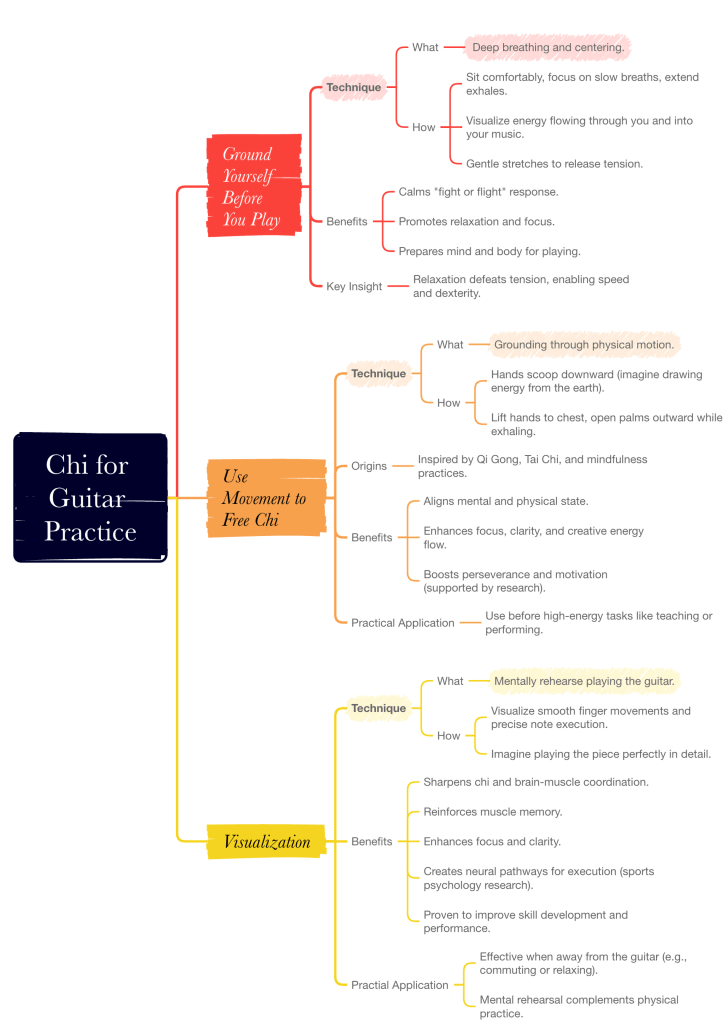
Building on the concept of chi, the next step is actively directing this energy in your practice. By grounding, using movement, and visualizing your music, you can enhance focus, creativity, and emotional depth in your playing.
Just as you stretch your fingers and warm up your hands before playing—something we all need to do to avoid injury—incorporate these three steps to properly prepare for your practice session:
1. Ground Yourself Before You Play
Take two minutes to breathe deeply and center yourself. Sit comfortably with your guitar, close your eyes, and focus on your breath. Inhale slowly, then exhale a little longer. Whenever I feel overwhelmed, I take deep breaths because my body tends to go into “fight or flight” mode. To calm my mind, I focus on slow breathing, with extended exhales, signaling to myself that “everything is okay; relaxation is safe.” This helps me settle down and regain focus. Not only does this practice calm me, but it also grounds me in the present moment, enhancing my concentration while playing. Afterward, I like to add gentle stretches to release any lingering tension.
Many guitarists dream of playing fast, like shredders, or at least mastering the mesmerizing dexterity of their guitar heroes. But what’s the arch-nemesis of speed and fluidity? Tension. And what’s the key to defeating tension and unlocking speed and dexterity? Relaxation. Learning to stay relaxed while playing is far more important than it might seem at first glance.
2. Use Movement to Free Chi
Having relaxed before playing, you now require energy. Imagine drawing energy from the earth: lower your hands as if scooping dirt, then lift them toward your chest and open your palms outward as you exhale. Repeat this motion a few times, visualizing energy flowing from the ground to your chest. This simple grounding technique helps center and focus your energy before playing.
Practices like Qi Gong, Tai Chi, and mindfulness meditation, which use the body to channel and visualize energy, are the origin of grounding, also known as “energy centering.” Imagine drawing energy from the earth into your body, which aligns your mental and physical state and enhances focus and clarity.
This technique boosts the flow of creative energy during performance. Research has shown that experiencing this flow during creative tasks improves affect and motivation, ultimately fostering perseverance (Cseh et al., 2013).
I always practice this “energy centering” exercise before anything where I need to bring high energy—whether it’s lecturing, teaching, or, yes, playing guitar. I always rely on it to help me focus and perform at my best.
3. Visualization
Before diving into a challenging piece with your guitar, take a moment to visualize the music. Picture your fingers gliding smoothly across the fretboard, effortlessly playing each note with precision. Envision the piece in every detail; imagine yourself playing it perfectly. This mental exercise sharpens your chi, improving both your focus and clarity. But beyond the spiritual benefits, visualization also has a practical impact: it strengthens your brain-muscle coordination. Your hands cannot execute a passage if your brain hasn’t already mapped it out and understood it.
Research in sports psychology has shown that visualization is important for skill development (Fonseca, 2024), as it creates neural pathways that prepare the body for physical execution (Prajapati & Das, 2023). By mentally rehearsing a piece, you reinforce muscle memory and enhance your ability to perform it flawlessly. Indeed, this is the scientific basis for channeling chi through visualization.
In my experience, visualization exercises are incredibly effective for practicing guitar when my instrument isn’t nearby—whether I’m commuting, relaxing in the park, or simply taking a break. By the time I return to my guitar, everything seems to fall into place. It’s not magic—it’s science. This kind of mental rehearsal, often referred to as “simulation” (Landriscina, 2013), is a proven technique that enhances performance across various areas, from public speaking to sports, and yes, even playing guitar.
Takeaways:
- Ground Yourself: Use deep breathing and mindfulness to calm your mind before playing guitar.
- Channel Energy: Incorporate movement exercises to align mental and physical energy.
- Visualize Your Music: Mental rehearsal sharpens brain-muscle coordination. Visualization allows effective practice even without your guitar.
Reflect: Have you ever visualized playing guitar? What impact has mental practice had on your skills?
Your Turn: What techniques do you use to connect with your body and mind during guitar practice?
III. Improvise with Intention: Make the Music Your Own
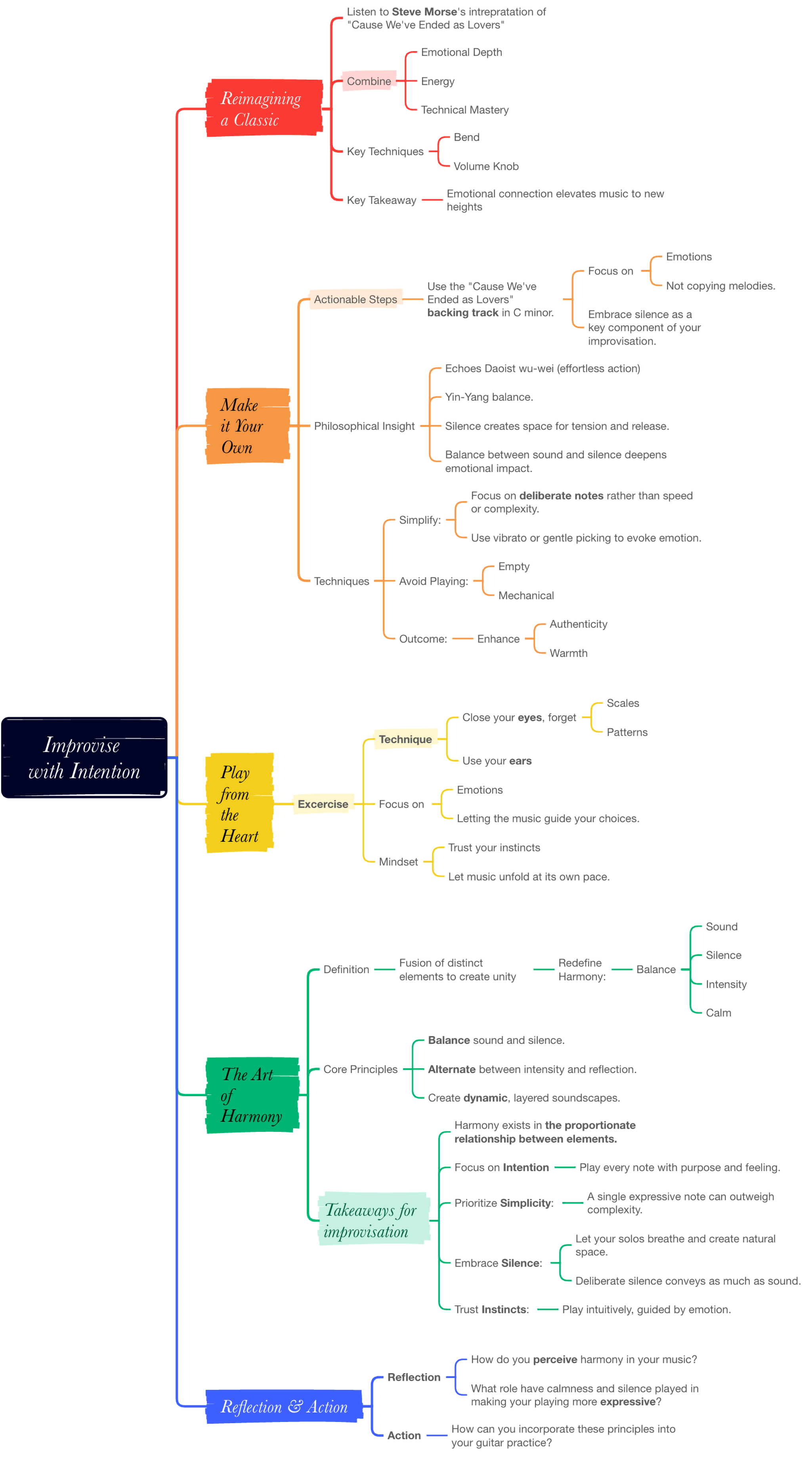
Building on your focused energy, the next step is to channel that chi into your improvisation. It’s about playing with emotion and intention, making each note an expression of your unique musical voice.
Reimagining a Classic
If the concept of Chi feels too abstract, let’s break it down in a more tangible way. Take a moment to listen to Steve Morse’s (Deep Purple, Kansas, Dixie Dregs) rendition of “Cause We’ve Ended As Lovers.” While Jeff Beck made this song legendary, Morse breathes new life into it with a unique blend of emotional depth and raw energy that never fails to leave me in awe. And pay close attention to how Steve creates those classic Jeff Beck tones without a tremolo bar—he controls the pitch with bends and his expert use of the volume knob. It’s a true masterpiece! Morse’s interpretation strikes the perfect balance of intention, heart, finesse, energy, and technical prowess. Every note he plays feels deliberate, showcasing the profound impact of emotional connection in music. This performance is a perfect example of how letting your feelings drive the sound can elevate the music to another level. Watch and listen, and let you be inspired by Steve Morse’s depth:
Make It Your Own: Improvise with Emotion and Intention
Now it’s your turn! Take the backing track of “Cause We’ve Ended as Lovers” in C minor and improvise your own version. Forget about copying the melody exactly. This is your moment to make it your own. Focus on the intention behind every note—the emotions and feelings you want to convey.
Don’t be afraid to embrace silence—it’s just as essential as the notes you play. In guitar playing, silence carries as much weight as sound, echoing the Daoist concept of wu-wei—doing without doing. Just as Daoism teaches effortless action in harmony with life’s natural flow, silence in music creates space for tension and release, deepening the emotional connection to the piece. The quiet moments between notes are never void; they are filled with potential, offering clarity and balance. This is the essence of Yin-Yang in music—where the stillness of silence and the energy of sound exist in a dynamic, complementary relationship. Just as Yin and Yang rely on each other to maintain harmony, the interplay between sound and silence in music creates a perfect balance, each amplifying the other, guiding the listener through a more profound experience.
When improvising, let the music guide you and flow naturally. You’ll be surprised at how much more personal and expressive your playing can become when you focus on the energy behind the notes instead of simply the notes themselves.
Or you can try with this other backing track:
For now, set aside speed and flashy techniques. At times, a single deliberate note can carry more weight than a multitude of them. Use a powerful vibrato to channel energy, or a soft, precise pick stroke to evoke serenity. Let your emotions guide each note, making sure every sound feels purposeful and full of life.
Avoid anything that feels empty or mechanical. This emotional release not only deepens your connection to the music, but it also frees your energy, bringing warmth and authenticity to your tone. Instead of focusing on complex, rapid phrases, aim for simplicity—whether that’s through long, expressive phrases or even just a single note, perfectly timed with the beat.
Play from the Heart: Let Music Guide You
If you want to take this exercise to the next level, close your eyes and forget about scales or patterns. Just focus on the notes that resonate with your emotions and the music you’re hearing. Let the music guide you—trust your instincts. Don’t rush it; let the music unfold naturally, and enjoy the process. You’ll find that this approach brings a more genuine, heartfelt expression to your playing.
The Art of Harmony: Balance, Space, and Expression
The Cambridge Dictionary defines harmony as the fusion of distinct yet interconnected elements, leveraging their shared characteristics to create unity. Harmony is everything. It’s not about achieving a perfect 50/50 balance—it’s about understanding when to play with intensity and when to slow down for reflection.
True harmony transcends chords and theory; it’s the subtle art of weaving layers of sound that feel rich and dynamic. This back-and-forth flow keeps both mind and body engaged, creating a seamless rhythm in life and music.
Embrace deliberate silence—don’t feel pressured to fill every moment with sound. Let your solos breathe, leaving space for the music to evolve naturally. At times, the silence that occurs between notes can convey a deeper message than the notes themselves. Harmony, whether in life or music, is about finding the right moments for action and stillness, where everything feels connected and in the adequate proportion.
Takeaways:
- Improvise Your Way: Focus on feeling and intention behind every note.
- Simplicity Over Speed: A single, well-played note with intention can convey more emotion than a flurry of complex phrases.
- Embrace Silence: Allow space in your playing for the music to breathe.
- Trust Your Instincts: Close your eyes, forget scales and patterns, and let the music guide your note choices.
- Redefine Harmony: Harmony is the dynamic balance of sound, silence, intensity, and calm. Apply this idea to your playing (and to your life).
Reflect: How do you perceive harmony in your music? What moments of calm or silence have made your playing more expressive?
Your Turn: How do you incorporate these principles into your guitar practice?
IV. Guitar Masters Speak: Embracing Chi and Creativity
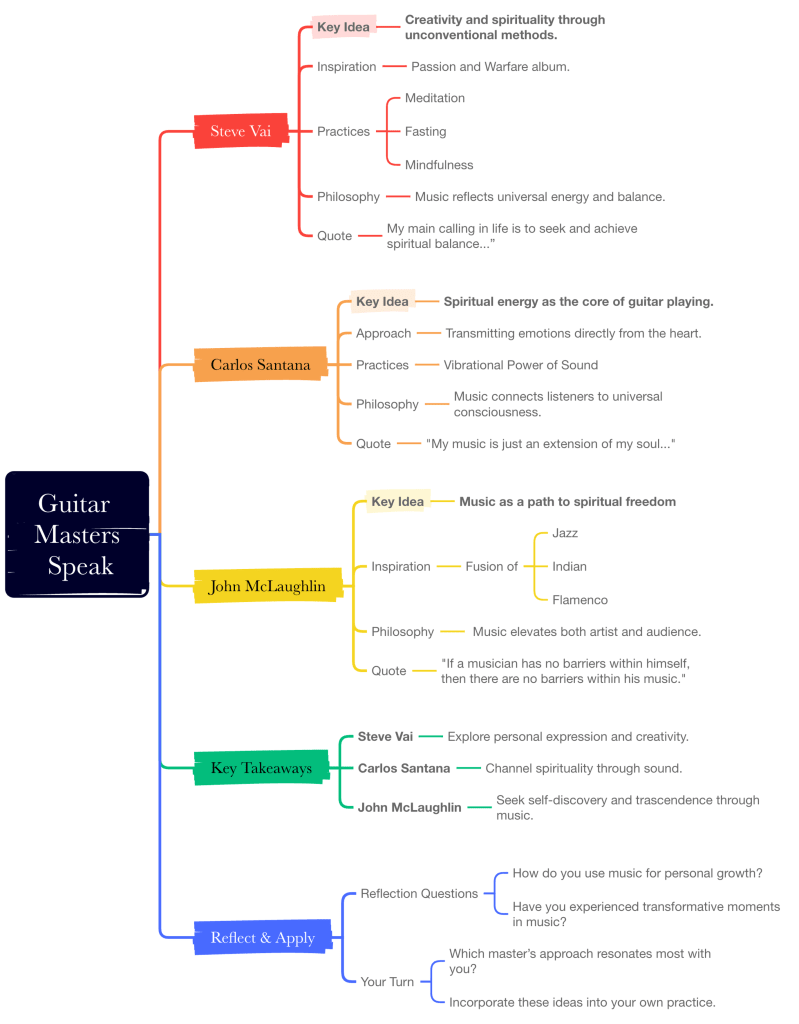
I’ve explained chi, but some guitar masters have integrated it into their playing. Beyond technical skill, creativity deeply intertwines with inner energy and spiritual practices. Legendary players don’t just play notes; they channel something greater, allowing their guitars to become extensions of their very souls. There are instances where this is deliberate and conscious. Let’s explore how icons like Steve Vai, Carlos Santana, and John McLaughlin have harnessed this profound energy, using their instruments to shape distinct musical voices that resonate on a deeper level.
1. Steve Vai: Spirituality and Creativity Through Guitar
Steve Vai was touring with David Lee Roth when I first came across his column in Guitar Player Magazine (or was it Guitar World?). Honestly, I can’t quite remember. His articles were packed with unconventional advice and outlandish ideas—things like playing random notes over a backing track while staying locked into the rhythm or even channeling energy through your guitar.
At the time, it all felt eccentric and experimental. But when Vai released Passion and Warfare in 1990, everything he wrote suddenly clicked for me. That album was the embodiment of his creativity, spirituality, and yes, his unique kind of madness. Tracks like For the Love of God felt like pure transcendence—something only someone as innovative, bold, and deeply introspective as Vai could create.
Steve Vai’s spiritual and philosophical beliefs, particularly concepts from Eastern practices like meditation and mindfulness, deeply influence his approach to guitar playing. He has spoken about how meditation, especially during fasting, helps him access deeper states of creativity. This practice allowed him to channel more of his inner energy into his music, with profound effects on his guitar playing. For instance, he recorded his famous piece “For the Love of God” during a period of fasting, which led to a transformative experience both spiritually and musically. (Jomatami, 2021)
Vai’s philosophy also embraces the idea of music as a reflection of the energy and forces within the universe. Drawing from concepts like the balance of opposites and spiritual alignment, he views his guitar as a tool for self-expression that transcends the physical.
“My main calling in life is to seek and achieve spiritual balance, and to express that through my instrument. Everything else is here today, gone later today.”
Steve Vai
Ultimately, Vai sees guitar playing as not just a technical skill but a journey of spiritual and personal growth, allowing him to communicate more deeply with his audience and himself. His work continues to inspire guitarists to explore the intersection of technique, mindfulness, and creative energy.
2. Transcendent Tone: Santana’s Spiritual Approach to Guitar
Years ago, I learned that a guitarist should embody five essential “S’s”: Sincerity, Simplicity, Sentiment, Spirituality, and, of course, Santana.
Carlos Santana is widely known for infusing his music with deep spiritual energy, which he actively channels through his guitar playing. Santana believes that spirituality transcends intellectualism, encouraging musicians to play from the core of their hearts rather than overthink.
This approach, according to him, allows artists to create music that resonates deeply with listeners. His focus on transmitting spiritual energy is central to his performances, which he describes as an attempt to connect listeners with a deeper, universal consciousness through sound.

Santana’s spiritual practices, such as meditation and a commitment to the vibrational power of music, draw from his ongoing spiritual journey. He has often expressed that the goal of his music is not merely to entertain but to elevate and communicate a higher energy. He sees his performances as a direct expression of this energy, where every note serves as a conduit for spiritual connection.
“My music is just an extension of my soul, of a higher power.”
Carlos Santana
3. John McLaughlin: Music as a Path to Spiritual Freedom
The first time I heard John McLaughlin was when he joined forces with fellow virtuosos Al Di Meola and Paco de Lucía to form the legendary Acoustic Super Trio. Their fusion of jazz, blues, and flamenco was electrifying—a true powerhouse of musical brilliance. What I didn’t realize at the time was how deeply rooted McLaughlin’s music was in spirituality. This profound connection wasn’t just a personal philosophy but the very cornerstone of the extraordinary music he created.
John McLaughlin views the guitar as a conduit for expressing his innermost being, aligning his performances with the rhythms of the universe. He describes music as a mirror that reflects the truth and energy of both the performer and the listener. For him, the power of music goes beyond entertainment; it is a means of elevating both himself and the audience to a higher, spiritual plane.
McLaughlin’s ongoing exploration of various genres and cultural influences, such as his work with Indian classical music and his fusion bands like the Mahavishnu Orchestra, reflects his dedication to spiritual growth through music.
This diverse exploration allows him to break down personal and musical barriers, seeking to communicate universal truths through sound.
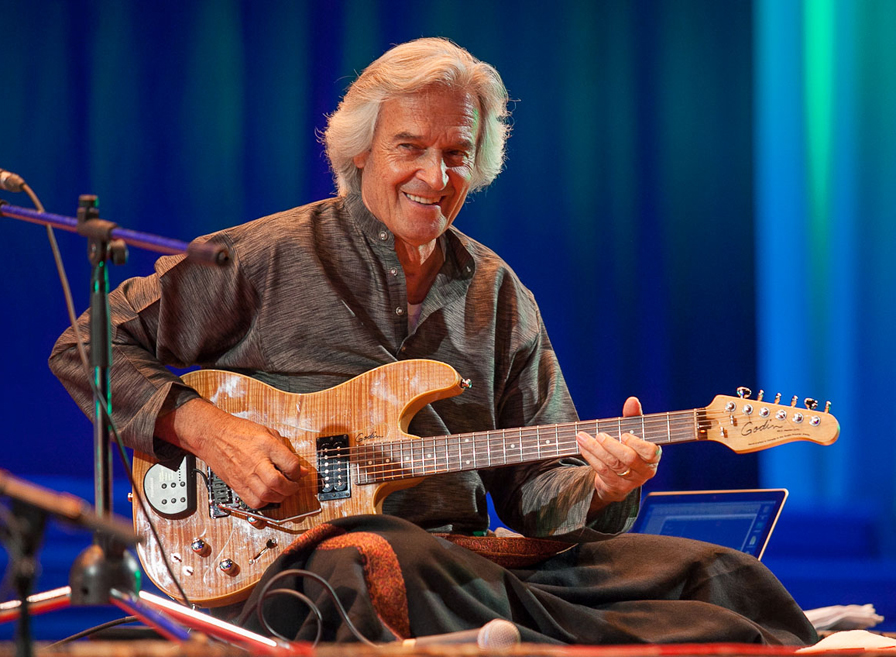
Ultimately, McLaughlin’s music is a vehicle for self-discovery, expression, and spiritual freedom, aiming to connect not only with the mind but with the heart and soul of those who listen. His approach to guitar playing encourages musicians to see the instrument as a tool for personal transformation and a medium for spiritual enlightenment.
“An audience is just a mirror of what’s happening on stage, and if what’s happening on stage has love in it—real feeling and conviction and strength and purity—then we are truly reflecting them, because it is their own nature that is coming back. Everything is. The music is. For me, the only barriers in music are the barriers in the musician and in the equipment he has to use. If a musician has no barriers within himself, then there are no barriers within his music.”
John McLaughlin
Takeaways:
- Steve Vai: His approach encourages exploring personal expression..
- Carlos Santana: He emphasizes spiritual connection through music.
- John McLaughlin: McLaughlin uses music for self-expression and spiritual growth.
Reflect: How do you use music for personal growth? Have you ever had a transformative moment while playing or listening to music?
Your Turn: Which of these approaches resonates with you the most?
Conclusion: Unlocking the Flow of Chi in Your Guitar Playing
Chi isn’t just an abstract idea; it’s a powerful energy that, when tapped into, can significantly enhance your guitar playing. By incorporating mindfulness, grounding, and intentional movement into your practice, you can deepen the emotional and technical aspects of your music. Guitar legends like Steve Vai, Carlos Santana, and John McLaughlin have all embraced spiritual practices, integrating chi and mindfulness into their playing. By following their example, you too can use chi as a tool for both artistic and personal growth.
While consistent practice and technical mastery are essential, connecting with your inner energy through chi can open up a whole new level of expression. Start by incorporating mindful breathing, grounding exercises, or even brief meditation sessions before you play. As you become more aware of your energy flow, you’ll unlock a greater sense of connection with your instrument, leading to more authentic and expressive performances.
Take action today—try integrating these practices into your next practice session. Begin with just a few minutes of mindful breathing or visualization and see how it impacts your focus, creativity, and overall playing. With time, you’ll notice a deeper, more powerful connection to your music.
The Final Takeaways
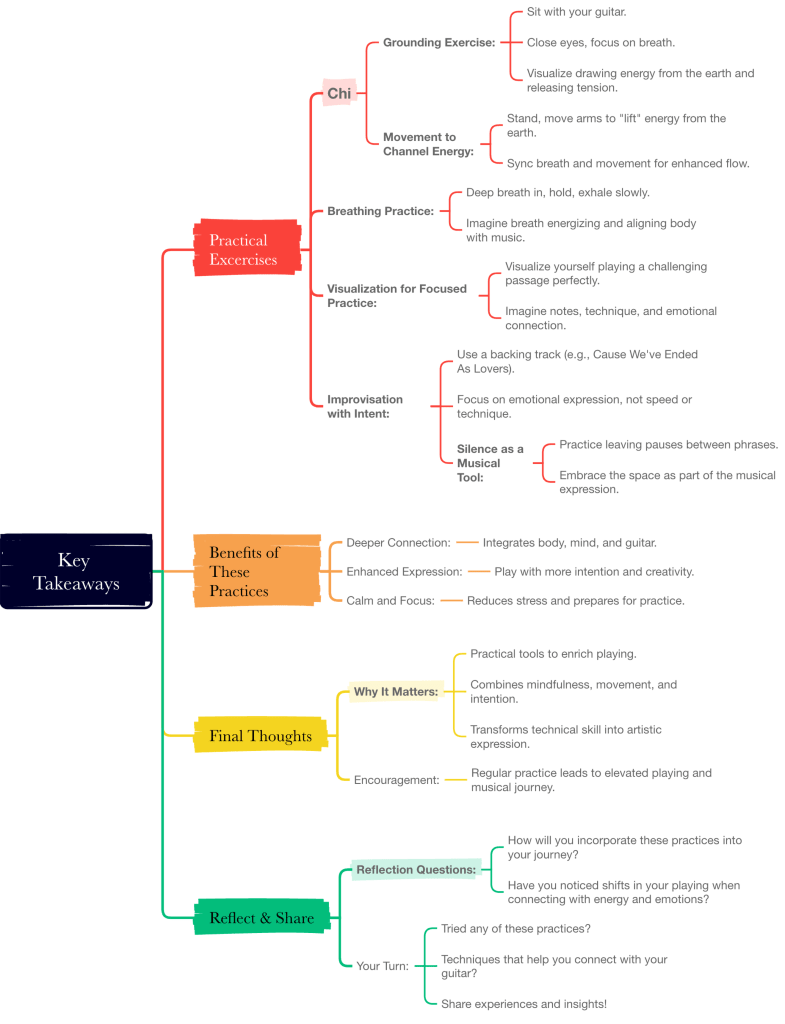
Here are some practical exercises you can try to integrate the concepts of chi into your guitar playing and solidify your understanding:
- Chi Grounding Exercise: Before you start practicing, take two minutes to ground yourself. Sit with your guitar, close your eyes, and focus on your breath. As you inhale, imagine drawing energy from the earth beneath you, and as you exhale, release any tension from your body. Repeat for a few cycles, allowing yourself to feel centered and present.
- Breathing Practice: Before each practice session, spend a few minutes focusing on your breath. Take a deep breath in, hold it for a moment, and exhale slowly. Imagine this breath energizing and aligning your body with the music you’re about to play. This simple practice can calm your nerves and prepare you mentally for a focused session.
- Chi Movement to Channel Energy: Stand up and move your arms as if you were drawing energy from the earth and lifting it into your chest. Perform this motion slowly, visualizing the energy flowing up through your body as you breathe deeply. As you move, try to sync your breath and movement to enhance the flow of energy. After a few repetitions, sit down and pick up your guitar, feeling the grounded energy in your body as you start to play.
- Visualization for Focused Practice: Before tackling a challenging passage, close your eyes and visualize yourself playing it perfectly. Imagine the notes flowing effortlessly from your fingers and the precision of your technique. Picture every detail: the movement of your hands, the sound of the notes, the emotional connection to the music. Then, pick up your guitar and play, trusting that the mental rehearsal has prepared you for success.
- Improvisation with Intent: Take a backing track, like “Cause We’ve Ended As Lovers,” and practice improvising over it. Don’t focus on speed or technique, but instead on the emotion behind each note. Play slowly and deliberately, letting each note reflect your feelings. If you feel unsure about a note, leave space instead of rushing through it. Embrace the silence between notes as part of the expression.
- Silence as a Musical Tool: Practice improvising, but this time, focus on leaving pauses and silences between your phrases. Instead of constantly filling the air with notes, allow the space to breathe and speak for itself. Sometimes, the most profound musical moments come from the absence of sound rather than the notes themselves.
By consistently incorporating these exercises, you’ll start to notice a deeper connection between your body, mind, and guitar. Over time, this practice can transform your musical expression, allowing you to play with more intention, creativity, and emotional depth.
Final Thoughts:
These chi-inspired practices are not just abstract concepts; they’re practical tools that can enrich your playing and help you find new layers of expression. The balance of mindfulness, movement, and intention brings a sense of focus and harmony to your guitar practice that goes beyond technical skill. So, try out these exercises regularly, and watch how they elevate not just your playing, but your entire musical journey.
Reflect & Share: Now that you’ve explored the connection between chi, mindfulness, and guitar playing, how do you plan to incorporate these practices into your own journey? Have you ever felt a shift in your playing when connecting with your energy and emotions? Share your thoughts, experiences, and any new insights you’ve gained.
Your Turn: Have you tried any of these practices before? What techniques help you connect more deeply with your guitar and music? Share your experiences, and let’s continue exploring this journey together!
References
Cseh, G. M., Phillips, L. H., & Pearson, D. G. (2015). Flow, affect, and visual creativity. Cognition & Emotion, 29(2), 281-291. https://doi.org/10.1080/02699931.2014.913553
Britannica, T. Editors of Encyclopaedia (2024, November 14). qi. Encyclopedia Britannica. https://www.britannica.com/topic/qi-Chinese-philosophy
Cole, C., “The Link Between Meditation and Effective Practice: Increasing the Pace of the Acquisition of Skill in Musical Practice” (2018). Theses and Dissertations. 365. https://csuepress.columbusstate.edu/theses_dissertations/365
Day, K. (2022). Mindful playing: a practice research investigation into shakuhachi playing and meditation. Ethnomusicology Forum, 31(1), 143–159. https://doi.org/10.1080/17411912.2021.2025121
Fonseca, T. (2024) Visualização mental no ensino e na aprendizagem de ciências: contributos da psicologia do desporto mental. Egitania Sciencia, 1(8), 61-78. https://doi.org/10.46691/8qmx2481
Jomatami. (2021) Steve Vai Explains What He Didn’t Like About ‘For the Love of God’ at First, Talks How He Recorded It in Different State of Mind During 10-Day Fast. Ultimate Guitar. https://www.ultimate-guitar.com/news/general_music_news/steve_vai_explains_what_he_didnt_like_about_for_the_love_of_god_at_first_talks_how_he_recorded_it_in_different_state_of_mind_during_10-day_fast.html
Landriscina, F. (2013). An Introduction to Simulation for Learning. In: Simulation and Learning. Springer, New York, NY. https://doi.org/10.1007/978-1-4614-1954-9_1
Malyavin V. (2022). The Configurations of Force (shi) in Chinese Cultural Tradition (focusing on martial arts). Problemy dalnego vostoka. no. 4, pp.144-159 DOI: 10.31857/S013128120021165-2
Prajapati, P., & Das, P. K. (2023). Visualization and victory: A study of sports imagery abilities among female hockey players at state and national levels in Gwalior, Madhya Pradesh. International Journal of Physical Education, Sports and Health, 10(5), 23-26. https://doi.org/10.22271/kheljournal.2023.v10.i5a.3063

 oscaronguitars.com
Leave a comment